
Model Context Protocol (MCP) is a framework designed to manage AI agent identities securely across their lifecycle. It addresses challenges like secret sprawl and weak identity controls by providing a structured approach to provisioning, managing, and deprovisioning agent identities. MCP integrates with OAuth/OIDC systems and platforms like Prefactor to ensure agents have unique, traceable identities with scoped permissions. Key benefits include:
- Provisioning: Automated creation of agent identities with minimal access rights.
- Management: Credential rotation, activity monitoring, and permission updates.
- Deprovisioning: Immediate revocation of credentials to reduce risks.
MCP helps organizations maintain security, compliance, and operational efficiency by enforcing least privilege access and providing clear audit trails for agent activities.
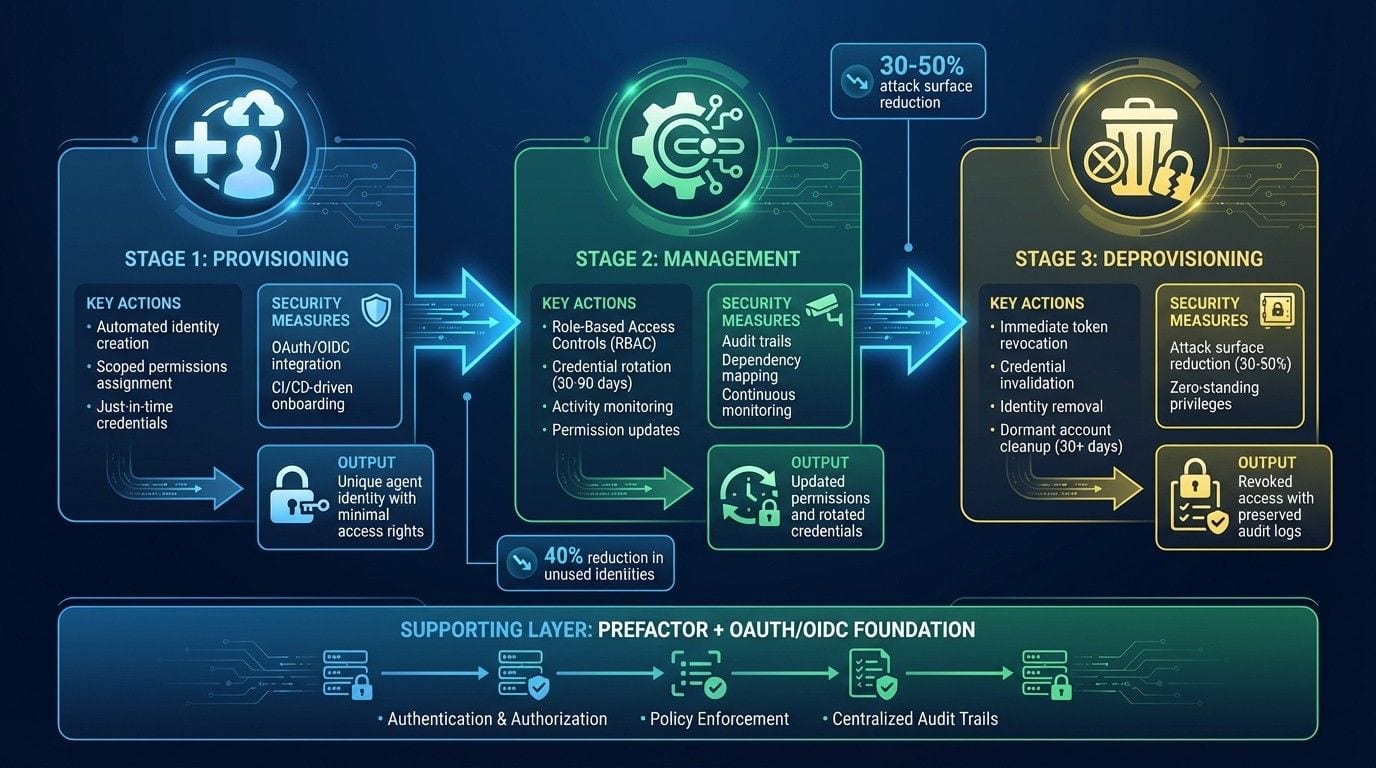
{MCP Agent Identity Lifecycle: Provisioning, Management, and Deprovisioning Workflow}
Know Your Agent: Solving Identity for AI Agents [Live Event]
Prerequisites for MCP Agent Identity Management
Setting up MCP's agent identity lifecycle controls starts with a secure authentication system. At its core, MCP relies on OAuth 2.0 and OpenID Connect (OIDC) to issue and validate tokens, which agents use to authenticate and access resources. Without this infrastructure, MCP cannot verify an agent's identity or its permissions.
OAuth/OIDC Integration
OAuth 2.0 and OIDC are the backbone of MCP authentication. OAuth issues scoped access tokens - short-lived credentials granting specific permissions, like read-only database access or write access to a deployment pipeline. OIDC builds on OAuth by introducing ID tokens, which include claims that identify the agent, such as its client ID, tenant, and environment. This information is critical because MCP servers need to know not only that an agent is authenticated but also which agent it is and the context in which it's operating.
To implement this, deploy a centralized Identity Provider (IdP) that supports OAuth 2.0 and OIDC. The IdP must be configured to handle both delegated (on-behalf-of) and standalone access patterns, as MCP supports both.
Security is non-negotiable. Use short-lived tokens, enforce automatic revocation upon detecting anomalies, and require MTLS (Mutual TLS) or signed JWTs for agent authentication. Conditional access policies should be in place, such as restricting tokens to specific network zones or requiring device posture checks for high-risk tasks. Additionally, your IdP should provide token introspection and revocation endpoints so MCP or platforms like Prefactor can verify token validity and immediately revoke compromised credentials.
With these measures in place, Prefactor can extend these capabilities specifically for MCP-managed agents.
Prefactor Platform Setup
Prefactor serves as the bridge between your OAuth/OIDC infrastructure and MCP-managed agents. By integrating Prefactor as an OIDC client with your IdP, you can enable SSO and MFA for enhanced security. Prefactor processes tokens and enforces policies that govern agent access based on their environment.
In Prefactor, you’ll define agent applications and map them to specific MCP servers and tools. Each agent gets scoped authorization, meaning it only receives the permissions it needs. For instance, a CI/CD agent might have mcp:tool:deploy.write permissions for staging but only mcp:tool:deploy.read for production, preventing unintended changes. Prefactor also integrates with CI/CD pipelines, allowing them to request tokens on behalf of agents. Policies are enforced automatically, eliminating the need for manual approval processes.
MFA is applied at the human layer, not for machine-to-machine interactions. When a developer or operator creates a new agent or assigns it elevated permissions, those actions are secured by SSO and MFA. Once the agent is provisioned, it operates independently, using its own credentials - such as client secrets, certificates, or workload identities - to obtain tokens from Prefactor. This separation ensures strong security while enabling agents to function autonomously at scale.
Provisioning Agent Identities with MCP
Once your OAuth/OIDC setup and Prefactor platform are ready, you can start provisioning agent identities. This step enables MCP by assigning each agent a unique identity, specific permissions, and secure credentials. The focus here is on automating identity creation while maintaining tight security - treating every agent as untrusted until explicitly granted access through defined policies.
Automating Identity Creation
Manually provisioning identities simply doesn’t scale when managing a large number of MCP agents. Instead, you can integrate identity creation directly into your deployment workflows. When a new agent is deployed, Prefactor's API can be used to generate a unique identity and assign the appropriate role. This identity also includes metadata specific to that agent.
By setting up access logic in Prefactor, you avoid the fragility of static permissions. Each agent gets its own audit trail from the moment it’s created, enabling you to trace every action to a specific identity and deployment.
Here’s how a typical automation flow works: your control-plane service or CI/CD pipeline calls Prefactor to register a new agent identity, assigns it to predefined role templates (like "read-only analytics" or "staging deployment"), and produces MCP configuration files that define what servers and tools the agent can access. Credentials or secrets are injected securely at runtime using methods like short-lived tokens or secret managers, ensuring sensitive data isn’t embedded in code or configuration files.
This automation lays the groundwork for precise and secure permission management.
Scoped Permissions and Delegated Access
MCP operates on the principle of least privilege, granting agents only the permissions they need for their tasks. During provisioning, you define scopes and roles that determine what operations agents can perform on MCP servers. For instance, a CI/CD agent might get read-only permissions in production but broader access in staging environments. Tight scoping minimizes the risk of accidental or malicious changes in critical environments.
Prefactor supports both attended (delegated) and unattended access modes. In attended mode, an agent acts on behalf of a human user through an on-behalf-of OAuth flow. The resulting token includes the user's context and delegated scopes, ensuring the agent cannot exceed the user's permissions. Unattended mode, on the other hand, allows the agent to authenticate independently with application-level roles, which is ideal for automated tasks like scheduled updates or incident response.
By managing roles, attributes, and delegated access within a single framework, Prefactor allows you to define access rules as code. These rules can then be deployed through your CI/CD pipeline, ensuring consistent, auditable, and role-based access across all agents, whether they’re operating autonomously or under human supervision.
CI/CD-Driven Onboarding
With automated provisioning and scoped permissions in place, integrating agent onboarding into your CI/CD pipeline becomes the next logical step. When you commit a new agent configuration to source control, the pipeline can automatically handle identity creation, assign permissions, and validate the setup before moving it to production. This approach treats agent authentication and authorization as infrastructure-as-code - versioned, testable, and reviewable.
Prefactor simplifies this process by automating identity creation and enforcing policies. For example, a pipeline step might call Prefactor to create or update an agent identity, attach it to a predefined role template, and generate MCP-compatible configuration files for deployment. Automated tests can then run against staging MCP servers to verify that the agent can authenticate and perform only the operations it’s authorized for.
This CI/CD-driven model also introduces policy checks at the provisioning stage. If an agent requests high-level permissions, such as access to production data, the pipeline can enforce manual approval or block the request based on predefined rules. By the time the agent is deployed to production, it has already gone through multiple validation steps, reducing the likelihood of misconfigurations or over-permissioned accounts.
Managing and Updating Agent Identities
Once agents are deployed, keeping their permissions up-to-date as roles evolve is critical for maintaining security. As projects progress, roles often shift - a staging agent might transition to production, or an analytics agent with read-only access might require write permissions for a new workflow. The tricky part? Updating these permissions without disrupting functionality or creating security vulnerabilities. The key lies in effective role management.
Role-Based Access Controls (RBAC)
Role-Based Access Controls (RBAC) simplify permission management by assigning agents to predefined roles based on their functions, like "invoice-writer" or "log-reader." Instead of customizing permissions for each agent, you simply adjust their role assignment when responsibilities change. The permissions tied to the role automatically update, eliminating the need to modify agent configurations directly.
It’s also important to distinguish between delegated access (where an agent inherits user permissions) and autonomous operations. This distinction ensures audit trails accurately capture who authorized what, avoiding excessive permissions. Prefactor’s unified model supports both modes, allowing you to define access rules once and apply them consistently across all MCP servers.
Credential Rotation and Dependency Mapping
Regularly rotating credentials like API keys, OAuth secrets, and certificates is essential to reduce the risk of compromise. Static credentials with long lifespans are particularly vulnerable because a single leak can lead to persistent unauthorized access. A common best practice is to rotate credentials every 30–90 days. Automating this process through CI/CD pipelines or secret-management tools ensures consistency and reduces manual effort. The process typically involves issuing new credentials, updating MCP server configurations, verifying agent authentication, and finally revoking old credentials.
Before initiating credential rotation, it’s crucial to map out all dependencies. This includes identifying where credentials are used - whether in MCP servers, external APIs, or secrets storage. Knowing exactly where credentials are stored, such as in environment variables, configuration files, or secrets vaults, helps ensure updates are coordinated across systems without causing outages or leaving orphaned credentials behind.
Continuous Monitoring with Prefactor
Prefactor’s audit trails provide detailed insights into every authentication event, capturing context like the agent, tenant, resource, and timestamp. In multi-tenant environments, this ensures that one tenant’s agents and logs remain isolated from others, while security teams still benefit from centralized visibility. Monitoring failed access attempts, high-privilege operations, and unusual behavior over time can help identify potential issues early.
This monitoring data can also be used to refine access controls. For example, if logs show an agent consistently doesn’t use certain high-privilege scopes, those permissions can be removed. Similarly, frequent failed attempts to access specific MCP tools might signal either a configuration issue or possible abuse, warranting further investigation. By integrating this feedback loop into your security practices, you can transform static RBAC policies and credential rotation schedules into a dynamic, adaptive security approach that evolves alongside your agents and aligns seamlessly with MCP’s lifecycle controls.
sbb-itb-6699583
Deprovisioning and Revoking Agent Identities
When an agent completes its task or a project wraps up, any active identities tied to it can become a security risk. Deprovisioning is the critical final step in managing an identity's lifecycle. This process involves securely removing agent access and eliminating credentials to ensure no orphaned accounts remain vulnerable to exploitation. Since AI agents can be spun up and shut down in mere hours or days, automating this revocation process is essential to keep up with the scale of machine operations.
Secure Identity Revocation
Revoking an agent's identity means immediately invalidating all its credentials and cutting off its access to every connected system. This process begins with an API call in Prefactor to invalidate OAuth tokens and badges. These changes are then propagated through your federated OIDC system, ensuring delegated permissions are revoked instantly. Afterward, database records tied to the agent's identity are deleted, while audit trail entries are preserved for compliance purposes. For example, if a financial assistant agent completes a currency exchange demo, a GitHub Actions step can trigger Prefactor's /revoke/{agent_id} endpoint. This action automatically removes access and logs the event.
Once revocation is complete, it's crucial to verify success. Use API endpoints to confirm the credentials are invalid (look for 401 errors) and review Prefactor's audit logs to check for revocation timestamps, agent IDs, and tenant details. This verification step ensures no credentials remain active in downstream systems, helping to catch any failures early and reducing potential vulnerabilities.
Reducing Attack Surfaces
After credentials are invalidated, the focus shifts to minimizing residual risks. Dormant agent identities can be a prime target for attackers, particularly if they retain high-privilege access after their purpose has ended. Prefactor's continuous monitoring system identifies dormant identities by flagging those with no API activity for a set period, such as 30 days. These accounts are then automatically queued for review and potential revocation. Before removal, Prefactor scans for dependencies and handles disconnections to avoid breaking any workflows.
In multi-tenant setups, Prefactor isolates revocation to the specific agent's namespace. This ensures that deprovisioning one tenant's agent won't accidentally impact others sharing the same MCP server infrastructure. This scoped approach enforces a "zero-standing privileges" policy, meaning agents only have access for as long as they need it. Once their task is complete, all access is revoked. By systematically removing unused service accounts and cleaning up RBAC roles immediately, you reduce your attack surface and eliminate the gaps often left by manual offboarding processes.
Best Practices for MCP Security
Protecting agent identities demands a consistent security framework that applies to every stage of their lifecycle. Implementing security-as-code ensures uniform enforcement of access rules during provisioning, management, and deprovisioning. These practices build on the MCP lifecycle controls discussed earlier.
Policy-Driven Security Controls
To enhance agent security, use policy-as-code for scalability and precision. By defining access rules in configuration files (like JSON or YAML) that integrate seamlessly with CI/CD pipelines, you can enforce essential measures such as limiting token time-to-live and requiring SSO verification at creation. These policies enable minimal, role-based, and dynamically adjustable permissions while ensuring instant deprovisioning when needed. Research from Delinea highlights that grouping machine identities by risk categories and scheduling regular reviews can reduce attack surfaces by 30–50% in environments with high machine identity usage.
Conclusion
MCP simplifies agent authentication processes, while Prefactor enforces strict identity lifecycle management. Together, they form a seamless integration where MCP acts as the protocol layer for agent discovery, connection, and authentication with tools and services. Prefactor, on the other hand, serves as the identity, authentication, and policy engine, ensuring secure and consistent control over these connections throughout their lifecycle. This combined approach delivers a standardized framework for managing non-human MCP-based agents, offering both improved security and operational efficiency.
Key Benefits of MCP and Prefactor
By pairing MCP with Prefactor, organizations can achieve enhanced security through features like unique, least-privileged agent identities, short-lived credentials, automated credential rotation, and instant revocation. Operational scalability becomes attainable with automated management of thousands of ephemeral agent identities, while MCP ensures uniform backend connections across different teams and environments. The platform also provides centralized policy enforcement and auditing capabilities, aligning with frameworks like Zero Trust and identity lifecycle management. This makes it easier to demonstrate control over non-human identities during audits. Additionally, CI/CD-driven onboarding and automated updates reduce manual effort, preventing configuration drift and minimizing the risks associated with secrets sprawl.
Next Steps
To start leveraging these benefits, begin by assessing your current AI agents, MCP servers, and machine identities. Map out how these interact with your OAuth/OIDC providers to pinpoint where credentials are created and stored. Deploy Prefactor as an authentication broker between MCP-based agents and backend services, integrating it with your identity provider to enable OAuth/OIDC flows instead of relying on static keys. Consider launching a pilot project to define baseline RBAC roles, test scoped tokens, and validate audit logs. Once successful, scale up by migrating legacy credentials into Prefactor, updating CI/CD pipelines to automatically register and provision new MCP agents, and establishing lifecycle policies that align with your organization’s standards for managing both human and machine identities.
FAQs
How does MCP securely manage agent identities?
The Model Context Protocol (MCP) protects agent identities through dynamic client registration, human-delegated authentication, and smooth integration with OAuth/OIDC systems. These features ensure access remains policy-based, auditable, and restricted to defined scopes, delivering strong security across the entire agent identity lifecycle.
How does Prefactor ensure secure management of agent identities?
Prefactor offers a comprehensive security framework designed to manage AI agent identities throughout their entire lifecycle. It supports secure authentication, dynamic client registration, and delegated access, all while working smoothly with existing OAuth/OIDC systems.
By using Prefactor, organizations can achieve greater control, scalability, and visibility over how agents are authenticated and authorized. This ensures both compliance and security are maintained at every step of managing agent identities.
How does MCP handle permissions and delegated access for agents?
MCP handles permissions and access delegation through dynamic client registration, offering secure authentication options like SSO, MFA, Magic Links, Passkeys, and social logins. These methods ensure agents operate within clearly defined and scoped permissions, limiting access strictly to what they need.
Prefactor takes this a step further by integrating with OAuth/OIDC systems to enable both role-based and attribute-based policies. This approach provides precise control over access, making permissions context-aware and easily auditable at the agent level. The result is a system that prioritizes compliance and security across the entire identity lifecycle.