
AI agents are reshaping how organizations handle data and transactions. But here's the problem: 95% of AI agent projects fail to reach production because companies can't track who or what is responsible for agent actions. This accountability gap creates compliance risks, especially under regulations like GDPR and HIPAA.
The solution? AI agent identity audits. These audits treat AI agents as unique identities, ensuring their actions are traceable to human owners. They differ from human identity audits by focusing on the dynamic, autonomous nature of agents, including their ability to create temporary identities and make independent decisions.
Key takeaways:
- Know Your Agent (KYA): Assign every agent a unique ID tied to a human owner.
- Audit Metrics: Track agent lifecycle, access controls, and action logs.
- Compliance Focus: Address U.S. regulations like HIPAA and SOX with detailed audit trails.
- Tools: Platforms like Prefactor simplify monitoring, logging, and reporting.
Agent Identity for MCP: Prefactor’s Approach to Secure, Auditable AI Agents (Demo + Deep Dive)
What Are AI Agent Identity Audits?
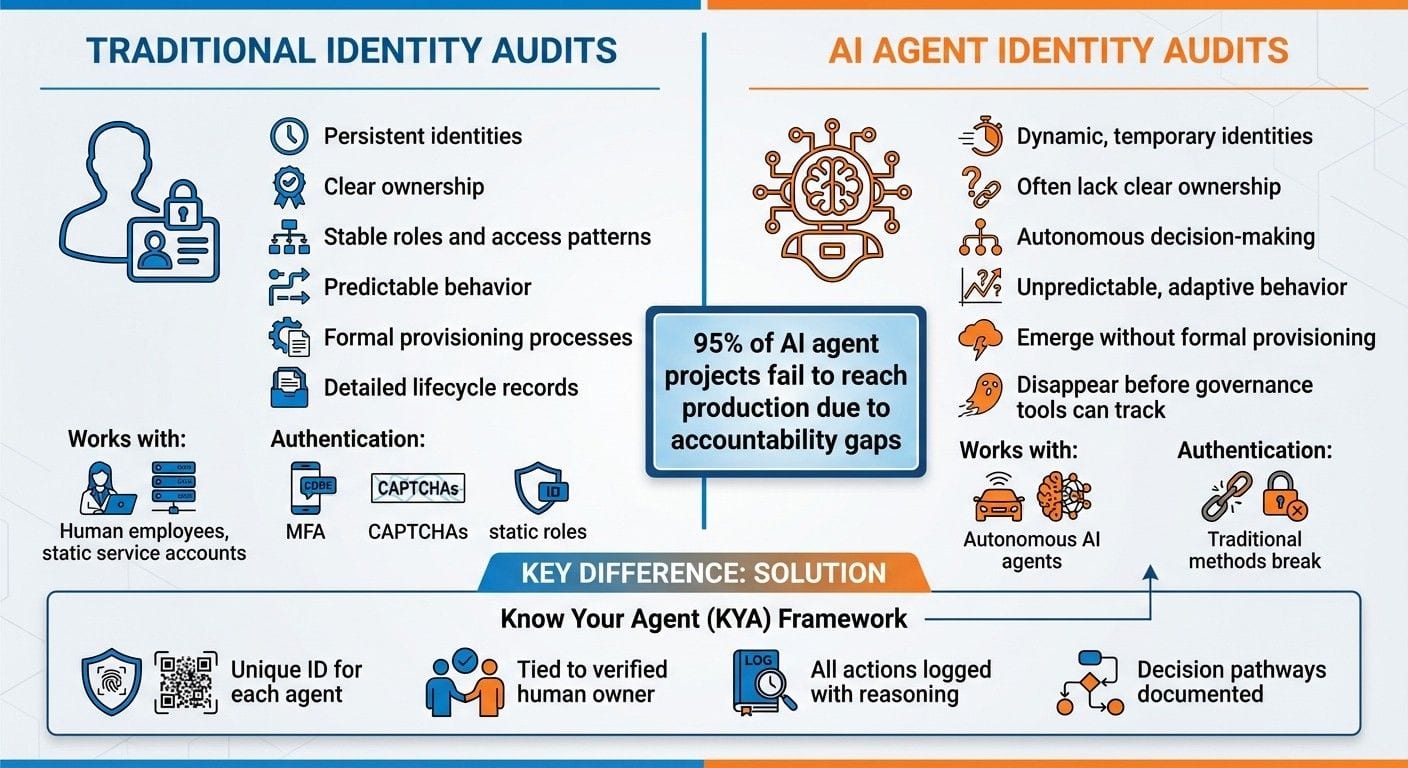
{AI Agent Identity Audits vs Traditional Identity Audits Comparison}
AI agent identity audits are a systematic way to review the digital identities of autonomous agents, ensuring their activities - like provisioning, access, and lifecycle management - are traceable. This process tackles the accountability gap that contributes to the failure of 95% of agentic AI projects.
Unlike traditional identity audits, which focus on human employees with stable roles and predictable access patterns, AI agent audits deal with entities that often appear and disappear quickly. These agents make independent decisions, often without clear, human-readable explanations. Compounding the issue, AI agent identities frequently lack formal reviews or clear ownership, necessitating an entirely new approach to auditing for these dynamic systems.
A core principle of these audits is Know Your Agent (KYA), which extends the familiar Know Your Customer (KYC) framework to AI. This involves assigning each agent a unique ID tied to a verified human owner and logging all actions along with their reasoning and decision pathways. Without such measures, organizations expose themselves to significant accountability risks.
AI Agents and Non-Human Identities Defined
AI agents are autonomous software entities capable of making independent decisions and performing tasks like accessing databases, processing transactions, or calling external APIs. Unlike traditional service accounts that operate based on static scripts, these agents adapt to context and use multiple tools to achieve objectives.
Each agent requires a digital identity to verify its legitimacy and control its access. However, traditional authentication methods like multi-factor authentication (MFA), CAPTCHAs, and static roles are inadequate for these agents. As one technical expert puts it:
"Agents aren't users. MFA, CAPTCHAs, and static roles break".
The challenges are substantial. AI agents often exist only briefly, spinning up to complete a task before disappearing - often faster than governance tools can track them. Additionally, their lack of clear human ownership makes it difficult to assign accountability, particularly in cases of sensitive data access or errors.
Why Traditional Identity Audits Don't Work for AI Agents
Traditional identity audits are built around the assumption of persistent identities with clear ownership and detailed lifecycle records. These processes work well for human users and static service accounts but fall short when applied to AI agents.
AI agents are dynamic by design. They emerge without formal provisioning, operate autonomously, and often vanish before governance tools can record their activities. Traditional audits rely on linking identities to a specific person or team, but with AI agents, this link is often missing. If an agent accesses sensitive data or performs critical transactions, tracing responsibility back to a human owner becomes a significant challenge, increasing regulatory risks.
The opaque nature of AI decision-making further complicates matters. While human actions can typically be explained, an agent’s decisions often lack transparency unless detailed logs of inputs, decision pathways, and rejected alternatives are maintained.
Identity Audits vs. Model and Data Protection Audits
It’s important to distinguish identity audits from other types of reviews, like model and data protection audits. Identity audits focus on questions like: Who authorized this agent? What resources can it access? When was it created or decommissioned? Who is responsible for its actions? These audits center on provisioning, access rights, ownership, and accountability.
On the other hand, model audits evaluate an AI’s behavior and reasoning, focusing on factors like bias, accuracy, and fairness. Meanwhile, data protection audits deal with how agents handle sensitive information, checking for encryption, privacy controls, data retention policies, and compliance with regulations like GDPR or HIPAA. While there can be overlaps, such as when an agent accesses data it shouldn’t, each type of audit addresses unique concerns.
For example, in a U.S. financial firm operating under KYC regulations, an identity audit would ensure a trading agent has a unique ID, logs all trades with a rationale, and links unauthorized data access to a responsible human owner. Meanwhile, model audits would evaluate the fairness of the trading decisions, and data protection audits would verify compliance with encryption and privacy standards.
Reporting Standards for AI Agent Identity Audits
Crafting standardized reports for AI agent identity audits involves modifying traditional IT audit frameworks to address the unique aspects of autonomous agents. These audits must account for the agents' dynamic lifecycles, independent decision-making, and ensure accountability is traceable to a verified human owner. This report structure lays the groundwork for achieving compliance and transparency in agent audits.
Standard Report Structure
An effective audit report should include the following key components:
- Executive Summary: Highlight the main findings and risks.
- Scope and Regulations: Define the audit's boundaries and the regulations it addresses.
- Audit Methodology: Detail the approach and tools used.
- Findings and Evidence: Present compliance gaps with supporting documentation.
- Remediation Plans: Provide actionable steps, assign responsible parties, and include U.S.-formatted timelines (MM/DD/YYYY).
This structure addresses a major shortfall identified by ISACA, which notes that many AI agents lack formal reviews, are not linked to specific owners, and can disappear before identity and access governance tools can intervene. Detailed findings should document issues like unlogged actions or missing ownership tags, supported by audit trails. Additionally, the report must capture versions of prompts, policies, and decision logic used during critical actions, treating these elements as code under version control.
Compliance Frameworks and Regulations
The NIST AI Risk Management Framework offers a robust foundation for organizing audit reports around four essential functions: govern, map, measure, and manage. Reports should document risks, measure them using key metrics (like access anomalies), and outline management strategies with complete audit trails that link agent actions to their human owners.
For U.S.-based organizations, sector-specific regulations further shape these reporting requirements. For example:
- HIPAA: Requires detailed logs of all agent access to Protected Health Information (PHI), ensuring actions are tied to verified human owners and comply with lawful processing standards. Immutable audit trails are critical for breach accountability.
- SOX: Mandates controls over financial actions initiated by agents, including logs of provisioning, access rationale, and deprovisioning. Reports must document who or what initiated actions, identify anomalies, and provide evidence of remediation.
Using Tables for Consistent Reporting
To improve clarity and accessibility, structured tables are highly effective. Tables can map agent classes to required controls and evidence, making audit trails easier to follow. For instance:
Agent Class | Risk Level | Key Controls | Evidence Required
Internal chatbots | Low | Ownership tagging, basic action logging | Audit logs showing 100% action traceability
Financial transaction agents | High | Continuous monitoring, anomaly alerts, decision-path logging | Reports of zero unauthorized accesses, linked to human owners
Healthcare data agents | High | PHI access controls, immutable audit trails, encryption verification | HIPAA-compliant logs with timestamp, agent ID, and authorization proof
This structured approach helps address the challenges of black-box reasoning in AI by providing auditors with clear, immutable evidence of compliance. Tools like Prefactor simplify this process by automatically generating detailed audit trails, offering complete visibility into who (or what) performed actions, when they occurred, and why - automating evidence collection.
Key Metrics to Include in Audit Reports
Creating effective audit reports means providing clear, measurable evidence that showcases oversight and accountability throughout the entire lifecycle of an AI agent. To meet regulatory requirements and demonstrate that agents operate under human control, organizations should focus on three key metric categories: identity lifecycle, access and authorization, and logging and accountability.
Identity Lifecycle Metrics
Tracking the identity lifecycle of AI agents ensures that every agent has a clear, documented history from creation to deactivation.
- Registered Agent CountThis metric tracks the total number of AI agents with unique identities tied to verified owners. Each agent’s registration should include details like provisioning, ownership, reasons for access, and eventual deprovisioning.
- Orphaned CredentialsThis measures the percentage of agent identities without an assigned owner or custodian. Ideally, organizations should aim for less than 1% of agents to be untagged. The formula is straightforward:(Number of untagged agents / Total registered agents) × 100.Regular reports should highlight trends and outline steps taken to address any gaps in the lifecycle.
- Deprovisioning Time for Inactive AgentsThis metric evaluates how quickly inactive agents are fully deprovisioned. A target of under 48 hours ensures that agents are promptly retired once they are no longer active, maintaining a complete and timely lifecycle record.
Here’s an example of how these metrics might be summarized:
Lifecycle Metric | Target Benchmark | Evidence Required
Registered agent count | 100% of agents inventoried | Central repository with unique IDs, attributes, owners
Orphaned credentials | Less than 1% untagged agents | Quarterly reports showing custodian assignments
Deprovisioning time | Under 48 hours from detection | Logs with timestamps showing inactivity and removal
Access and Authorization Metrics
Once lifecycle metrics are in place, the next step is to focus on access permissions and their proper management.
- Privileged Access Usage RateThis tracks the percentage of agents with elevated permissions and how often those permissions are used. Keeping high-risk actions below 5% demonstrates that elevated permissions are tightly controlled and only granted to verified entities.
- Cross-Boundary Data Transfer VolumeMonitoring data flows between trust boundaries ensures sensitive data is handled appropriately. Approval logs for each transfer provide evidence of compliance with legal and organizational requirements.
- Periodic Access Review Completion RateThis metric measures how consistently organizations review agent permissions. The goal is to review 100% of agent access quarterly. Reports should detail the percentage of agents reviewed (e.g., 95% reviewed in the last 90 days) and outcomes, such as revocations due to scope creep.
Logging and Accountability Metrics
Robust logging practices are essential for ensuring traceability and accountability for every action taken by or involving an AI agent.
- Action-Level Audit Trail CompletenessThis metric ensures that 100% of agent actions are logged, capturing details like who initiated the action, when it occurred, the rationale, and the inputs/outputs. Logs should clearly indicate whether a human, application, or agent performed the action and provide a decision pathway for full accountability.
- Reasoning Traces CapturedThis tracks the percentage of decisions that include human-readable explanations. Capturing the rationale behind decisions enhances transparency and helps address concerns about black-box outputs.
- Anomaly Detection RateThis metric focuses on identifying unusual behavior by tracking the number of alerts per 1,000 actions. Behavioral analytics can flag deviations, such as unexpected access spikes, and aim to resolve alerts within 24 hours. For example:"Agent X triggered a 20% access spike outside its scope; access was revoked and reviewed."
According to ISACA, logging every action - whether initiated by a human or AI - is critical to mitigating risks associated with black-box systems. Platforms like Prefactor can integrate these metrics to strengthen audit trails and ensure compliance is measurable and verifiable.
Tools and Platforms for AI Agent Identity Audits
Managing AI agent identities calls for platforms specifically designed for AI governance. Traditional identity and access management (IAM) systems - optimized for humans using methods like multi-factor authentication and CAPTCHAs - don’t fit the unique needs of AI agents. Instead, organizations need tools to discover, register, monitor, and govern AI agents as distinct identities, ensuring clear ownership and accountability.
Agent Control Planes: Prefactor
An agent control plane acts as a centralized governance hub, managing identities, policies, telemetry, and audit trails for an organization’s AI agents. Prefactor fills this role by registering each AI agent as a governed identity tied to a verified human owner. This approach keeps all agent configurations, policies, and lifecycle states in one place, avoiding the fragmented evidence collection often seen in manual audit processes.
Prefactor provides everything auditors need: centralized registration of agents as unique identities, clear ownership mapping to human sponsors, lifecycle controls for provisioning and deprovisioning, detailed activity logs, and real-time monitoring. By enforcing uniform policies across various models, tools, and environments, auditors can easily get a comprehensive view of an agent’s identity, access privileges, and activities over time.
The platform’s real-time monitoring features include live session tracking, identity-aware telemetry, behavior anomaly detection, and alerts for policy violations. Beyond centralized control, Prefactor generates standardized audit reports that align with key compliance metrics.
Automated Audit Workflows
Manual auditing can slow things down and lead to mistakes. Automated workflows lighten the load by managing tasks like discovery, evidence collection, and reporting without constant human oversight. Prefactor integrates with CI/CD pipelines to automatically detect new deployments, register agents, log access events, schedule regular access reviews, and generate standard audit reports.
Organizations can create workflows tailored to specific control goals. For example, Prefactor can automatically document access requests, approvals, and grants for each agent, schedule recurring access reviews with activity summaries for certification, and generate audit reports (e.g., quarterly SOX compliance packs or HIPAA evidence). By automating tasks like inventory reconciliation, detecting ownerless agents, and validating permissions, auditors can focus on exceptions and system design.
Prefactor’s policy-as-code model ensures authentication and authorization rules are versioned, testable, and reviewable, just like any other infrastructure component. This creates clear audit trails that demonstrate compliance and effective internal controls for regulators and auditors. These automated processes complement the standardized reporting approach discussed earlier.
U.S. Compliance and Cost Tracking
Comprehensive audit trails are only part of the picture - compliance and cost tracking are equally important. U.S. regulations like HIPAA, GLBA, and banking Know Your Customer (KYC) requirements demand traceability, least privilege, and documented accountability for automated systems managing sensitive data or financial transactions. Prefactor supports these needs through a Know Your Agent (KYA)-style registry, which ties each agent to a verified human owner or team, ensuring accountability for all actions. The platform enforces strict access controls, allowing only authorized agents to handle sensitive data, with every access event logged.
Prefactor’s immutable, time-stamped audit trails provide strong evidence of compliance and operational controls. These trails support enterprise-wide access reviews and SOX control frameworks, critical for U.S.-listed companies under regulatory scrutiny.
Additionally, Prefactor tags agent activity with business unit and environment data, enabling detailed cost reports and ROI analysis in U.S. dollars. This helps organizations conduct chargeback assessments and identify unusual spending patterns, which may signal misconfigurations or misuse.
Capability | Traditional IAM/IGA Tools | Agent Control Plane (Prefactor)
Identity Type | Designed for human users and static service accounts | AI agent identities with autonomy and dynamic behavior
Discovery | Manual or focused on human accounts | Automated discovery of AI agents across systems
Ownership | Managed by user managers or application owners | Tied to verified human sponsors with clear lifecycle responsibilities
Logging | System-centric logs not always linked to agents | Agent-specific audit trails capturing detailed actions and context
Policy Control | RBAC/ABAC applied at application or directory level | Fine-grained, agent-aware policies defining authorized actions and escalation paths
Audit Readiness | Requires manual log correlation | Pre-packaged audit reports and continuous compliance monitoring
Cost Tracking | Tracks costs by user or application license | Per-agent usage data in U.S. dollars, supporting chargeback and ROI analysis
Conclusion
AI agent identity audits require a major shift in how organizations handle governance. Traditional identity systems designed for humans simply can't keep up with the dynamic nature and autonomy of AI agents. Without standardized reporting, organizations struggle to demonstrate due diligence during audits or justify AI-driven decisions under regulations like GDPR and HIPAA.
The metrics discussed in this guide - such as tracking the identity lifecycle, monitoring access and authorization, and maintaining detailed logs - help transform audits into proactive governance tools. By ensuring every agent action can be traced back to verified human owners through immutable, real-time audit trails, organizations can close the accountability gaps that lead to the failure of 95% of AI-driven projects.
To address these challenges at scale, specialized platforms are essential. Prefactor’s centralized agent control plane is one example, offering real-time visibility, robust audit trails, and compliance controls. By treating AI agents as distinct identities with version-controlled logic, containment policies, and clear ownership mapping, organizations can meet U.S. regulatory standards like HIPAA, GLBA, and KYC while maintaining operational control.
Extending Know Your Customer (KYC) principles to AI with "Know Your Agent" (KYA) frameworks ensures every automated action is tied to a responsible party. Features like automated audit workflows and standardized reporting not only simplify regulatory reviews but also minimize legal risks. By implementing documented registration, persistent digital credentials, and agent-level audit trails now, organizations can securely scale AI deployments for the future.
As AI agents become increasingly autonomous, the real challenge lies in how quickly standardized reporting systems can be adopted to avoid regulatory scrutiny or costly compliance failures.
FAQs
How are AI agent identity audits different from traditional identity audits?
AI agent identity audits are all about verifying and managing the unique identities of autonomous AI agents. The goal? To ensure these systems are secure, reliable, and meet governance standards. These audits focus heavily on real-time monitoring, maintaining control, and creating detailed audit trails specifically designed for AI systems.
On the other hand, traditional identity audits cater to human identities. They revolve around validating personal credentials, checking access permissions, and ensuring compliance with security policies. The big difference? AI agents operate in a much more dynamic way, often requiring specialized tools to monitor their activity, compliance, and operational metrics as they happen.
How do AI agent identity audits support compliance with regulations like GDPR and HIPAA?
AI agent identity audits are essential for meeting regulatory requirements like GDPR and HIPAA. These audits involve keeping thorough, traceable records of how AI agents interact, manage access, and handle data. This process ensures that AI systems operate within strict privacy and security guidelines.
By implementing these audits, organizations not only uphold transparency and accountability but also make it easier to prove compliance during inspections or investigations. This approach helps safeguard sensitive information and minimizes the chances of regulatory breaches.
Why don’t traditional authentication methods work for AI agents?
Traditional authentication methods, such as multi-factor authentication (MFA) or CAPTCHAs, are built with human users in mind and depend on static, manual processes. However, these methods fall short when applied to AI agents, which demand adaptive, scalable, and autonomous identity management to function efficiently.
AI agents operate at machine speed and often handle tasks on a massive scale. This makes it crucial to implement secure and flexible systems that cater to their specific identity requirements. Without the right solutions, organizations could face challenges in maintaining visibility, security, and control over their AI-driven operations.