Granular Access Control with MCP is all about securing how AI agents interact with APIs and applications. Instead of relying on outdated methods like static roles or manual configurations, MCP uses OAuth 2.1 flows to ensure every action is tightly controlled. Here's the quick breakdown:
- What is MCP? A framework that uses OAuth 2.1 to authenticate AI agents and enforce precise permissions through token-based access.
- Why it matters? It prevents AI agents from having excessive permissions, reducing risks like data breaches or unauthorized actions.
- How it works? Tokens are tied to specific scopes and claims, ensuring agents can only access what they’re allowed to.
- Key Models:
- RBAC: Assigns fixed roles like "admin" or "read-only."
- ABAC: Uses dynamic attributes to adapt permissions.
- PBAC: Leverages external policy engines for context-aware rules.
- Tools like Prefactor simplify integration, offering CI/CD workflows, audit trails, and scoped policies for multi-tenant environments.
Securing AI Agents (A2A and MCP) with OAuth2 – Human and Agent Authentication for the Enterprise
Core Principles of Granular Authorization in MCP
Granular authorization in the MCP framework revolves around three main elements: actors, resources, and policies. These components form the backbone of secure machine-to-machine (M2M) communication. By understanding how they work together, you can effectively define authorization models and fine-tune access policies to ensure secure interactions.
Key Components of MCP Authorization
MCP authorization relies on several key players to maintain security:
- MCP clients: These are AI agents or large language models that send requests to access specific resources.
- MCP servers: These provide access to tools, APIs, datasets, and other resources that agents interact with.
- Authorization servers: These manage OAuth 2.1 flows, handling user login and consent processes.
- Users: They grant permissions, delegating access to agents to act on their behalf.
Resources in MCP systems include APIs, datasets, tools, and prompts - essentially, anything the agents interact with. Actions define what agents are permitted to do with these resources. For instance, scopes like data.read allow reading data, data.write permits modifications, and execute enables specific operations.
When an unauthenticated request is made, the system initiates an OAuth 2.1 flow using Protected Resource Metadata. The server then validates the access token on each request, ensuring the scopes and claims match the permissions required for the requested resource and action.
Authorization Models for MCP
MCP implementations use three distinct authorization models, each tailored to different needs in AI agent workflows:
- Role-Based Access Control (RBAC): This model assigns permissions based on predefined roles, such as "admin" or "read-only." Tokens include arrays like
roles[], which are checked against required scopes (e.g.,mcp:read). RBAC works well for static access patterns but may not offer the flexibility needed for dynamic AI environments. - Attribute-Based Access Control (ABAC): ABAC uses dynamic attributes from JWT claims - like
organization_id,environment, orsensitivity- to evaluate permissions. This model is ideal for adapting to changing conditions. For example, an ABAC policy might allow write access only if the agent’sorg_idmatches the resource’s and the data sensitivity is low. ABAC avoids hardcoded logic, scaling efficiently through policy engines. - Policy-Based Access Control (PBAC): PBAC employs external policy engines (e.g., Cerbos) to evaluate context-aware rules. It also provides decision logs for each authorization check, making it particularly useful for managing multiple agents across various tenants and environments.
Using Scopes and Claims for Granular Control
Scopes and claims are essential tools for enforcing granular access control in MCP. OAuth scopes define what actions an agent can perform on a resource. For instance, data.read limits an agent to read-only access, while mcp:write allows modification of tools. During authorization, clients request specific scopes using resource indicators, and the MCP server validates the token’s scope claim and audience claim (aud) to ensure the token is valid only for the issuing server, preventing misuse.
JWT claims add another layer of granularity by including dynamic attributes that guide authorization decisions. Examples of these claims include:
organization_id: Ensures tenant isolation.environment: Differentiates between development and production environments.sensitivity: Classifies data by its sensitivity level.roles[]: Supports RBAC integration.
After token validation, MCP servers extract these claims to enforce policies. For example, access might be denied if sensitivity=high and the agent lacks proper clearance.
In multi-tenant setups, scopes like tenant:read:{org_id} paired with claims such as organization_id: "acme-corp" restrict access to specific tenants. Similarly, a scope like env:prod:execute combined with a claim environment: "production" prevents development agents from accessing production resources. Prefactor supports these scoped JWTs with custom claims, simplifying integration with existing OAuth/OIDC systems. These claims feed directly into policy rules, eliminating the need for direct management of authorization servers.
Designing Access Policies for MCP
Steps to Design MCP Access Policies
To create effective access policies for your MCP (Model Context Protocol), start by identifying all MCP server resources - databases, APIs, tools, endpoints - and organize them based on their sensitivity. For example, public-facing data may only need basic authentication, while highly sensitive records require stricter controls, such as advanced authentication and audit logging. Once resources are classified, define agent roles. For instance, a "read-only analyst" might have the data.read role, while an administrator would need data.write.
Combine Role-Based Access Control (RBAC) for assigning fixed roles with Attribute-Based Access Control (ABAC) for more flexible, context-aware permissions. For example, ABAC might allow data writes only during business hours (e.g., 9:00 AM–5:00 PM ET) and from trusted IP addresses. Once roles and resources are mapped, the next step is to define the specific dimensions that will enforce these access controls.
Policy Dimensions in MCP
MCP access policies are built around several key dimensions that ensure secure and precise control:
- Agent Identity Verification: Policies rely on token claims like
agent_idoruser_idto verify the identity of the requester. - Resource Access Controls: Clearly defined scopes, such as
tools.readversustools.execute, prevent over-permissioning and limit access to only what’s necessary. - Network Constraints: Restrict access to approved IP ranges or Virtual Private Clouds (VPCs) to reduce exposure to external threats.
- Time-Based Controls: Enforce limits like token expiration and restrict access to specific business hours for added security.
- Business Justification: Require metadata, such as
"reason: audit_review", to validate sensitive actions. In healthcare settings, policies might mandate [HIPAA](https://en.wikipedia.org/wiki/Health_Insurance_Portability_and_ Accountability_Act)-compliant metadata, like a"patient_consent_id", for emergency access scenarios.
By incorporating these dimensions, MCP policies create a robust framework that logs every access decision. This ensures transparency and provides detailed insights into why a particular access request was approved or denied.
Implementing Granular Access Control with MCP
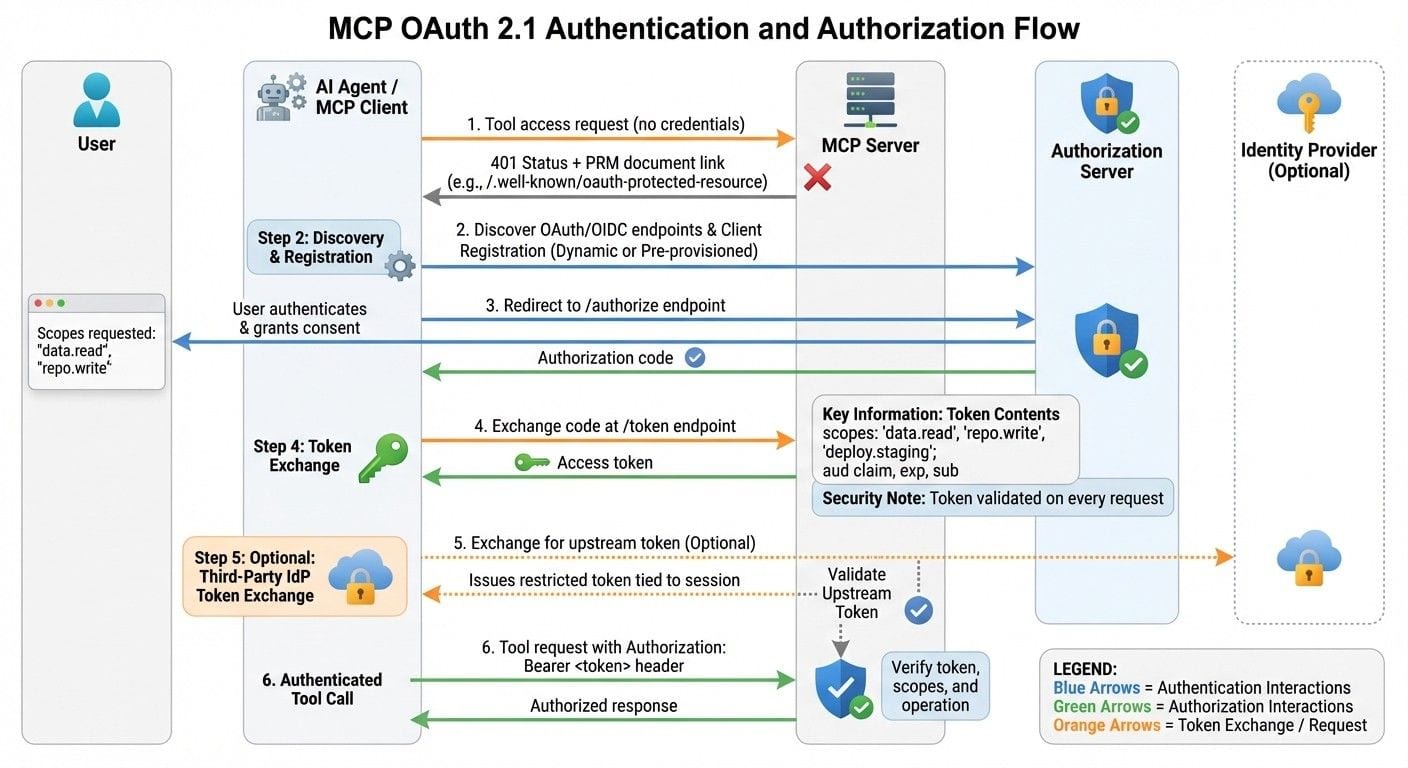
MCP OAuth 2.1 Authentication and Authorization Flow Diagram
Authentication and Authorization Flow
When an AI agent attempts to use a protected tool without valid credentials, the MCP server responds with a 401 status and provides a link to its PRM document, located at /.well-known/oauth-protected-resource [1][2]. This step helps the client discover essential OAuth/OIDC endpoints for tasks like authorization, token issuance, and client registration.
The MCP client must register as an OAuth client, either through dynamic registration or by using pre-provisioned credentials. Once registered, it begins a secure authorization code flow by redirecting the user to the /authorize endpoint. Here, the user authenticates and grants consent for specific scopes, such as data.read or repo.write. After the user approves, the client exchanges the authorization code at the /token endpoint to obtain an access token. This token includes key details like scopes, audience claims, expiration, and subject identifiers [1][2][4].
If a third-party identity provider is part of the process, the MCP server performs an additional token exchange. It validates the upstream token and then issues a more restricted token tied to the authorized session [4][6]. For every subsequent tool call, the MCP client attaches an Authorization: Bearer <token> header, allowing the server to verify whether the token authorizes the requested tool and operation [1][2][5].
Managing Policies and Scopes
After authentication, effective policy management ensures token scopes are translated into precise access permissions. MCP policies should be stored in a version-controlled repository, where they can undergo pull-request reviews, automated tests, and CI/CD pipeline processing [5][7]. This "policy-as-code" approach guarantees consistent access control across all environments, from development to production.
To enforce fine-grained access control, design specific scopes and avoid general-purpose ones like mcp:all. Break down permissions by action and resource - for example, use scopes like tickets.read and tickets.write, or distinguish between deploy.staging and deploy.production. Adding contextual claims to tokens, such as env=prod or tenant_id=acme, further strengthens security by ensuring isolation and preventing unauthorized cross-tenant access [2][7]. Prefactor simplifies this process by serving as a centralized control plane. It issues tokens that are aware of tenants and environments and ensures scope policies are applied consistently across all MCP servers.
Common Use Cases
MCP's secure token management and policy enforcement enable a variety of operational scenarios.
CI/CD-Driven Access and Just-in-Time Roles:Automation agents in CI/CD pipelines often need to deploy code, run tests, or update infrastructure - but only within specific environments and tenant boundaries. By using short-lived tokens with just-in-time scopes like deploy.staging or infra.read, the risk of a compromised credential is minimized. Such tokens are limited in scope and cannot be used to access production systems or other tenants' resources [2][7].
Additionally, temporary, narrowly scoped tokens can be issued for specific tasks. For example, during a monthly audit, a token with billing.read access can be provisioned and set to expire once the audit concludes. This approach ensures that agents operate with the least-privilege principle while reducing risks across various tasks and environments [2].
Monitoring and Governing MCP Access
Observability in MCP Systems
To ensure strong security in MCP systems, it's essential to log every interaction. This includes tracking all tool invocations, authorization decisions, and any denied requests. For each tool call, record details such as the agent's identity, the user, the resource being accessed, the action performed, and any input metadata (with sensitive information carefully redacted). Similarly, log the results of these actions. Authorization decisions should also be documented, capturing which policy was evaluated, the matching rules, the scopes and claims used, and whether the request was approved or denied [3][7].
These logs should be streamed into a centralized monitoring platform, like a SIEM or an observability stack. This integration allows security teams to correlate MCP activity with broader infrastructure events [3][7][8]. With a unified view, it becomes possible to implement detection rules for unusual behaviors, such as a single agent making an abnormally high number of calls, repeated authorization failures involving privileged scopes, or agents accessing resources outside their usual tenant or project contexts [3][7][8]. Time-based anomaly detection can also help identify irregular patterns, like a CI agent suddenly interacting with financial tools during off-hours [7][8].
These monitoring efforts lay the foundation for conducting regular access reviews, which are crucial for maintaining a secure environment.
Regular Access Reviews
For systems relying on long-lived machine identities and AI agents, periodic access reviews are a must. These reviews help prevent privilege creep and ensure adherence to the principle of least privilege. Start by creating a complete inventory of all MCP agents, including their identities (such as service accounts, tenants, and users) and the scopes and roles they currently hold [2][3][8]. Reviews should be conducted on a regular schedule - monthly or quarterly - and focus on identifying unused tools, overly broad permissions, and instances of cross-tenant or cross-environment access [3][8].
To identify over-provisioned privileges, compare the configured scopes with actual usage over a rolling 30- to 90-day period [3][8]. Automated reports can flag concerning trends, such as agents accumulating permissions across multiple tools or temporary emergency scopes that were never revoked. For long-lived identities, enforce maximum scope lifetimes and require documented business justifications for any privileged scopes. This approach aligns with governance frameworks like SOX, HIPAA, and PCI [3][8]. Prefactor's scoped, multi-tenant authorization and CI/CD-driven access streamline this process by linking permissions to version-controlled, reviewable policies.
When these reviews uncover unusual activity, swift incident response becomes critical.
Incident Response and Remediation
After access reviews, it's crucial to act quickly on any findings to mitigate potential threats. If an MCP agent is found to be compromised, the first step is to revoke its tokens immediately using the authorization server and any relevant platform-layer revocation APIs. Following this, rotate any underlying credentials the agent may have accessed, such as API keys or database credentials [1][2][4]. Update or temporarily disable MCP access policies tied to the compromised agent class or client ID, explicitly blocking risky tools or actions while the investigation is underway [3][8]. Additionally, invalidate cached sessions in dependent systems.
Forensic analysis is key to understanding the scope of the incident. Start by reconstructing a timeline of events using MCP server logs, policy decision logs, and identity provider logs. This helps trace all actions taken by the affected agents and users [3][7][8]. Compare denied and allowed requests to pinpoint security gaps, such as policy changes, scope modifications, or unauthorized cross-tenant actions. Logs specific to MCP decisions - showing which policies were evaluated, the attributes considered, and the final allow/deny outcomes - are invaluable for identifying policy weaknesses [3].
Prefactor’s detailed audit trails and CI/CD-based policy histories make it easier to uncover the root cause, assess the extent of the compromise, and determine which data or systems were impacted. This significantly reduces the time required to contain the issue and restore security.
Conclusion
Granular access control with MCP is transforming how secure machine-to-machine interactions are managed. By adopting scoped permissions, OAuth 2.1 flows, and policy-as-code, it addresses the risks posed by autonomous AI agents while ensuring full transparency into every action taken.
The success of MCP implementation hinges on three key practices: validating tokens with scope checks for every request, conducting regular access reviews to avoid privilege creep, and maintaining audit trails that log who or what performed each action, along with the timing and purpose. These steps help AI agents operate within strict boundaries and meet compliance demands in high-stakes industries like finance and healthcare, setting the stage for secure and scalable AI operations.
Prefactor streamlines this process by integrating MCP-compliant authentication, delegated access, and agent-level audit trails into its platform. It works seamlessly with your existing OAuth/OIDC setup and supports CI/CD-driven policy deployment, ensuring access policies are versioned, tested, and easy to review across your AI ecosystem.
To reduce security risks and enable scalable AI agent access, focus on crafting least-privilege policies using role-to-scope mapping, validating tokens on every request, and establishing robust monitoring and governance practices. These strategies will help you maintain a secure and efficient environment for AI agents within your organization.