
AI agents are everywhere - handling tasks autonomously and accessing sensitive systems. But managing their identities securely is often overlooked, leading to risks like ghost agents, privilege escalation, and compliance issues. Here's how to manage the entire lifecycle of AI agent identities effectively:
- Provisioning: Set up agents with clear ownership and scoped permissions.
- Governance: Monitor actions, enforce policies, and regularly review access.
- Deprovisioning: Revoke access and clean up credentials when agents are retired.
Traditional methods like static API keys don’t cut it anymore. Use modern protocols like OAuth/OIDC and tools like Prefactor to streamline authentication, enforce least-privilege access, and maintain detailed audit logs. This ensures security, compliance (e.g., SOC 2, ISO 27001), and operational efficiency.
Key Takeaways:
- Treat AI agents as first-class identities with clear ownership and purpose.
- Automate identity management through CI/CD pipelines and policy-based controls.
- Use short-lived tokens, avoid static keys, and integrate robust monitoring.
- Regularly review access and decommission unused agents to prevent vulnerabilities.
Managing AI agent identities isn’t just about security - it’s about maintaining control as automated systems scale.
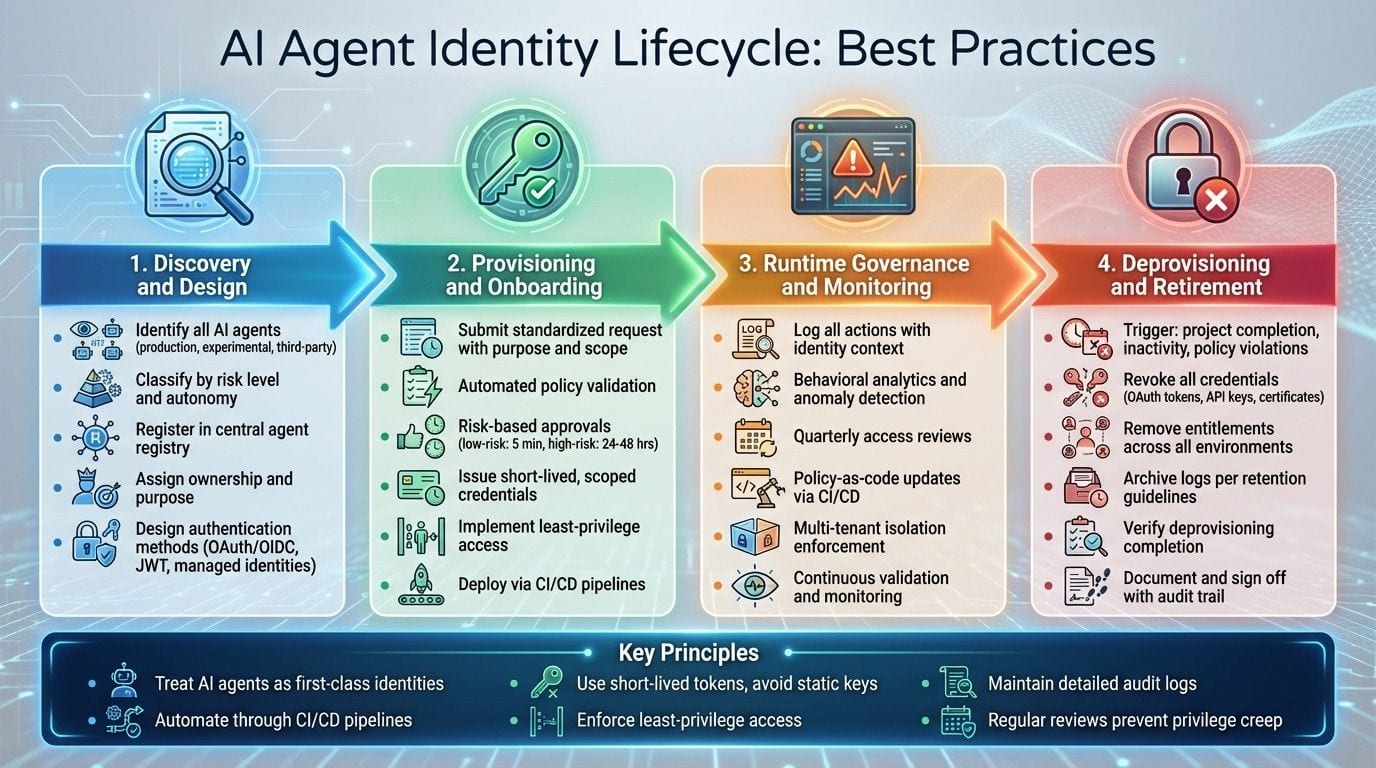
{AI Agent Identity Lifecycle Management: 4-Stage Framework}
AI Agent Identity Governance Basics
What Is an AI Agent Identity?
An AI agent identity is essentially a dynamic digital profile that allows autonomous systems to operate, access resources, and log their actions independently. Unlike static service accounts or API keys, these identities are designed to be created and terminated frequently, spanning across multiple applications and data environments.
While human identities are tied to individuals, with permissions often linked to HR processes or role changes, AI agent identities are tied to workloads or specific capabilities. For example, you might have an identity for a "L3 support triage agent" or a "Finance invoice reconciliation agent." These identities need to include details about their purpose, risk level, and operational boundaries. AI agents can operate in two modes: autonomous mode, where they act independently, and delegated mode, where they act on behalf of a user. Each mode requires different authentication methods and more detailed logging compared to traditional accounts.
Key components of an AI agent identity include a unique identifier, a clear and human-readable name, and metadata. This metadata might cover details like the purpose of the agent, its owner, the environment it operates in, its risk level, allowed scopes, credential type, lifecycle information, and pointers to audit logs.
Core Principles of Identity Governance
AI agents must be treated as first-class identities, with clear ownership and a defined lifecycle. They should only be granted the minimum permissions needed for specific tasks, using time-bound and scoped tokens. When acting on behalf of a user, delegated credentials are used to ensure traceability and accountability.
A "never trust, always verify" approach is essential. Every action and access request must be authenticated, authorized, and evaluated against current policies and risk signals. Key telemetry includes:
- Authentication events (who or what authenticated and from where)
- Authorization decisions (policies applied and scopes granted)
- Resource access logs
- Behavioral analytics to detect anomalies
Platforms like Prefactor help implement these principles by issuing scoped OAuth/OIDC credentials for agents, integrating with CI/CD pipelines to restrict access to specific environments, and enforcing policy-based delegation for user-specific actions. These practices not only reduce risk but also address compliance and audit requirements.
Compliance and Audit Requirements
Regulations such as SOC 2, ISO 27001, and PCI DSS require that non-human identities are uniquely identifiable, access-controlled, and auditable. Logs must capture key details like agent identity, sponsor, timestamps (in UTC or local US time), target resources, and decision context. These tamper-resistant logs are critical for non-repudiation and must be retained for periods ranging from one to seven years, depending on the industry standard.
Frameworks like the EU AI Act prioritize transparency, risk management, and human oversight. For AI agent identity governance, this means documenting agent roles, limitations, and controls, as well as ensuring human accountability for high-risk use cases. Organizations in the US that operate globally or handle EU data must integrate AI agent records into their processing activities, risk registers, and Data Protection Impact Assessments. Logs and identity systems must also be prepared to support regulatory inquiries.
To enable thorough investigations, logs should link request IDs across microservices, making it possible to trace actions end-to-end. They should also differentiate between autonomous operations and user-delegated actions by linking back to the originating user when necessary.
Prefactor simplifies compliance by offering detailed audit trails at the authentication and authorization layers. It records every token issuance, delegated access grant, and resource access decision tied to specific agent identities and their sponsors. This centralized system makes it easier to demonstrate compliance and manage audits throughout the entire lifecycle of AI agent identities, from provisioning to deprovisioning.
Stage 1: Discovery and Design
Agent Discovery and Classification
The first step is to identify all the AI agents currently in use. This involves scouring code repositories, deployment pipelines, cloud environments, and API gateway logs to locate active agents. These could include production systems, experimental tools, internal utilities, chatbots, RPA bots with large language model (LLM) enhancements, or even third-party SaaS agents that interact with your data.
A common issue is the existence of "ghost agents" - abandoned identities that still have permissions, creating potential vulnerabilities. Without a full inventory, managing these risks becomes nearly impossible. To avoid this, conduct interdisciplinary workshops to catalog all existing and planned agents. Capture details like their purpose, level of autonomy (assistive or fully autonomous), the data they access, environments they operate in (development, test, production), integration points, and their credential models. This comprehensive documentation ensures no agent is overlooked.
Once you've identified the agents, classify them based on factors like business function, data sensitivity, operating environment, and risk exposure. For instance, a high-autonomy trading bot accessing sensitive financial data will need stricter controls than a low-autonomy chatbot answering basic FAQs. Additional classifications - such as trust boundaries (internal-only, B2B, or public-facing) and identity models (acting independently or on behalf of a user) - help refine governance strategies and assign the right level of oversight to each agent.
All agents should be registered in a central agent registry. This registry acts as a single source of truth, including unique identifiers, ownership details (assigned team or individual), business purpose, classification attributes, trust boundaries, and criteria for decommissioning. To ensure new agents are tracked from the start, integrate this registry with your CI/CD pipelines, requiring registration before credentials are issued. Assign an accountable owner or sponsor to each agent. This person will oversee access approvals, monitor logs, and manage deprovisioning when the agent is no longer needed. Proper ownership and a detailed inventory are essential for effective identity design and provisioning in later stages.
Identity and Trust Design
With a detailed inventory in hand, the focus shifts to creating secure authentication mechanisms and fine-grained permissions. Authentication methods should align with an agent’s role and risk profile. For example, short-lived tokens (OAuth/OIDC, JWT) are ideal for temporary or task-specific agents, while managed identities (like AWS IAM roles or Azure Managed Identities) are better for long-running autonomous agents that require seamless authentication without manual credential handling. For scenarios requiring high levels of trust, certificates and mutual TLS can provide mutual authentication. Avoid static API keys altogether; instead, rely on short-lived tokens or managed identities for better security.
Decide whether an agent needs its own identity or should use delegated access tied to a user. Autonomous agents performing background tasks across sessions need their own service identity, while agents extending a user’s session - such as a copilot for analyzing sales data - should use delegated access models. Delegated access ensures least-privilege principles are maintained and provides traceability back to the originating user. Establish standardized permission scopes and resource types early in the process (e.g., data.read.customer, ticket.create, payment.initiate.limited) to encourage consistent permission patterns and avoid ad-hoc solutions.
Compliance with the Machine Client Protocol (MCP) is another priority. This requires machine-readable, scoped authorizations that support delegated access and auditing. Agents should be able to request just-in-time permissions using standardized protocols like OAuth/OIDC. Platforms like Prefactor simplify this by offering an authentication layer tailored to AI agents. Prefactor supports secure agent logins, delegated access, MCP compliance, OAuth/OIDC integration, scalable scoped authorization, CI/CD-driven access, multi-tenant environments, and agent-specific audit trails. Instead of building custom credential management systems, Prefactor integrates with existing identity infrastructure, enforcing policy-as-code for faster and more secure identity management.
From the outset, logging and telemetry should be non-negotiable. Define the events that must be logged for each agent, such as authentication attempts, resource access, policy denials, and any unusual data access patterns. Your identity model should enable mapping every logged event to a specific agent and its owner. This is critical for security monitoring and compliance audits. Register every agent with mandatory logging to ensure visibility and accountability.
Stage 2: Provisioning and Onboarding
Automated Provisioning Workflows
A structured provisioning process is essential for managing the lifecycle of AI agent identities. Here's how it works: A human sponsor or service submits a standardized request that outlines the agent's purpose, required systems, data sensitivity levels, and expected lifespan. This request is logged in an ITSM tool or as CI/CD metadata.
The identity platform then checks the request against pre-established policies. It verifies factors like allowed agent types, environments, maximum scopes, and data classifications. Any exceptions are flagged for further review. Risk-based approvals are routed to relevant stakeholders, such as the agent's owner, application owner, or security and compliance teams, with all decisions recorded for auditing purposes. For low-risk agents - like read-only analytics tools in non-production environments - pre-approved templates can enable automatic approval within five minutes, provided they meet strict criteria such as limited scopes, non-sensitive data, short lifespans, and predefined environments. On the other hand, high-risk agents that handle sensitive data like PHI, PII, or payment systems in industries like U.S. healthcare or finance require multi-step approvals, typically completed within 24–48 hours.
Once approved, the IAM system creates a non-human identity for the agent, including details like its owner, purpose, environment, sensitivity, and expiration date. Roles and scopes are assigned based on policy using role-based access control (RBAC) with environment tags, avoiding ad hoc permissions. Infrastructure-as-code practices ensure consistency. Short-lived, scoped credentials - such as OAuth/OIDC tokens, mTLS certificates, or workload identities - are issued and securely stored in a vault, never embedded in code. Deployment pipelines retrieve these credentials just-in-time from the identity platform or a secret manager, ensuring synchronization between the identity state and the environment. Finally, the agent is registered in a central inventory with ownership details and deprovisioning criteria, while initial telemetry baselines are set up for monitoring.
With credentials securely provisioned, the next focus is enforcing least-privilege access.
Implementing Least-Privilege Access
To implement least-privilege access for AI agents, it's crucial to define roles, scopes, and context from the outset. Assign narrowly defined roles tied to specific tasks, such as support_ticket_reader_production or billing_updater_us-region, instead of broad "admin" roles. Separate read, write, and admin capabilities to minimize unnecessary access. Use OAuth/OIDC scopes to constrain data access by region or business unit.
Assign distinct, minimal roles for each environment (development, testing, production) and avoid sharing credentials or roles across them. For example, production agents should never access development test data, and vice versa. Where possible, condition entitlements on factors like network location, time of day (U.S. time zones), or workload identity claims to reduce misuse risks. Common pitfalls to avoid include granting human "superuser" accounts to agents, reusing generic machine accounts across multiple agents, allowing broad database access instead of table- or schema-specific permissions, and relying on static API keys without resource scoping.
Provisioning through CI/CD pipelines helps codify agent identities as infrastructure-as-code. Define each agent in a version-controlled manifest (e.g., YAML) that specifies ownership, purpose, environments, roles, scopes, and maximum lifespan. At deployment time, the pipeline interacts with the identity platform to create or update the agent's identity and entitlements based on this manifest. Short-lived credentials should be issued per environment - for instance, staging tokens with narrower scopes and lower rate limits than production tokens - and fetched only at deployment or runtime from a secure secret manager. Automated policy checks (policy-as-code) in the pipeline can block deployments if requested entitlements exceed permitted patterns, such as preventing write access to production databases from a development environment. In multi-tenant SaaS setups, include tenant identifiers and environment tags in the agent's identity claims to enforce strict boundaries.
Credential management ties it all together for secure onboarding.
Credential Management Best Practices
The right credential type depends on the agent's context and risk profile. OAuth2 client credentials or OIDC machine clients are ideal for server-side agents that need to call APIs within or across organizations. These credentials support scoped access, token expiration, and integration with existing IAM and logging systems. For cloud-based agents, workload identities tied to runtime environments are a strong choice. mTLS certificates enable robust mutual authentication for service-to-service traffic, especially in zero-trust networks and service meshes, with automated rotation handled by certificate authorities. Short-lived signed tokens (like JWTs issued by an identity provider) work well for ephemeral or high-scale agents, balancing security and performance.
Static API keys and shared secrets should be avoided wherever possible, particularly for agents accessing sensitive or regulated data. If legacy APIs require static keys, mitigate risks by wrapping them with strict IP allowlists, rate limits, and aggressive rotation policies. Effective credential management emphasizes time-limited and automatically rotated secrets. For most agents, default lifetimes should range from minutes to a few hours, with refresh mechanisms governed by policy. High-risk operations may require single-use or extremely short-lived tokens. Automate client secret and certificate rotations based on risk levels - every 30–90 days for moderate-risk systems, and more frequently for high-risk ones - ensuring dependent services update seamlessly without downtime.
Prefactor simplifies this entire process by providing an authentication layer designed specifically for AI agents. It supports secure logins, delegated access, MCP compliance, OAuth/OIDC integration, scalable scoped authorization, CI/CD-driven access, multi-tenant environments, and detailed audit trails. Instead of building custom credential management systems, Prefactor integrates with existing identity infrastructure, enforcing policy-as-code to streamline identity management. As one CTO from a venture-backed AI company explained:
"The biggest problem in MCP today is consumer adoption and security, I need control and visibility to put them in production".
With MCP-compliant authentication, Prefactor offers full visibility and agent-level audit logs, ensuring organizations have a clear record of who (or what) accessed what, when, and why.
Stage 3: Runtime Governance and Monitoring
Continuous Monitoring and Telemetry
Once deployment is complete, every action taken by an agent should be meticulously logged with detailed identity context. This includes actions like API calls, data access, and resource usage, all of which must capture the agent, owner, tenant, and environment involved. Logs should be immutable and timestamped in UTC to align with U.S. audit standards such as SOX, HIPAA, and GLBA.
Behavioral analytics can then process this raw telemetry to identify anomalies. Establish a baseline for each agent or agent class, factoring in expected data volumes, operational patterns, time-of-day activity, and resource usage. Alerts should be configured for any deviations from this baseline. For instance, if a read-only analytics agent suddenly attempts a bulk export of customer data in the middle of the night, this should immediately trigger an alert. These alerts can be integrated with SIEM or SOAR systems to automate responses like revoking tokens or escalating the issue.
Prefactor simplifies runtime monitoring by offering built-in agent-level audit trails. By integrating OAuth/OIDC and adhering to MCP compliance, it provides real-time visibility into every agent action - covering the who, what, when, and why. This not only aids in anomaly detection but also supports compliance reporting in live environments.
Such robust telemetry practices lay the groundwork for thorough access reviews and timely policy updates.
Access Reviews and Policy Updates
Conducting periodic access reviews is essential to avoid privilege creep and unauthorized access. On a quarterly basis, the owner or sponsor of each agent should reassess the agent’s entitlements, data scopes, and delegated permissions. Any unused or excessive access should be promptly removed, following a "use it or lose it" approach. Treat AI agents as equivalent to human users within U.S. compliance frameworks by including them in access certification campaigns and documenting all decisions made during the review process.
For dynamic or short-lived agents, continuous validation replaces periodic reviews. This can be achieved by issuing short-term, scoped tokens at runtime, automating credential rotation, and immediately revoking access when anomalies, ownership changes, or task completions are detected. Just-in-time access should also be enforced, granting only the permissions necessary for the task at hand. These permissions should be restricted by resource type, tenant, and environment.
Policy updates should be managed as policy-as-code, stored in version-controlled repositories, and updated through CI/CD pipelines. Each update should go through code review before deployment to ensure every change is trackable and reversible. When an agent’s tasks or access needs evolve, update the policy manifest and redeploy it via the pipeline. Prefactor’s CI/CD-driven access model simplifies this process, enabling you to define authentication and authorization policies once and scale them as needed. While provisioning ensures minimal entitlements at the start, continuous reviews help prevent privilege creep during ongoing operations.
As governance becomes more complex, maintaining strict isolation across tenants and environments is crucial.
Multi-Tenant and Multi-Environment Governance
In multi-tenant environments - whether serving different customers or internal business units - strict isolation is non-negotiable. Each tenant must have its own unique identities, keys, and isolated data partitions to eliminate the risk of cross-tenant data access. This can be enforced through scoped authorization, tenant-specific policies, and runtime validation, which checks the tenant context for every request.
Production environments should have stricter policies and monitoring compared to development or testing environments. Tag telemetry data with clear labels (e.g., dev, staging, production) to ensure traceability during audits. For organizations with multiple legal entities or regulated segments, maintain separate policy sets for each tenant. For example, healthcare tenants might require HIPAA compliance, while payment-processing tenants must adhere to PCI DSS standards.
Prefactor’s multi-tenant capabilities can support this governance model at scale. It provides scoped authorization, tenant-specific policies, and delegated access controls to ensure strong isolation while maintaining security. This centralized approach reinforces zero-trust principles across all tenants and environments, ensuring no compromises in oversight or protection.
Stage 4: Deprovisioning and Retirement
Triggers for Deprovisioning
Deciding when to retire an AI agent is just as important as deciding when to deploy one. Some common triggers include the completion of a project, the phase-out of the operating environment, replacement by a newer model, changes in ownership, policy violations, or extended inactivity. Security factors also play a key role. If monitoring reveals unusual behavior, heightened risk levels, or prolonged inactivity of an identity, these should prompt a review and possible decommissioning. For U.S. companies, it’s crucial to log every trigger with exact timestamps (e.g., 03/15/2025 14:32:05) and associate it with change tickets. This provides a clear audit trail that explains why the agent was retired and who authorized it.
These triggers lay the foundation for a secure and orderly offboarding process.
Secure Offboarding Practices
A secure offboarding process starts with validating the trigger and ownership - confirm who is accountable for the agent and ensure there’s a legitimate business reason for its retirement. The next step is to disable new access while keeping only the minimal permissions needed for any remaining tasks. After that, revoke all active credentials such as OAuth/OIDC tokens, API keys, and mTLS certificates. This should be done across all relevant systems, including OAuth/OIDC providers, API gateways, key management platforms, and secret managers.
Once credentials are revoked, remove all entitlements, roles, and policies across every environment. Also, clean up dependent resources like queues, webhooks, and temporary data to ensure no lingering permissions remain. Using an agent asset graph can help map out and systematically clean up these dependencies.
Next, archive logs in accordance with regulatory retention guidelines. Ensure the logs are immutable and can be centrally accessed for future reference. Afterward, verify deprovisioning through automated checks. This includes confirming that login attempts using the agent’s identity fail, no roles are attached, and no active tokens remain. Document this verification in your audit system. Finally, document and sign off on the process with the agent’s owner (or sponsor) and the security or compliance team. Attach supporting evidence, such as screenshots, API responses, or log extracts, to an internal ticket for future audits.
Ephemeral Agents and Automation
Ephemeral agents require a fully automated deprovisioning process. These agents should be designed for automated identity creation, access assignment, and teardown. Each instance should have a dynamic, time-limited identity with narrowly defined permissions, short-lived tokens, and a clear time-to-live (TTL). When the task is complete or the TTL expires, the agent and all related credentials should be automatically destroyed.
This automated approach reduces standing privileges and eliminates the risks associated with dormant identities. In many organizations, non-human identities, including AI agents, now outnumber human ones. This increases the risk of attacks if deprovisioning isn’t handled correctly. Dormant identities that linger for months or even years can become vulnerable entry points for attackers.
Tools like Prefactor simplify the management of ephemeral agents by integrating deprovisioning into CI/CD pipelines and OAuth/OIDC systems. By automating provisioning and teardown in testable, version-controlled workflows, Prefactor helps eliminate ghost agents and ensures every retirement is thoroughly logged and compliant. This centralized approach enables scalable and secure retirement processes for all agents across various environments.
Know Your Agent: Solving Identity for AI Agents [Live Event]
Key Takeaways
Effectively managing AI agent identities at scale means treating them as full-fledged digital identities. Each agent should have a distinct identity, an assigned owner, and a defined business purpose that ties back to a central inventory system. With non-human identities mcpnow outnumbering human ones in many organizations, failing to manage these properly can compromise your entire compliance framework.
The most effective lifecycle management practices are automated and guided by policies, leveraging CI/CD workflows to handle tasks like provisioning, credential rotation, and deprovisioning. This approach ensures credentials don’t go stale and supports zero trust principles at scale. It’s crucial to enforce least-privilege, scoped, and time-limited access for all tokens. Additionally, using continuous monitoring with behavioral analytics helps detect anomalies as they happen. Regular access reviews and recertifications prevent privilege creep, and adopting ephemeral, just-in-time identities further strengthens security. These measures also simplify compliance with regulatory requirements.
For enterprises in the U.S., strong lifecycle management bolsters regulatory compliance for frameworks like SOC 2 and ISO 27001 by ensuring clear ownership, robust access controls, and auditable records. Maintain comprehensive logging with time-stamped records (e.g., 03/15/2025 14:32:05) and retention policies that meet U.S. legal standards. Automated lifecycle controls not only ease audit processes but also demonstrate continuous governance to regulators, customers, and cyber insurers.
Platforms such as Prefactor incorporate these best practices by offering MCP-compliant authentication, centralized agent login, and delegated access integrated with OAuth/OIDC systems. Prefactor enables scoped, policy-driven authorization, CI/CD-powered onboarding, multi-tenant readiness, and detailed agent-level audit trails. These features make it easier to enforce least-privilege access, monitor agent actions, and scale securely across complex environments.
FAQs
What are the risks of failing to manage AI agent identities effectively?
Failing to keep AI agent identities in check can open the door to major security risks like unauthorized access, data leaks, and harmful activities. Without the right safeguards, it becomes challenging to track what agents are doing, enforce rules, and spot weak points in your system.
This kind of oversight can snowball into operational hiccups, compliance violations, and a heightened risk of cyberattacks - jeopardizing your organization's data and systems. Putting secure, scalable identity management at the forefront is key to staying in control and reducing these risks.
What steps can organizations take to comply with SOC 2 and ISO 27001 when managing AI agent identities?
To meet the requirements of SOC 2 and ISO 27001, organizations need to focus on secure identity management, enforce robust access controls, and keep thorough audit trails for every activity involving AI agents. It's equally important to perform regular risk assessments and update policies to keep up with emerging threats.
Tools like Prefactor can simplify the compliance process by offering features such as scalable authorization, delegated access, and agent-level auditing. These capabilities integrate smoothly with existing security systems, while continuous monitoring of AI agents ensures regulatory compliance and bolsters overall security measures.
Why are short-lived tokens better than static API keys for AI agents?
Short-lived tokens offer a safer option compared to static API keys because they significantly lower the chances of unauthorized access. If someone manages to get hold of a token, its short lifespan limits how long it can be exploited. In contrast, static API keys remain active indefinitely unless you manually revoke them.
Another advantage of short-lived tokens is their ability to provide more adaptable access control. Permissions can be updated on the fly, ensuring AI agents only have the exact level of access required at any given moment. This not only boosts security but also adds a layer of operational flexibility.