Ultimate Guide to ABAC for MCP Authentication
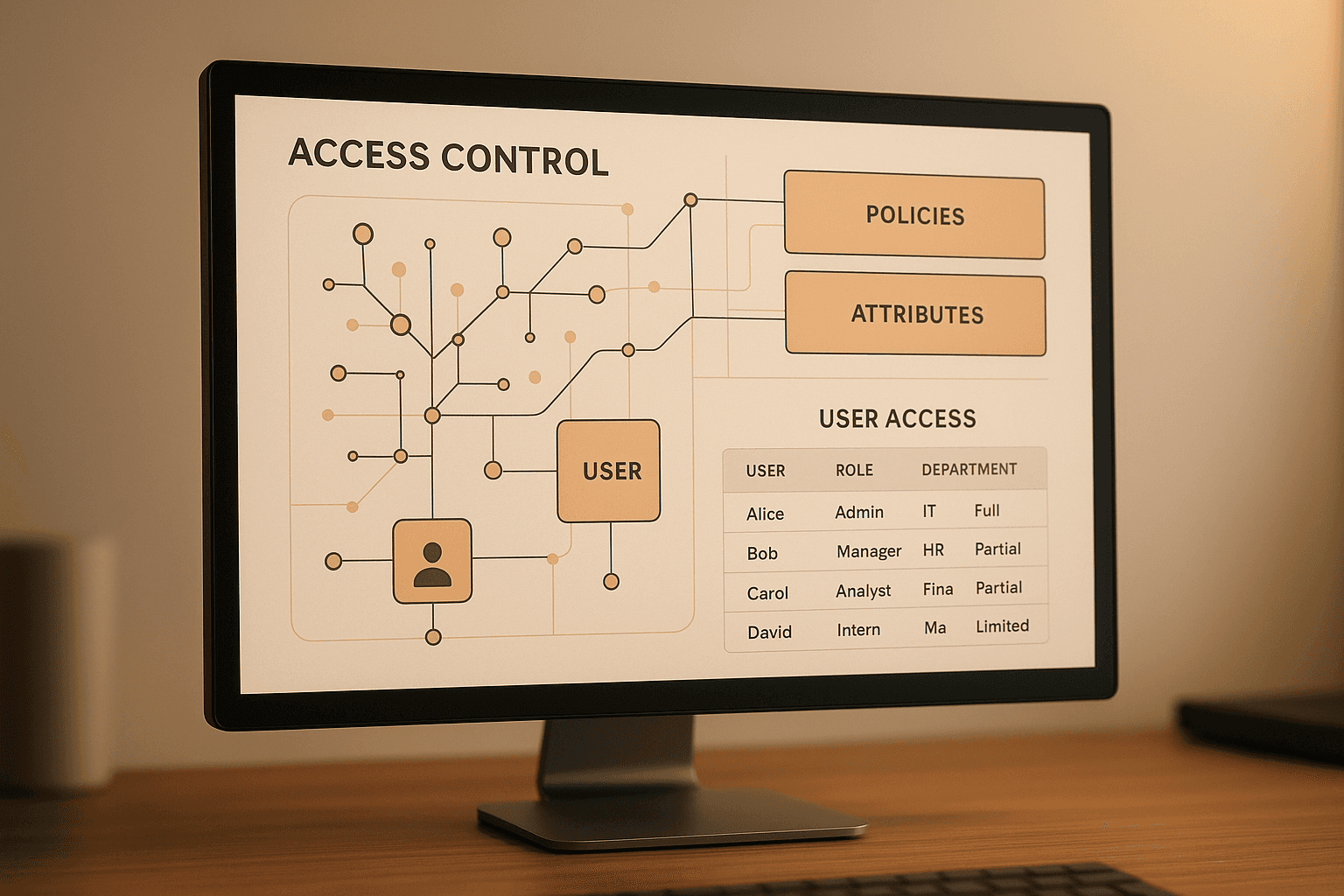
Attribute-Based Access Control (ABAC) is a flexible way to manage access, especially for AI agents in Model Context Protocol (MCP) environments.
Attribute-Based Access Control (ABAC) is a flexible way to manage access, especially for AI agents in Model Context Protocol (MCP) environments. Unlike traditional Role-Based Access Control (RBAC), which assigns static roles, ABAC makes decisions based on dynamic factors like user identity, resource sensitivity, action type, and environmental context. This approach ensures precise, real-time access control.
Here’s what you need to know:
- How ABAC Works with MCP: It leverages token claims (like user roles or IP addresses) and real-time conditions to decide whether an AI agent can perform an action. For example, an agent might only access payroll data during business hours from a trusted network.
- Why ABAC is Important: Static roles aren't enough for AI agents that handle data across multiple tenants and changing conditions. ABAC reduces role complexity by up to 70%, making it easier to manage policies and ensure compliance.
- Core Attributes Used:
- Subject: Who is making the request (e.g., agent ID, tenant).
- Resource: What is being accessed (e.g., data type, sensitivity).
- Action: What is being done (e.g., read, write).
- Environment: Context like time, location, or risk level.
- Policy Enforcement: Policies are defined using declarative languages (like Rego or Cedar) and enforced in real time. A "default-deny" model ensures no action is allowed unless explicitly permitted.
- Implementation Steps:
- Collect attributes (e.g., JWT claims, IP addresses).
- Define policies in a policy engine.
- Evaluate requests dynamically.
- Enforce decisions with strict deny-by-default rules.
ABAC is especially useful for securing AI agents that operate autonomously, ensuring access controls are precise and scalable. Tools like Prefactor simplify this by managing attributes, policies, and audit trails, making it easier to deploy AI agents securely in MCP environments.
Core Components of ABAC in MCP Authentication
Key Attribute Types in ABAC
In Model Context Protocol (MCP) environments, Attribute-Based Access Control (ABAC) decisions rely on four main categories of attributes. These attributes work together to determine whether an AI agent is allowed to perform a specific action.
Subject attributes define the identity of the AI agent. These include details like agent ID, delegator identity, tenant, assigned scopes, and risk scores. For instance: {agent_id: "agent-support-1", tenant: "acme", role: "support_agent"}.
Object attributes describe the resource being accessed. Within MCP, this includes elements such as the tool name (e.g., customers.get_details), resource roots (e.g., projects/{id}), data classification tags (public, pii, financial), and tenant ownership. For example, a customer record might carry attributes like: {resource_type: "customer_profile", tenant: "acme", sensitivity: "pii"}.
Action attributes specify the operation being performed. Examples include read, write, execute_tool, delete, or bulk_export. These attributes often align with OAuth scopes and MCP tool operations, enabling precise policy distinctions, such as differentiating between execute_tool: "create_ticket" and execute_tool: "delete_ticket".
Environment attributes capture contextual details like time of day (using UTC timestamps), IP address or network zone, deployment environment (dev, staging, prod), authentication method (e.g., mTLS versus bearer token), and token properties (such as expiration and audience). For instance, a policy might permit tool execution only from production agents during U.S. business hours (9:00 a.m.–6:00 p.m. PT).
When an AI agent makes a request to an MCP server, the system evaluates all these attributes together. For example, it considers the agent (X), acting for a tenant (Y), attempting to execute a tool (Z) on a resource (R) with certain sensitivity, in a specific environment (E). This comprehensive evaluation ensures every request is thoroughly assessed.
Policy Definition and Enforcement
ABAC policies are typically defined using declarative languages like Cedar, Rego (used with Open Policy Agent), or other vendor-specific domain-specific languages (DSLs). These policies express conditions based on the four attribute categories. For example, a Cedar-style policy might state: "Allow an AI agent to execute the tickets.create tool only for its own tenant and only for non-admin projects." This policy evaluates subject attributes (from OAuth 2.1 JWTs), object attributes (provided by the MCP tool layer), the action (e.g., execute_tool with a specific operation), and the context (extracted from request metadata).
Enforcement is handled through a decoupled architecture. After validating a token, the enforcement module in the MCP server intercepts each tool call. It gathers attributes from the JWT, mTLS identity, tool request, and other metadata before consulting the Policy Decision Point (PDP). The PDP - powered by tools like Cerbos, Oso, or Cedar-based services - evaluates policies and returns an allow or deny decision. It may also include obligations, such as redacting specific fields.
Supporting this system are two additional components:
- Policy Information Point (PIP): Retrieves supplementary attributes from sources like identity providers, user directories, or resource services.
- Policy Administration Point (PAP): Provides a space for authoring, testing, versioning, and deploying policies, often through Git-backed repositories or admin interfaces.
Prefactor plays a key role in supplying the attributes needed for ABAC policies in MCP. By supporting "Support roles, attributes, and delegated access - in one unified model", Prefactor ensures MCP servers have the detailed metadata required for accurate ABAC decisions. Additionally, its policy-as-code approach integrates seamlessly with CI/CD pipelines, enabling policies to be version-controlled, testable, and reviewable like any other part of your infrastructure.
Default Deny and Security Best Practices
A default-deny approach strengthens security by ensuring that any request not explicitly allowed - or missing required attributes - is automatically blocked. This principle is fundamental to secure ABAC implementation in MCP environments. As noted in OWASP guidance, "any unrecognized agent or scope should be blocked automatically", and authorization should be evaluated on a per-request basis rather than per session.
Middleware should be configured to deny requests with missing or invalid attributes. While short-lived, scoped tokens provide a baseline, ABAC adds an extra layer of fine-grained verification. For example, even if an agent has a valid customers:read scope, an ABAC policy might still deny the request if:
- The customer record belongs to a different tenant,
- The record is marked as restricted, or
- The request originates from an untrusted network zone.
To ensure transparency and traceability, log every authorization decision. This includes details like the evaluated attributes, policy ID, and PDP response. Such logging supports audits, debugging, and overall visibility into actions performed by agents in production environments.
Role-based access control (RBAC) vs. Attribute-based access control (ABAC)
Implementing ABAC in MCP Environments
{ABAC vs RBAC: Key Differences for MCP Authentication}
Steps to Configure ABAC for MCP
Setting up Attribute-Based Access Control (ABAC) in Model Context Protocol (MCP) environments involves four key steps:
- Collect attributes: Gather essential data, including JWT claims, agent metadata, environmental details (like IP addresses and timestamps), and resource-specific information such as MCP tool scopes.
- Define policies: Use a Policy Decision Point (PDP) and a policy language like XACML or Rego to create rules. For instance: "Allow access if agent.role = 'editor' AND resource.scope = 'read' AND time < expiration."
- Evaluate requests: Send the collected attributes to the PDP for real-time decision-making, typically following OAuth authentication.
- Enforce decisions: Implement a default-deny approach at the server level to block any unauthorized tool calls automatically.
These steps provide a structured approach to integrating ABAC into MCP environments, ensuring precise and secure access management.
MCP authentication naturally aligns with ABAC. The process begins with client discovery at the /.well-known/oauth-protected-resource endpoint (as per RFC 9728), initiating OAuth 2.1 with PKCE. During server-side validation, attributes are collected from the JWT, such as scopes tied to roles and the "aud" claim for server-specific checks. This enables detailed access control, like permitting an agent to read certain tools but not execute them.
For policy definition and enforcement, tools like Cerbos, Oso, and Open Policy Agent (OPA) are well-suited for MCP environments. These systems rely on Rego for attribute evaluation and enforce a deny-by-default principle. They also integrate with identity management platforms, supporting federated identity for seamless operation.
ABAC vs RBAC Comparison
Understanding the differences between ABAC and Role-Based Access Control (RBAC) is essential for determining the right approach for your MCP environment. While RBAC relies on static roles like "reader" or "editor" for scope mapping, ABAC offers dynamic, per-request enforcement. For example, ABAC can enforce rules that depend on trust levels or specific conditions, making it ideal for complex scenarios.
Aspect | ABAC | RBAC
Granularity | High (attributes and context) | Medium (roles and hierarchies)
Flexibility | Dynamic, contextual rules | Static role assignments
MCP Suitability | Ideal for complex agent-tool interactions | Works for basic scope enforcement
Overhead | Higher (evaluates each request) | Lower (session-based)
Context Awareness | Considers time, location, and risk | Limited unless roles are customized
Maintenance | Policies as code, version-controlled | Can lead to role proliferation
ABAC's ability to consider dynamic attributes like time, location, and agent attestation makes it more adaptable for growing and complex MCP environments. While RBAC may be simpler to implement initially, its static nature can become a limitation over time as your needs evolve.
Advanced ABAC Strategies for MCP Authentication
Combining ABAC with Resource Roots
Resource roots serve as base directories (like /users/{user_id}/projects) that define and restrict the scope of agent access. When paired with Attribute-Based Access Control (ABAC), these roots ensure that policies evaluate attributes such as agent identity, user delegation, and resource ownership. This setup authorizes actions strictly within specified boundaries, effectively preventing unauthorized lateral movement between tenants or users.
For implementation, embed resource roots into JWT claims (e.g., resource_root: '/users/{id}') and ensure access requests align with these claims during policy evaluation. A compatible policy engine can match agent attributes against these predefined hierarchies. At the MCP server level, validate that the aud claim corresponds to the requested resource root. For example, in a GitHub MCP integration, ABAC policies can limit agents to specific repository roots like repo:alice/my-repo, with all requests subjected to a default-deny rule unless explicitly permitted.
This setup offers precise control. For instance, an AI agent might access /users/alice/projects while being automatically denied access to /users/bob/*. These restrictions are enforced by checking JWT claims, such as sub for agent ID and custom resource_root claims, ensuring access is tightly controlled.
By leveraging resource-root policies, organizations can enable dynamic context evaluation tailored to evolving security needs.
Dynamic Context Evaluation
Dynamic context evaluation adds a layer of real-time intelligence to every authorization decision by incorporating session-specific signals. This approach enhances the reliability of access controls by factoring in transient attributes like IP addresses, geolocation, SIEM threat scores, compliance flags, and token age.
For example, when an AI agent attempts to access a sensitive MCP tool, the ABAC system evaluates both static attributes (e.g., agent role and scopes) and dynamic ones, such as the current IP's reputation, whether the request complies with mTLS certificate checks, and threat intelligence data. If a threat score exceeds a set threshold - say, 0.7 out of 1.0 - the system denies access, even if the token itself is valid:
<code>if (threatIntel.getScore(request.ip) > threshold) return DENY;</code>
OWASP recommends evaluating these attributes on a per-request basis rather than relying on session-based checks. This allows for immediate detection of compromised sessions, enhancing security. While this method may introduce some latency due to external data queries, techniques like intelligent caching and short-lived context windows can help minimize delays without compromising security.
Common Pitfalls and Best Practices in ABAC for MCP
When implementing Attribute-Based Access Control (ABAC) in Model Context Protocol (MCP), avoiding common mistakes and following key best practices is essential for maintaining both security and performance.
Standardizing Attribute Management
Inconsistent attribute handling can lead to unreliable policy evaluations in MCP environments. For example, if one system pulls user location data from IP metadata while another relies on geolocation APIs, the resulting discrepancies can weaken security and undermine access decisions. The solution? Establish a centralized Policy Decision Point (PDP) that standardizes attributes like agent identity, permissions, and context before enforcement.
To achieve this, focus on normalizing core attributes such as agent IDs, scopes, permissions, and environmental variables. Use CI/CD pipelines to enforce these standards consistently. Additionally, adopt short-lived, scoped JSON Web Tokens (JWTs) tied to specific attributes, ensuring they are validated server-side in line with OWASP guidelines.
A real-world example illustrates the impact of standardization: in 2025, Cerbos integrated ABAC with an MCP server for a financial services firm. By unifying attributes across more than 50 tools, they reduced policy misfires by 92%, dropping from 1,200 to just 96 incidents per month within three months. This approach also ensured zero compliance violations during audits.
By standardizing attributes, you not only enhance security but also create a solid foundation for testing edge cases effectively.
Testing Policies for Edge Cases
ABAC policies often fail when tested against static conditions but not dynamic contexts. Scenarios like time-based restrictions, location-based conditions, token expiration overlaps, and multi-agent delegation chains can expose vulnerabilities. For instance, an agent might have valid scopes but still breach rules by performing an "after-hours delete operation."
To mitigate these risks, adopt a test-driven approach using policy simulation frameworks. These tools allow you to test attribute combinations (e.g., expired tokens paired with valid agent IDs) and simulate failures like network delays. Integrate these tests into CI/CD pipelines to catch regressions early. Platforms like Cerbos PDP enable dry-run evaluations, logging decisions without actual execution.
Ensure policies are validated on a per-request basis with a "deny-by-default" approach. Check claims such as exp, iss, aud, and scopes rigorously. Aim for 100% coverage of high-risk scenarios, including cross-tenant access attempts and other complex edge cases.
Comprehensive testing not only strengthens security but also supports continuous auditability by ensuring logged decisions are both accurate and compliant.
Maintaining Auditability and Compliance
Distributed policy decisions across MCP servers, agents, and upstream services can lead to fragmented logs, making it difficult to trace authorization decisions. Without detailed agent-level logs, investigating breaches caused by over-privileged access becomes nearly impossible. This lack of traceability increases liability, especially in AI-driven environments, and exposes organizations to risks like GDPR or SOC 2 violations.
To address this, log every authentication attempt, policy evaluation, and decision at the PDP level. Include full attribute sets, agent IDs, timestamps (in MM/DD/YYYY format), and outcomes. Store these logs immutably and integrate them with Security Information and Event Management (SIEM) systems for anomaly detection. Prefactor, for instance, provides compliance-ready features for MCP, offering per-agent audit trails that track all delegated access and revocations. Use structured formats like JSON, with fields such as agent_id, policy_id, decision, and attributes, to facilitate forensic analysis.
This continuous logging approach reinforces the default-deny principle, ensuring that every authorization decision is both traceable and compliant.
To measure the effectiveness of your ABAC implementation, monitor these key metrics:
- Policy evaluation latency: Aim for evaluations under 100ms.
- Deny rate on edge cases: Target a deny rate above 95% for unauthorized actions.
- Audit log completeness: Ensure 100% coverage of all decisions.
- Attribute consistency score: Strive for zero drift incidents per quarter.
Conclusion
Attribute-Based Access Control (ABAC) is transforming how AI agent security is handled in Multi-Cloud Platform (MCP) environments. Instead of relying on static roles or overly broad permissions, ABAC evaluates the subject, action, resource, and context for every request. This dynamic approach is tailor-made for the challenges faced by autonomous agents working across multi-tenant systems.
The advantages are evident: ABAC enforces the principle of least privilege by default, which significantly reduces risks tied to token leaks or agent mishaps. By centralizing policy decisions and maintaining detailed logs of every authorization request - complete with attribute context - organizations can meet compliance standards like SOC 2 and GDPR, as well as industry-specific regulations.
Scalability is another key benefit. Policies are based on attributes such as tenant_id, environment, or risk_level, instead of manually mapping every possible role-resource combination. This means when new agents or tenants are added, assigning the correct attributes through CI/CD pipelines ensures existing policies apply instantly - no manual updates needed. Plus, the policy-as-code model allows access logic to be versioned and tested just like any other piece of application code. Platforms like Prefactor are perfectly aligned with this streamlined, scalable approach.
FAQs
How does Attribute-Based Access Control (ABAC) improve security for AI agents in MCP environments?
ABAC enhances security for AI agents operating in MCP environments by implementing detailed, context-aware access control. It bases permissions on specific agent attributes - like their role, location, or the current operational context - allowing for dynamic and precise access management.
This method minimizes the chances of granting excessive permissions, improves the ability to audit activities, and ensures that all interactions adhere to established policies. By customizing access according to the unique requirements of each agent, ABAC supports a strong and secure compliance structure.
What is the difference between ABAC and RBAC in access control?
ABAC, or Attribute-Based Access Control, determines access by evaluating attributes such as user information, resource characteristics, and situational factors. This approach supports detailed, context-sensitive permissions, making it a great fit for dynamic and intricate environments.
In contrast, RBAC, or Role-Based Access Control, grants permissions based on predefined roles. This method is simpler to manage but doesn't easily adapt to shifting conditions. While ABAC offers greater flexibility and precision, RBAC works better for straightforward, static access needs.
What are the best practices for implementing and managing ABAC policies in an MCP environment?
To successfully implement and manage ABAC (Attribute-Based Access Control) policies in an MCP (Multi-Cloud Platform) environment, start by establishing precise and detailed access controls. These controls should align closely with agent attributes, roles, and the specific operational context. It's crucial to make these policies transparent, easy to test, and version-controlled. By integrating them into your CI/CD pipelines, you can streamline updates and minimize the likelihood of errors or misconfigurations.
Tools like Prefactor can simplify policy management by connecting with existing identity systems, accommodating multi-tenant configurations, and enforcing context-sensitive, delegated access.