
How to Analyze Multi-Agent AI Attack Surfaces
Multi-agent AI systems are complex networks of autonomous agents that work together to complete tasks, like planning trips or managing emails. While efficient, they come with significant security risks, such as context poisoning, prompt injection, and dependency vulnerabilities. These threats can compromise sensitive data, disrupt workflows, or trigger unauthorized actions. Traditional security tools often fall short in managing these challenges due to the dynamic and interconnected nature of these systems.
To address these risks, you need a structured approach:
- Profile Agent Capabilities: Document each agent's role, permissions, and access to data and tools.
- Map Dependencies: Create visual diagrams showing how agents interact to identify weak points.
- Analyze Attack Vectors: Focus on threats like malicious inputs, communication manipulation, and dormant vulnerabilities.
- Monitor Behavior: Establish baselines for normal agent activity to detect anomalies.
- Use Static Analysis: Review agent code and configurations to uncover vulnerabilities before deployment.
- Mitigate Risks: Prioritize threats based on likelihood and impact, and implement controls like kill switches, rate limits, and audit trails.
Tools like Prefactor can automate monitoring, visualize agent interactions, and enforce compliance, helping organizations secure their systems while scaling AI projects. Start by inventorying agents, mapping dependencies, and setting up monitoring within the first 30–90 days to build a solid security foundation.
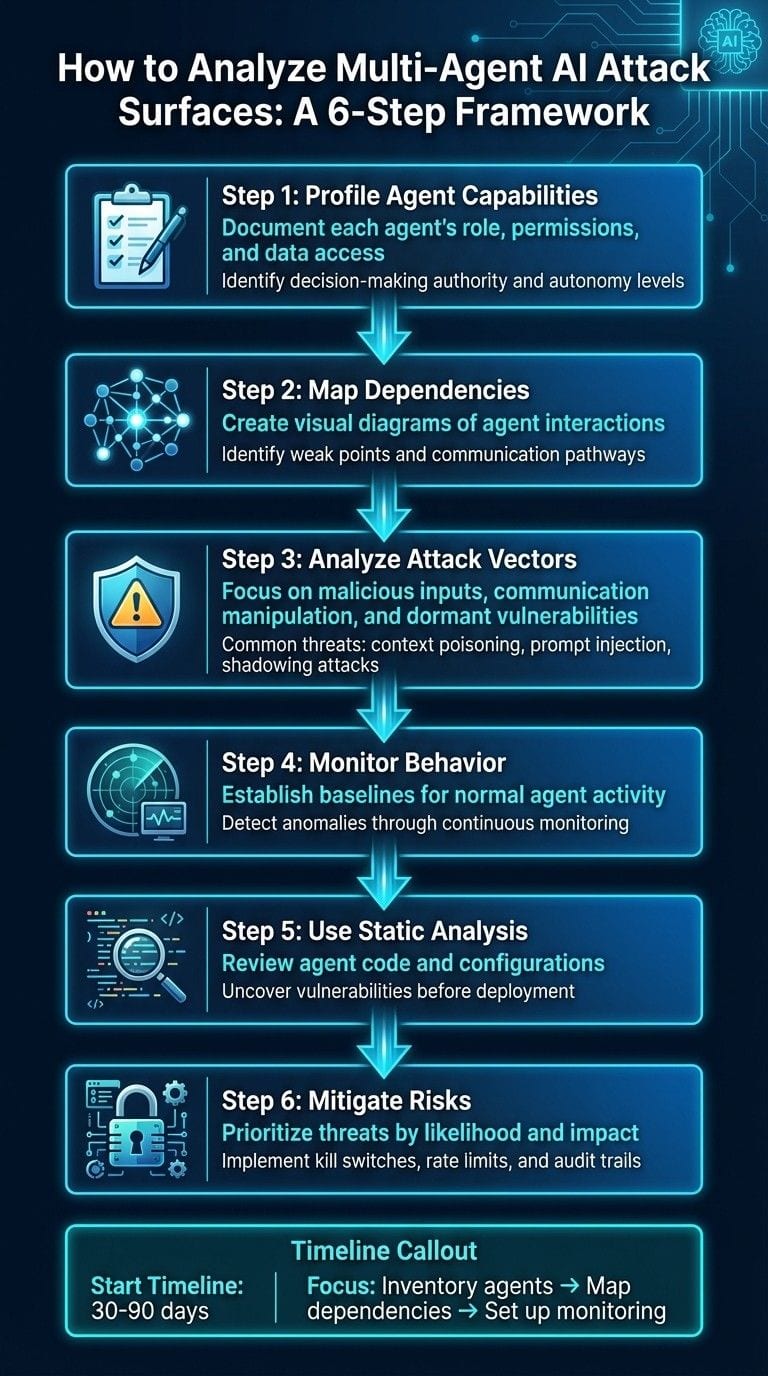
{6-Step Framework for Analyzing Multi-Agent AI Attack Surfaces}Mapping Agent Capabilities and Dependencies
How to Profile Agent Capabilities
Profiling agent capabilities involves a two-step process. First, outline each agent's role, permissions, and the data it can access - like customer PII or financial records. Document its decision-making authority, noting what it can do without human oversight, and identify the users or systems that can trigger its actions. This step establishes the agent's scope, defining its level of autonomy and access boundaries, which is crucial for understanding the initial attack surface.
The second step digs deeper into the tools, APIs, databases, file systems, and external services the agent can interact with. For each resource, record its authentication method, privilege level, and the sensitivity of the data it handles. Research from SANS on the Agent Interrogator framework revealed that automated tools can identify agent resources with detection rates ranging from 45% to 100%, depending on the complexity of the agent setup. This variability underscores the importance of systematic profiling - relying solely on documentation often misses hidden or overlooked capabilities.
For U.S.-based enterprises, a structured template can help streamline this process. Include columns for agent ID, business owner, primary function, autonomy level, accessible data classifications, tools and integrations (with permissions), human approval requirements, and logging coverage. This format not only provides clarity but also supports compliance with regulations like SOC 2, HIPAA, and GLBA by mapping which agents handle sensitive customer or financial data.
Once the agent's profile is complete, the next step is to map out its interactions and identify potential dependency risks.
Creating Relationship and Dependency Maps
With agent profiles in place, the next task is to map out how agents interact. Visual diagrams can illustrate which agents can invoke or orchestrate others, share data directly or through shared repositories, or trigger external systems. These maps are essential for identifying vulnerabilities. For example, compromising a low-privilege agent could create pathways to breach more sensitive agents, potentially leading to unauthorized purchases, data leaks, or account manipulation.
To model these interactions, use a directed graph that represents agents, tools, and data stores as nodes, with edges showing communication or dependency links. Examples might include "SupportAgent → CRM API" or "PlannerAgent → ExecutorAgent." Tools like LangChain or MCP can export configuration data into graph formats, which can then be visualized with standard diagramming software. To ensure these maps stay accurate as your system evolves, treat them as infrastructure-as-code - automatically updating them via configuration repositories and CI/CD pipelines whenever new agents, tools, or connections are added.
Platforms like Prefactor simplify this process by automatically discovering and visualizing agent relationships. Prefactor monitors runtime agent calls, tool usage, and message routing to generate an up-to-date graph of agent interactions, resource access, and workflows. Its comprehensive audit trails allow teams to drill down into specific nodes or edges to review historical actions. This helps validate whether a dependency is secure or requires additional constraints before moving agents from testing to production.
Identifying and Assessing Attack Vectors
Common Attack Vectors in Multi-Agent AI
Multi-agent systems face unique threats, especially those targeting how agents communicate with each other. One common issue is context poisoning, where malicious data infiltrates shared memory or databases. This can lead to a chain reaction of errors across multiple agents, disrupting the system's functionality.
Another vulnerability is indirect prompt injection. This happens when attackers use outputs from tools or external inputs to manipulate agents. For instance, in ATAG evaluations of an automated email responder, attackers embedded commands in email attachments. These commands tricked one agent into producing harmful outputs, which then spread to other agents.
Shadowing attacks are also a significant concern. Here, malicious agents disguise themselves as legitimate ones to intercept or manipulate messages. They exploit dependency maps in frameworks like LangChain to achieve this. Similarly, sleeper cell propagation takes advantage of dormant vulnerabilities in one agent that later spread through communication channels.
Other risks include the leakage of sensitive information during inter-agent communication and coordinated attacks. Such attacks can often be detected by analyzing communication patterns for anomalies, using techniques like entropy-based analysis.
Once these attack vectors are identified, the next step is to evaluate their likelihood and the potential damage they could cause.
How to Assess Threat Likelihood and Impact
After pinpointing possible attack vectors, the next challenge is to quantify their risk. This involves modeling your system's structure and identifying weak points. Start by mapping out your system's topology and analyzing vulnerabilities, particularly in shared resources like databases. Tools like ATAG frameworks and MulVAL-generated attack graphs can help assign probabilities to different attack scenarios based on success rates.
For example, during Agent Interrogator testing with the Damn Vulnerable LLM Agent (DVLA), detection rates varied significantly. Tool detection frequency hit 95% across 20 runs, while DVLA-MCP detection ranged from 45% to 100%, largely due to the unpredictable behavior of large language models.
To evaluate the potential impact, combine the likelihood of threats with the damage they could cause. A breach in one agent can ripple through the system, disrupting goals or causing unexpected spikes in resource usage. Quantify threat likelihood using data from attack success rates (ASR) and attacker precondition matches. Then, assess the impact using metrics like the number of affected agents, the sensitivity of compromised data, and operational downtime.
Establishing behavioral baselines is another critical step. Monitor resource usage, communication patterns, and decision-making sequences under normal conditions. Use anomaly detection methods like clustering, time-series analysis, and entropy measurements to flag unusual activity. Employ a tiered monitoring approach: broad, passive metadata analysis for general coverage, paired with deep inspections for suspicious activities. This balance ensures both system performance and security remain intact.
Behavioral and Static Analysis of Agents
Setting Up Behavioral Baselines
To deepen the security understanding of multi-agent systems, it’s essential to establish behavioral baselines. These baselines should track four key dimensions: resource usage (like CPU, GPU, memory, and I/O), communication patterns (including frequency, size, and timing), decision sequences (such as ordered tool and API calls), and outcomes (e.g., success rates, time-to-completion, and rollbacks).
Each agent type, role, and environment - whether in staging or production - should have its own baseline. Additionally, segment these baselines by time-of-day and day-of-week to account for normal operational cycles. Use telemetry data aggregated into windows that strike a balance between resolution and system performance.
Efficient telemetry collection is critical. Start with lightweight metadata, such as timestamps, sender and receiver IDs, message lengths, tool names, and status codes. Reserve detailed content logging - like message bodies or tool parameters - for high-risk scenarios or sandbox environments. Store this data in time-series or columnar databases, applying retention policies based on risk levels. For example, sensitive workflows might require 30 days of detailed logs, while aggregated statistics could be retained for 90 days or more.
Rather than relying on isolated threshold breaches, monitor for patterns involving multiple signals. For instance, a sudden 3–5× spike in message rates to an orchestrator, combined with unexpected tool usage and prolonged task durations over 15–30 minutes, could signal a developing threat. Enterprises often define alert thresholds statistically, flagging anomalies that exceed three standard deviations from a 30-day rolling baseline. However, escalation usually requires multiple correlated anomalies before triggering an alert.
This type of behavioral monitoring provides a strong foundation for identifying threats and works hand-in-hand with static analysis to uncover hidden vulnerabilities.
Using Static Analysis to Find Vulnerabilities
Static analysis complements behavioral monitoring by reviewing agent code, workflows, and configurations without executing them. This approach helps identify structural weaknesses, such as unsafe tool bindings, overly permissive actions, or predictable communication patterns, before deployment.
One effective method is sequential pattern mining, which examines historical logs of communication and decisions. Routine tasks tend to follow consistent tool-call chains, so an unusual sequence - like "SummarizeEmail → ExtractCredentials → CallExternalAPI" - should raise immediate concerns.
Another helpful technique involves entropy measurements. For example, low entropy in responses where diversity is expected could indicate constrained or manipulated prompts. Conversely, high entropy - manifested in irregular timing or variable payload sizes - might suggest covert channels or data exfiltration attempts.
Static analysis can be further enhanced by exporting orchestration logic and model architectures into intermediate formats, such as computation graphs, policy JSON/YAML files, or domain-specific languages (DSLs). These representations can then be analyzed using tools like PyTorch or TensorFlow. Such frameworks enable advanced techniques like generating saliency maps to identify sensitive token patterns, analyzing layer activations to detect backdoor behavior, and running synthetic test scenarios to evaluate responses to adversarial prompts. Because these analyses are conducted offline, they can be seamlessly integrated into enterprise CI/CD pipelines to block deployments when risk thresholds are exceeded.
Repeated testing with tools like the Agent Interrogator framework highlights the variability in detection rates, underscoring the importance of continuous static analysis.
Mitigating Risks with Prefactor
How to Prioritize Risks
After identifying potential attack vectors through behavioral and static analysis, the next step is to determine which ones demand immediate attention. A practical approach is to use a four-quadrant matrix with Likelihood on one axis and Impact on the other. Here’s how to define the criteria:
- High Impact: Scenarios involving potential losses exceeding $500,000, exposure of regulated data, or safety-critical consequences.
- High Likelihood: Attack techniques that have a track record of success and minimal existing controls.
Each identified vector is then placed into the matrix. For example, if an attacker exploits prompt injection to manipulate a planning agent into making unauthorized payments over $5,000, this would fall into the High/High quadrant. On the flip side, a low-privilege agent accessing non-sensitive logs might land in the Low/Low quadrant.
For every quadrant, you should define specific governance actions:
- High/High risks: Require mandatory human approval.
- Medium/High risks: Implement rate limits and enhanced logging.
- High-impact events: Use automated kill switches for immediate containment.
To prioritize risks effectively, evaluate each vector using five key criteria:
- Exploitability: Has this been documented in similar systems?
- Blast Radius: Could this affect multiple agents or tools?
- Data Sensitivity: Does it involve regulated data like PCI, HIPAA, or GDPR?
- Agent Autonomy: Does the agent control critical actions (e.g., transferring funds, modifying configurations)?
- Detectability: Can current monitoring systems catch this?
Start by addressing High/High risks, then move on to High-impact/Medium-likelihood scenarios. These rankings should guide your governance measures, ensuring precise and effective mitigation.
Prefactor Features for Risk Mitigation
Prefactor builds on the risk matrix to implement targeted controls, helping you address identified threats head-on. Let’s break down how it works.
Real-Time TelemetryPrefactor provides live monitoring of agent tool calls and their parameters. For example, you can set alerts for high-impact workflows like payments exceeding $10,000, flagging unusual activity as it happens.
Agent-Level Audit TrailsComprehensive action logs allow security teams to reconstruct attack paths and understand how incidents unfold. These logs also help compliance teams align with frameworks like SOX or HIPAA by documenting who approved high-risk actions and when. Over time, analyzing these records highlights recurring attack patterns, false positives, and areas where your risk matrix might need adjustments.
Containment MeasuresPrefactor enables graduated responses to threats. For instance:
- Kill Switches: Immediately pause agents or workflows when behavioral thresholds are breached.
- Role-Based Access: Centralized controls ensure that only authorized teams can trigger responses, whether via UI or API.
- Graduated Responses: Depending on the severity, you can implement rate limiting, enhanced logging, or full suspension of workflows.
Compliance ControlsPrefactor maps agents and tools to specific data classifications (e.g., PII, PHI, financial data) and jurisdictional rules (e.g., U.S.-only data storage). For high-risk scenarios, you can configure policies to restrict data access. For example:
- Block agents from exporting U.S. customer PII to non-compliant third-party APIs or regions.
- Require explicit approvals for sensitive actions, such as deleting records or modifying access rights.
Prefactor also maintains audit trails to prove these controls are enforced in real time, ensuring agents operate within compliance boundaries - even when fully autonomous.
Example in ActionImagine a U.S. company using a planning agent that delegates tasks to a data-retrieval agent and a payment agent. An attacker uses prompt injection to trick the planning agent into initiating unauthorized high-value payments. The risk matrix already flagged "autonomous payments above $5,000 based on untrusted content" as High Impact/High Likelihood. Prefactor steps in by:
- Tagging the payment workflow as high-risk and requiring human approval for any transaction over $5,000.
- Monitoring cross-agent calls to detect when the planning agent starts directing large payments.
- Triggering an anomaly alert and activating a kill switch after several suspicious attempts.
- Logging the entire agent chain and approvals for forensic review and compliance reporting.
This layered approach transforms what could have been a catastrophic breach into a contained and manageable incident, providing valuable insights for future prevention efforts.
DEF CON 33 - Securing Agentic AI Systems and Multi-Agent Workflows - Andra Lezza, Jeremiah Edwards

Conclusion
Multi-agent AI systems introduce a broader attack surface compared to traditional applications. If even one agent is compromised, it can spread malicious activity throughout the system, turning trusted communication channels into potential attack vectors. What might begin as a simple prompt injection could escalate into unauthorized payments, data breaches, or compliance violations.
As U.S. enterprises incorporate more agents, tools, and integrations, the attack surface grows exponentially - far beyond what manual oversight can handle. For organizations governed by regulations like SOX, HIPAA, or GLBA, moving from a proof-of-concept stage to full production requires centralized visibility into agent activities, detailed audit logs, and strict policy enforcement across diverse environments [9]. Addressing these challenges calls for a proactive and structured approach to security.
The defense-in-depth strategy outlined here is effective because no single measure can secure multi-agent environments. Security must be an ongoing effort, tightly integrated with CI/CD pipelines, cloud tools, and risk management frameworks.
To tackle these challenges head-on, start with a clear action plan. Within the first 30–90 days, focus on these key steps: inventory all agents, map their dependencies, analyze potential threats, establish behavioral baselines, enforce least-privilege access, and pilot an Agent Control Plane like Prefactor. This will help centralize visibility, controls, and audit logs before expanding to other teams [9]. By following these steps, you can transform vague risks into manageable exposures, ensuring secure scaling while maintaining compliance and customer trust.
Continuously refine your threat models and incorporate insights from incident response and red-teaming as new vulnerabilities and coordination patterns emerge [9]. Establish feedback loops between incident response, red-teaming, research teams, and your governance platform. This ensures every discovery strengthens your defenses. Organizations that adopt this disciplined approach will safely scale AI agents in production, setting themselves apart from the majority that fail to move beyond the proof-of-concept stage.
FAQs
What are the biggest security challenges in multi-agent AI systems?
Multi-agent AI systems come with a host of security challenges that organizations must tackle to ensure safe operation. One major issue is unauthorized access, where attackers exploit system weaknesses to take control. Another concern is impersonation attacks, where bad actors disguise themselves as legitimate agents to infiltrate the system. Then there's the risk of data leakage, which can result in sensitive information being exposed or misused. On top of that, malicious agent behavior - when rogue agents act contrary to their intended purpose - can disrupt operations. Finally, a lack of real-time visibility into what agents are doing can make it harder to detect and respond to security breaches quickly.
To mitigate these risks, organizations need to establish strong governance, continuous monitoring, and clear compliance frameworks. These measures are essential for deploying AI agents securely and efficiently on a larger scale.
What’s the best way to map dependencies between AI agents?
To map dependencies between AI agents effectively, organizations should rely on tools that provide real-time visibility and detailed audit trails. These tools allow teams to monitor interactions, access patterns, and relationships among agents, offering a transparent view of how the system operates as a whole.
Using these solutions, businesses can pinpoint essential dependencies, enhance system reliability, and retain control over operations - even as their AI systems grow in complexity.
How can context poisoning be detected and prevented in multi-agent AI systems?
Detecting and stopping context poisoning in multi-agent AI systems involves using a mix of reliable tools and smart strategies. One crucial step is setting up strong authentication measures, like MCP authentication, alongside dynamic client registration. These ensure that access is both secure and tailored to the specific context.
Another key factor is leveraging platforms that offer real-time visibility and detailed audit trails. These tools allow organizations to track agent activities, enforce security policies, and manage agent identities effectively. Together, these measures work to minimize the chances of malicious interference and keep AI systems protected from context poisoning risks.