
AI agents bring new security challenges that older models like STRIDE can't handle. These include adversarial attacks, data poisoning, and multi-agent impersonation. The MAESTRO Framework addresses these risks with a 7-layer architecture tailored to AI systems, focusing on:
- Foundation Models: Core AI technologies, vulnerable to adversarial examples.
- Data Operations: Risks like data poisoning and backdoor triggers.
- Agent Frameworks: Susceptible to logic manipulation and prompt injection.
- Deployment Infrastructure: Targets include container escapes and pipeline vulnerabilities.
- Security/Compliance: Ensures access control and regulatory alignment.
- Agent Ecosystem: Manages agent interactions and prevents impersonation.
- Evaluation/Observability: Tracks threats and maintains transparency.
MAESTRO prioritizes layered defenses and real-time monitoring, offering practical solutions like adversarial training, memory isolation, and mutual authentication. By breaking systems into layers, it helps identify and mitigate risks across the AI lifecycle. This approach is essential for securing AI agents in dynamic environments.
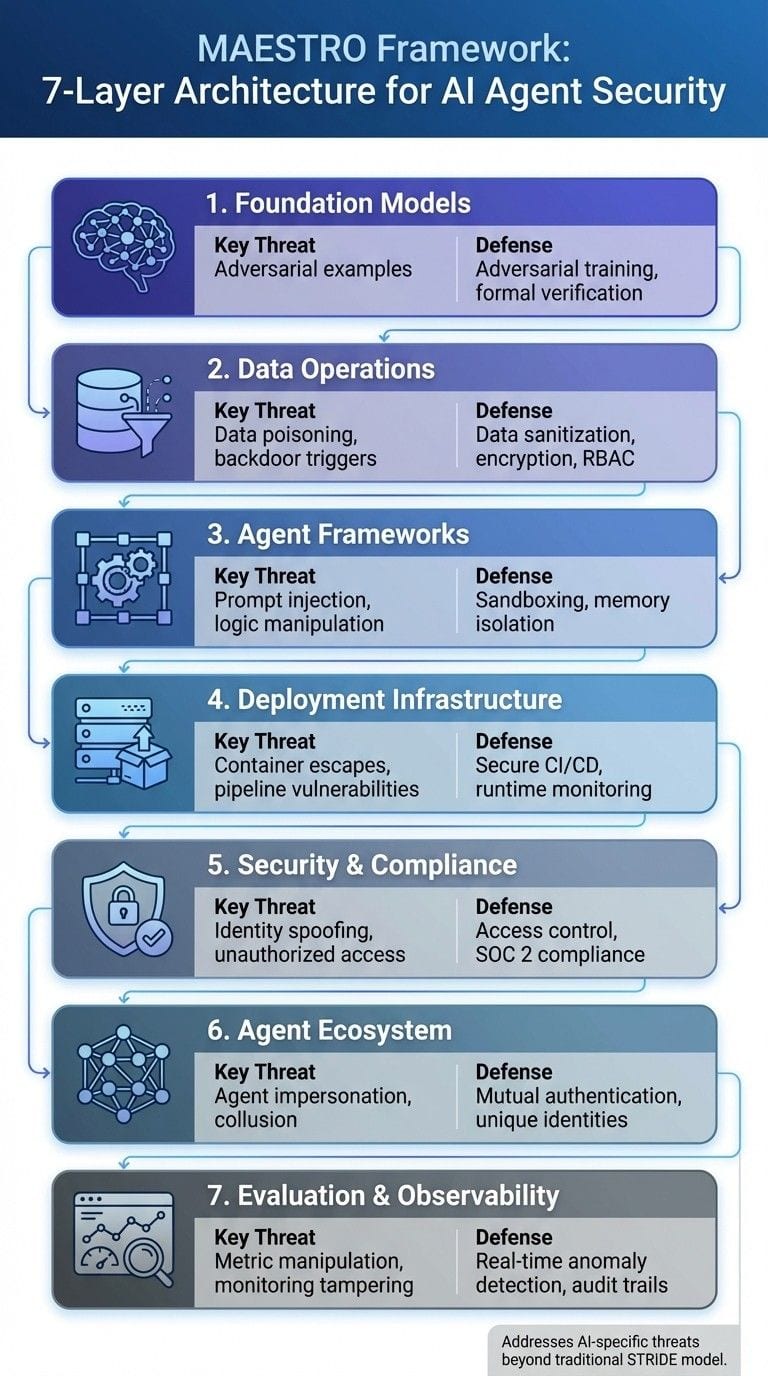
{MAESTRO Framework 7-Layer Architecture for AI Agent Security}
MAESTRO Architecture and Layers
The 7 Layers of MAESTRO
MAESTRO's architecture is designed to tackle the evolving security challenges of AI systems with a structured, layered approach. By breaking down AI agent systems into seven distinct layers, MAESTRO focuses on isolating vulnerabilities, analyzing risks at each interaction point, and implementing precise security measures.
These seven layers include:
- Foundation Models: The core of AI capabilities, powering the system's intelligence.
- Data Operations: Responsible for data ingestion, processing, and storage.
- Agent Frameworks: Tools that enable development, reasoning, and decision-making processes.
- Deployment Infrastructure: The runtime environments that host and execute the agents.
- Security and Compliance: Ensures access controls, regulatory adherence, and system integrity.
- Agent Ecosystem: Manages interactions between agents and their integration with business systems.
- Evaluation and Observability: Monitors system performance, tracks threats, and ensures operational transparency.
This layered breakdown allows organizations to pinpoint and address specific risks. For instance, in a fraud detection system, the Agent Ecosystem layer plays a critical role in managing real-time decision-making and coordination. By organizing AI systems into these layers, MAESTRO provides a clear framework for understanding and mitigating unique security challenges.
AI-Specific Threats in MAESTRO
AI systems face a wide range of threats that go beyond traditional security models. From adversarial attacks to data manipulation, these risks target the unique characteristics of AI agents. Here’s how each layer in MAESTRO can be affected:
- Foundation Models: Adversarial examples can lead to unpredictable or harmful decisions.
- Data Operations: Vulnerable to data poisoning, where attackers inject malicious inputs or backdoor triggers into training datasets.
- Agent Frameworks: Susceptible to prompt injection attacks that manipulate agent logic.
- Deployment Infrastructure: At risk from container escapes or vulnerabilities in deployment pipelines.
- Agent Ecosystem: Faces threats like agent impersonation or collusion between multiple agents.
- Security and Compliance: Must defend against identity spoofing and unauthorized access.
- Evaluation and Observability: Can be compromised if attackers manipulate metrics or tamper with monitoring systems.
Real-world examples highlight the urgency of these threats. For instance, telemetry delays or increased computational loads have been observed as warning signs of attacks. By leveraging MAESTRO, organizations have implemented measures like memory isolation and real-time anomaly detection to address these issues effectively.
How MAESTRO Extends Traditional Threat Models
Traditional models like STRIDE focus on static risks, which fall short when dealing with the adaptive and dynamic nature of AI agents. MAESTRO goes further by introducing a layered approach that considers AI-specific threats and their cascading effects across different layers.
For example, a vulnerability in a Foundation Model - such as model extraction - could lead to exploitation in the Agent Ecosystem, enabling malicious collusion. Static models often miss these cross-layer risks, but MAESTRO’s framework ensures they are addressed.
In addition to identifying risks, MAESTRO emphasizes adaptive mitigation strategies, including:
- Formal Verification: Ensuring systems work as intended under all circumstances.
- Explainable AI: Enhancing transparency in decision-making.
- Adversarial Training: Preparing models to resist attacks.
- Red Teaming: Simulating attacks to uncover weaknesses.
- Mutual Authentication: Strengthening agent-to-agent communication.
- Runtime Safety Monitoring: Continuously tracking and addressing threats during operation.
Applying MAESTRO to AI Agent Systems
Foundation Models and Data Operations
At the heart of AI agent security lie foundation models and data operations. These layers face threats like adversarial examples, which can distort model predictions, and data poisoning, where training data is tampered with to inject backdoor triggers into self-learning agents. Through the MAESTRO framework, vulnerabilities such as delayed telemetry and increased computational loads have been identified, often stemming from insufficient system adaptations.
To counter these risks, strategies like adversarial training, formal verification, and rigorous data sanitization are essential. Incorporating explainable AI (XAI) allows for thorough decision auditing, ensuring transparency. Additionally, safe fine-tuning practices, paired with robust data access controls - such as encryption and role-based permissions - help prevent sensitive information leaks during operations. By aligning with MAESTRO's layered defense approach, these measures effectively strengthen each segment of the AI system.
Next, let’s examine how agent frameworks and deployment infrastructures are vulnerable to exploitation and the steps needed to secure them.
Agent Frameworks and Deployment Infrastructure
The agent frameworks layer is particularly susceptible to attacks like manipulation of orchestration logic, where decision-making processes are altered, and insecure MCP endpoints, which can grant unauthorized access. In some cases, prompt injection attacks have even disabled fraud monitoring systems embedded in business logic[5].
To address these threats, techniques such as sandboxing are critical for isolating agent execution environments. Implementing mutual authentication for all agent interactions ensures secure communication. Secure CI/CD pipelines can safeguard operations from tampering, while memory isolation and real-time anomaly detection are invaluable for identifying and mitigating suspicious activities before they escalate. Continuous monitoring of deployment infrastructure is also necessary to uncover cross-layer risks, where vulnerabilities in one layer could compromise others. These steps uphold MAESTRO's focus on adaptive, real-time threat mitigation across its seven-layer framework.
Beyond addressing core model vulnerabilities and deployment risks, securing the broader agent ecosystem requires enhanced visibility and compliance measures tailored to AI systems.
Security, Compliance, and Agent Ecosystems
Multi-agent ecosystems present unique challenges, including communication channel attacks through intercepted messages, identity spoofing in multi-agent interactions, and hierarchical compromises, where higher-level agents maliciously control subordinate agents. Standard authentication methods often fall short for autonomous agents, leaving governance gaps.
Prefactor steps in to tackle these issues with tools like real-time visibility, detailed audit trails, and compliance controls designed specifically for managing AI agents. Prefactor assigns unique, secure identities to agents, enabling scoped and auditable access under human oversight. Its SOC 2 compliance and seamless integration with OAuth/OIDC-based identity solutions help organizations bridge the accountability gap - a gap that contributes to the failure of 95% of agentic AI projects. As one CTO from a venture-backed AI firm explained:
"The biggest problem in MCP today is consumer adoption and security. I need control and visibility to put them in production".
Organizations can define agent access policies directly within CI/CD pipelines, making them versioned, testable, and reviewable, just like other infrastructure components. These efforts align with MAESTRO's mission of adaptive, real-time threat mitigation across every interaction within the agent ecosystem.
Implementing MAESTRO for AI Agent Authentication and MCP Security
AI Agent Identities and Trust Boundaries
AI agents should be treated as fully recognized identities. Each agent - whether it's a planner, worker, or system - must have a verifiable identity tied to cloud IAM constructs like AWS IAM roles, Azure managed identities, or service accounts. This setup ensures mutual authentication and accountability in multi-agent environments where agents interact with tools, APIs, and other agents.
To maintain security, establish clear trust boundaries by enforcing secure communication protocols between agents. Each agent's permissions, such as allowed tools, data access scopes, and transaction limits (e.g., a $10,000 daily spending cap), should be well-documented. Creating data flow diagrams that map interactions - like user ↔ agent, agent ↔ MCP tool server, and agent ↔ external APIs - helps identify vulnerabilities such as spoofing, tampering, or privilege escalation.
Role-based access controls (RBAC) play a key role here, assigning specific permissions to agent identities based on their tasks. For example, a data-querying agent might only have read-only access, while an action tool might have execute-only rights. Combining RBAC with mutual authentication reduces the risk of compromised higher-level agents taking control of subordinate ones.
Securing MCP Tools and Interactions
Once agent identities and trust boundaries are established, the next step is securing MCP tool interactions. These tools are vulnerable to risks like over-privileged access, injection attacks, and tampering with inter-agent messages. For instance, prompt injection attacks have been known to disable fraud monitoring systems embedded in business logic. MAESTRO addresses these risks by authenticating tools using agent identities, enforcing fine-grained permissions (e.g., limiting a payment tool to approve-only transactions under $1,000), and validating inputs.
Fine-grained permissions are critical to following the principle of least privilege. For example, an email tool might only be allowed to send messages to pre-approved domains, or an API tool might be restricted to specific HTTP methods and resource paths. Implementing these controls requires breaking down the system according to MAESTRO's layers, identifying threats specific to each tool, applying role-based permissions at the tool level, and validating them during runtime to minimize false positives in monitoring.
For MCP integrations, agents should authenticate using methods like OAuth 2.0 client credentials, mutual TLS, or signed requests. Meanwhile, tool endpoints should be secured with pinned certificates, schema validation, and enforced rate limits. Red teaming exercises can simulate injection scenarios, helping refine permissions before live deployment.
Using MAESTRO in Production Operations
With secured agent identities and MCP interactions in place, production operations require robust measures to maintain these defenses. MAESTRO's layered security framework is directly implemented in production environments. Prefactor, for instance, applies MAESTRO controls by assigning unique identities to agents, integrating RBAC for MCP tools, and enforcing trust boundaries with real-time authentication. The platform supports OAuth/OIDC-based identity solutions like Auth0, Okta, and Firebase, enabling agents to securely access APIs programmatically. Organizations can also define agent access policies within CI/CD pipelines, ensuring these policies are version-controlled, testable, and reviewable.
Kill switches provide an immediate way to stop abnormal agent behavior, while real-time monitoring identifies threats across multiple layers, such as injection attempts. Comprehensive audit trails log all authentications and tool interactions with precise timestamps (e.g., 03/15/2025 2:05:33 PM), ensuring compliance and accountability. Prefactor’s SOC 2 compliance and detailed agent-level audit trails address the accountability gap that contributes to the high failure rate - 95% - of agentic AI projects.
In one network monitoring study using MAESTRO, robust identity modeling and clearly defined trust boundaries successfully prevented performance issues caused by adversarial attacks. The study reported reduced telemetry delays through memory isolation and improved real-time anomaly detection, demonstrating MAESTRO's effectiveness in ensuring secure MCP communications.
Automated Threat Modeling in Agentic AI: Maestro Framework + 7-Layer System Analysis
Conclusion
MAESTRO reshapes the way we approach threat modeling for dynamic AI agent systems. By using a multi-layered framework, it provides a structured way to secure AI agents from the initial design phase through deployment. This approach uncovers vulnerabilities that traditional methods often overlook, such as data poisoning, multi-agent collusion, and tool misuse, offering a deeper level of protection.
Its layered design has been tested in practical scenarios, proving its effectiveness. For instance, research using MAESTRO on network-monitoring agents revealed vulnerabilities that caused issues like delayed telemetry and higher computational demands. One study highlighted MAESTRO's capability as "viable in operational threat mapping, prospective risk scoring, and the basis of resilient system design," showing that defense strategies like memory isolation and adaptation-logic monitoring can mitigate risks effectively.
To implement MAESTRO, start by breaking down your agent architecture into layers, then assess risks both within each layer and across layers. Regularly update your mitigation strategies as agents evolve. This is not a one-time task - AI agents change over time, introducing new risks with every model update, tool integration, or workflow adjustment. Platforms like Prefactor make this process seamless by enabling real-time visibility and secure operations through MAESTRO's controls.
Prefactor’s Agent Control Plane enhances MAESTRO's capabilities by using unique agent identities, role-based access for MCP tools, real-time authentication enforcement, and SOC 2-compliant audit trails that log every action with precise timestamps. These features address the accountability issues that contribute to the high failure rates - up to 95% - of agentic AI projects.
To secure your AI agents, map your architecture to MAESTRO’s layers, focus on high-impact threats, and establish continuous monitoring. These steps will help you detect anomalies at scale and ensure the security of your deployments.
FAQs
What makes the MAESTRO framework different from traditional threat models like STRIDE?
The MAESTRO framework takes a targeted approach to tackle the specific security challenges posed by agentic AI systems. Unlike traditional models such as STRIDE, which offer broad threat classifications, MAESTRO zeroes in on the intricate dynamics of autonomous agents working within multi-agent environments.
Key features of MAESTRO include real-time visibility, comprehensive audit trails, and robust governance systems. These elements enable organizations to maintain security and compliance on a large scale. This makes MAESTRO especially effective for businesses deploying AI agents in live production settings, where flexibility and operational control are essential.
What security measures does the MAESTRO framework suggest for safeguarding AI agent systems?
The MAESTRO framework emphasizes several critical security measures to safeguard AI agent systems. It suggests using robust authentication methods, such as multi-factor authentication (MFA), dynamic client registration, and social login options. To simplify identity management, integrating with well-known identity providers like Auth0 or Okta is highly recommended.
Another key focus is on role-based access control (RBAC), which ensures that both users and agents only have access to the specific resources they need. The framework also highlights the importance of maintaining detailed audit trails and implementing real-time monitoring. These measures help organizations track activities effectively, maintain operational oversight, and meet security and compliance requirements.
How does the MAESTRO framework prevent multi-agent impersonation in AI systems?
The MAESTRO framework addresses the challenge of multi-agent impersonation by giving each AI agent a secure and independent identity. Using MCP authentication, it ensures that every agent is uniquely identifiable, significantly reducing the chances of impersonation.
This method improves both oversight and management, equipping organizations with the ability to monitor their AI agents closely while protecting against potential security risks.