
PKCE (Proof Key for Code Exchange) is a critical security measure in OAuth 2.1, designed to protect authorization code flows from interception and misuse. This is especially important for AI agents, which often operate in environments without secure client secret storage. Here's what you need to know:
- What PKCE Does: Adds a cryptographic challenge-response mechanism to ensure intercepted authorization codes cannot be misused.
- Why AI Agents Need It: AI agents are "public clients" that can't securely store secrets, making them vulnerable to attacks. PKCE mitigates these risks.
- How to Implement: Generate a secure code verifier and challenge for every session, use the
S256hashing method, and enforce PKCE on both client and server sides. - Best Practices: Issue short-lived tokens, validate redirect URIs, monitor agent behavior for anomalies, and log PKCE events for auditing.
PKCE Implementation Best Practices for AI Agents
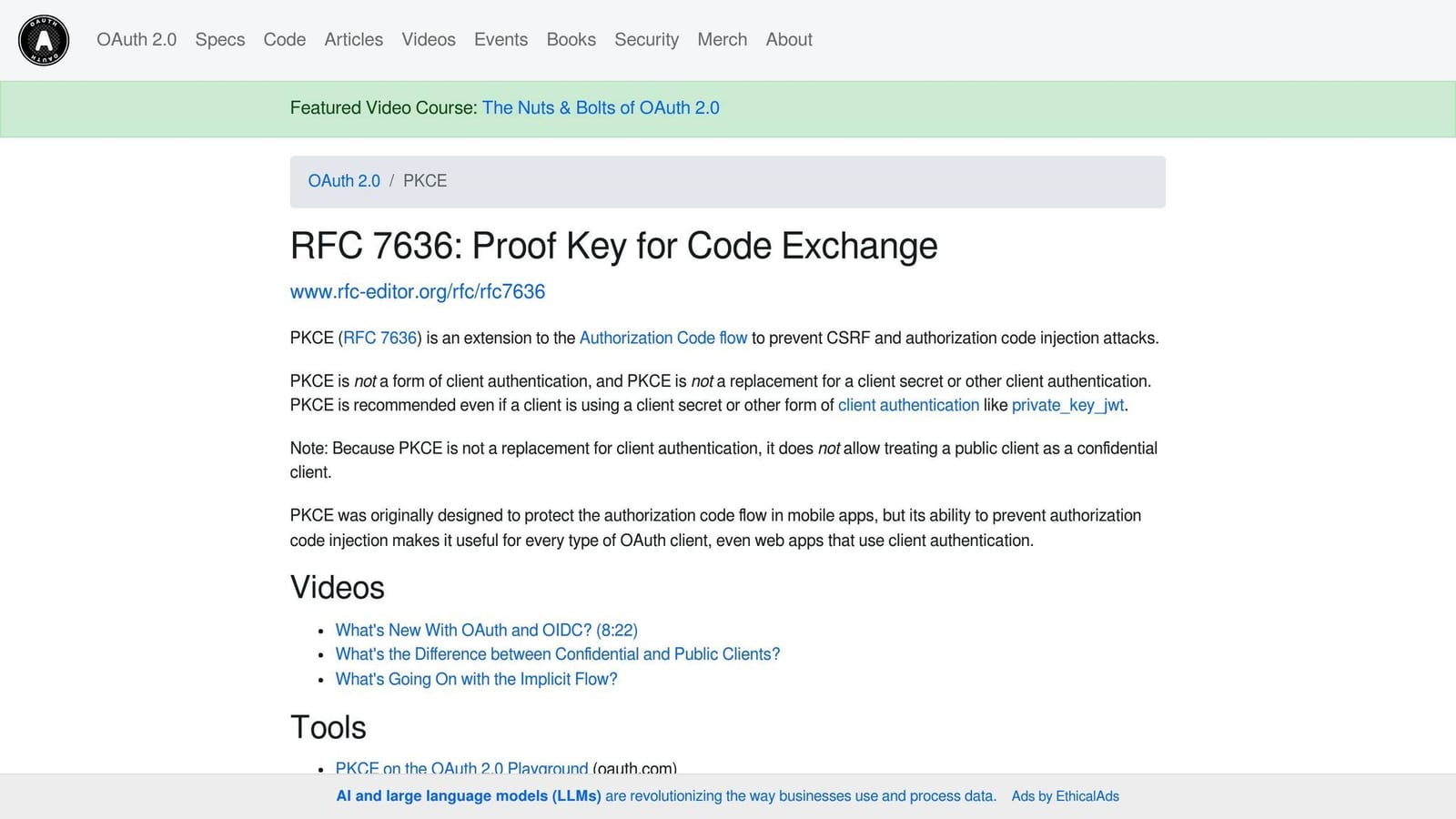
Require OAuth 2.1 with PKCE
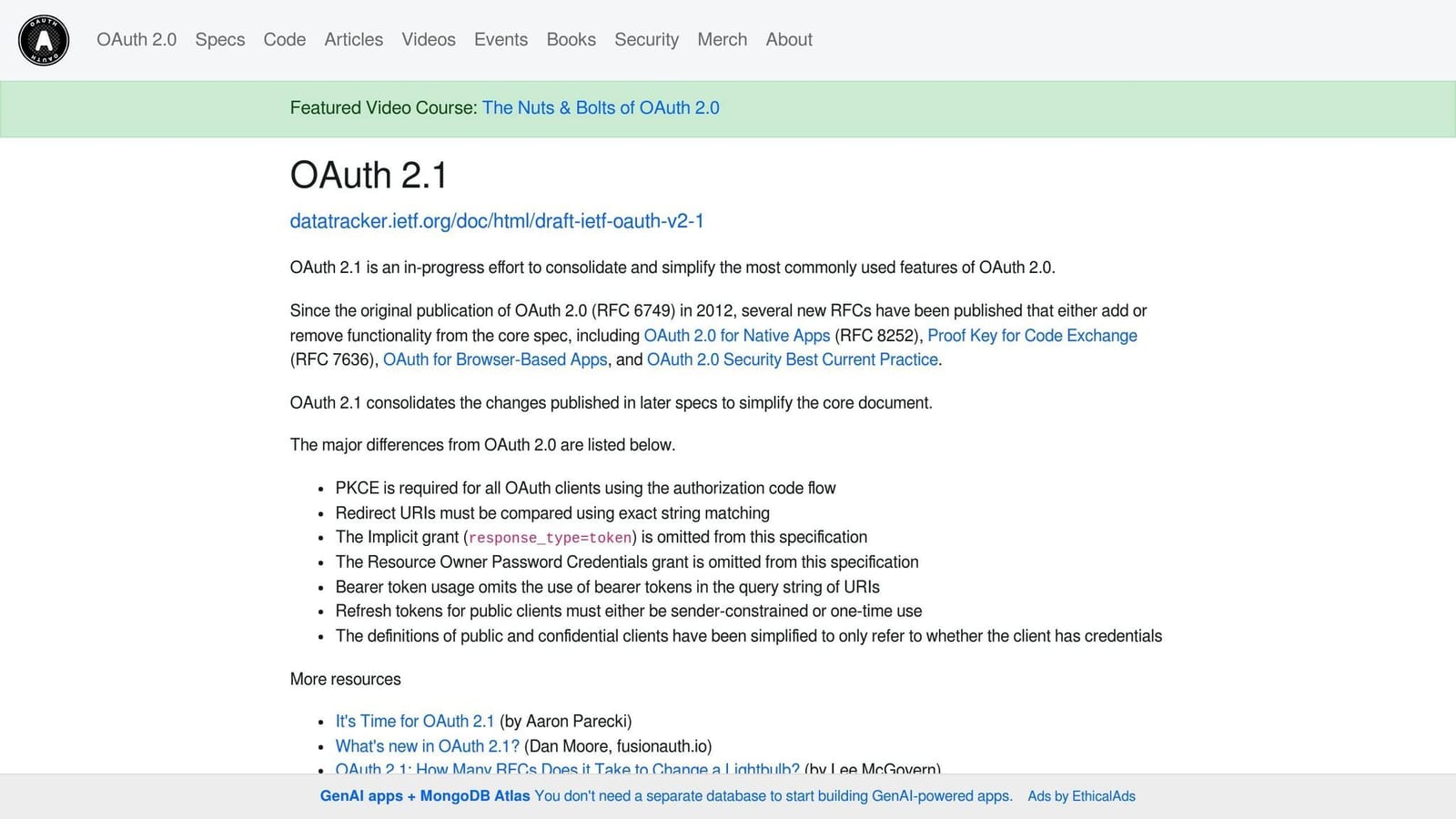
OAuth 2.1 mandates the use of PKCE for all authorization code flows, regardless of whether your AI agent operates as a public or confidential client. This requirement ensures that each transaction is independently safeguarded. Even if an attacker manages to intercept the authorization code - through a malicious redirect, log leak, or man-in-the-middle attack - they won’t be able to exchange it for tokens without the correct verifier.
For AI agents running in environments like containers, CI/CD pipelines, or orchestrated clusters, enforcing PKCE eliminates the risks tied to static client secrets. By adding this extra layer of protection, PKCE helps guard against potential compromises at the network or host level.
Start by generating secure PKCE parameters before initiating the authorization process.
Generate Secure Code Verifier and Challenge
To create a secure code verifier, use a cryptographically secure pseudorandom number generator (CSPRNG) to produce a high-entropy, URL-safe string between 43 and 128 characters. A common method is generating 32 random bytes with a CSPRNG and then encoding them in base64url format without padding.
Next, derive the code challenge by applying a SHA-256 hash to the verifier and encoding the result in base64url format (again, without padding). Always use the S256 method for this step, as the plain method is not secure.
Each authorization transaction should have a unique verifier and challenge pair. Avoid reusing these values across sessions or sharing them between different agent instances. To minimize risks, store the verifier in ephemeral memory tied to the active transaction, avoiding persistent storage or logs. In high-scale environments with multiple agent instances, ensure each instance uses its own CSPRNG to prevent replay attacks or confusion between agents.
Use Authorization Code Flow with PKCE
A secure implementation separates front-channel and back-channel operations. Start by generating your PKCE parameters on the AI agent's backend. Then, initiate the front-channel authorization request by directing the user or operator to the authorization server's /authorize endpoint. Include parameters such as:
response_type=codeclient_idredirect_uriscopestatecode_challengecode_challenge_method=S256
Once the user authenticates and grants consent, the authorization server will redirect to your registered redirect_uri, including the authorization code and state parameter. Immediately validate the state to prevent CSRF attacks. Next, securely communicate with the token endpoint over HTTPS. Include the authorization code, redirect URI, any required client authentication (for confidential clients), and the code verifier in this request. Keep the verifier secure and confined to this channel to prevent interception.
Issue Short-Lived and Scoped Tokens
After completing the authorization process, focus on secure token management. Access tokens should have a short lifespan - typically 5 to 15 minutes - to limit potential damage if a token is leaked. Use granular scopes to define specific permissions, such as agent:read:customer or agent:write:logs, and request only the minimum access required for the task.
For long-term access, use refresh tokens with strong client authentication and PKCE. Implement refresh token rotation and monitor for unusual patterns, such as token reuse or access from unexpected locations. If irregularities are detected, revoke the tokens immediately. This approach balances tight security with stable and efficient authorization.
Integrate Prefactor for PKCE Management
To simplify and enhance PKCE handling, consider integrating Prefactor’s infrastructure. Prefactor automates PKCE management for AI agents through its MCP-compliant authentication platform. This solution eliminates common errors in manual token handling and seamlessly integrates with your existing OAuth/OIDC systems. It enables AI agents to securely and programmatically access APIs and applications while maintaining full PKCE protection.
Securing AI Authentication: A developer’s guide to MCP auth
Common PKCE Implementation Mistakes and How to Fix Them
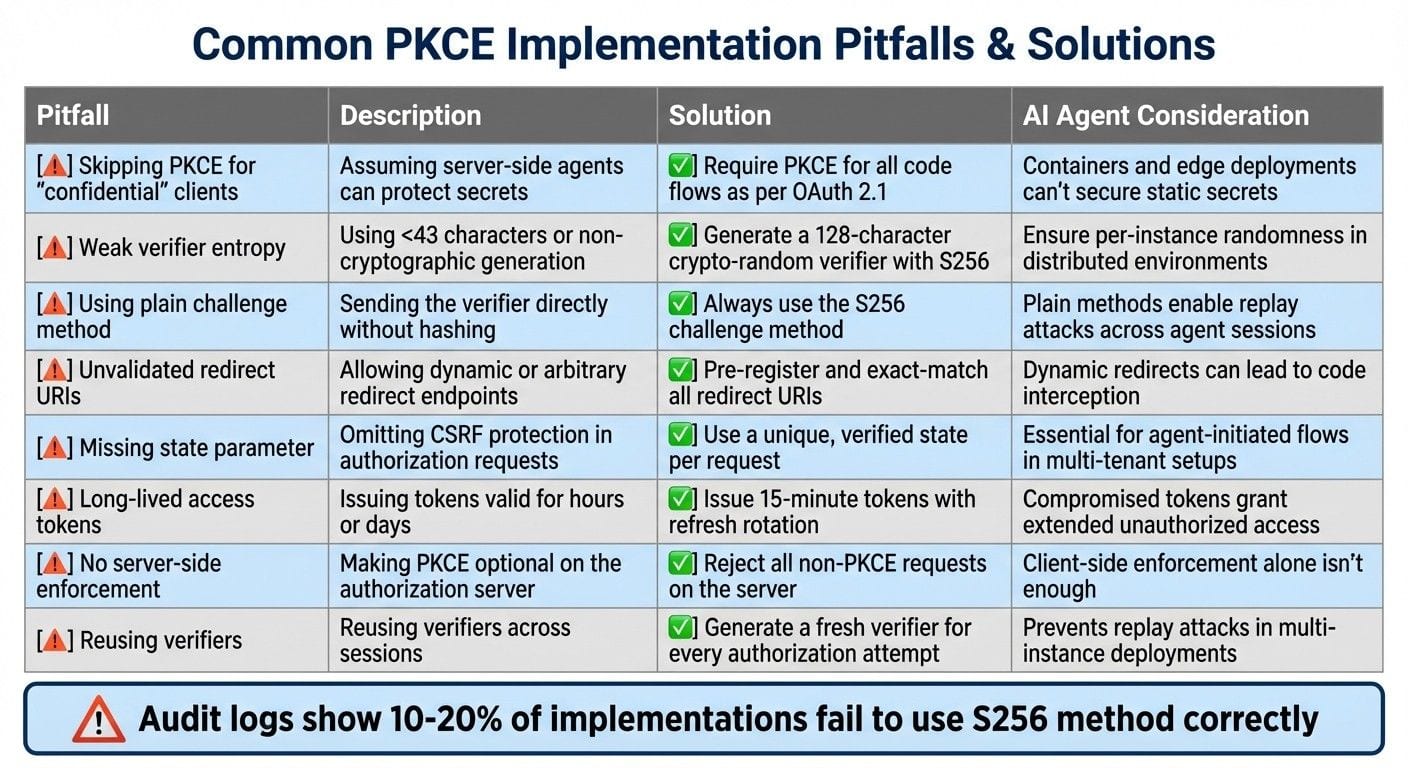
{Common PKCE Implementation Mistakes and Solutions for AI Agents}
Mistakes in PKCE (Proof Key for Code Exchange) implementation can leave authorization flows vulnerable to attacks like token theft, interception, and unauthorized access. To build a secure authentication system, it’s crucial to understand these common pitfalls and how to address them.
One frequent error is skipping PKCE for server-side AI agents, under the assumption that these agents can safely store client secrets. However, in distributed and dynamic environments like containers or backend services, secrets are rarely secure, making code interception a real threat - even for server-side applications.
Another issue is the use of weak code verifiers. Short strings (fewer than 43 characters), predictable random number generators, or deterministic seeds can make verifiers insecure. To avoid this, ensure that your verifier has high entropy and is generated using proper cryptographic methods.
Below is a table summarizing some common PKCE pitfalls and their solutions:
Pitfalls and Solutions Table
Pitfall | Description | Solution | AI Agent Consideration
Skipping PKCE for "confidential" clients | Assuming server-side agents can protect secrets | Require PKCE for all code flows as per OAuth 2.1 | Containers and edge deployments can't secure static secrets
Weak verifier entropy | Using <43 characters or non-cryptographic generation | Generate a 128-character crypto-random verifier with S256 | Ensure per-instance randomness in distributed environments
Using plain challenge method | Sending the verifier directly without hashing | Always use the S256 challenge method | Plain methods enable replay attacks across agent sessions
Unvalidated redirect URIs | Allowing dynamic or arbitrary redirect endpoints | Pre-register and exact-match all redirect URIs | Dynamic redirects can lead to code interception
Missing state parameter | Omitting CSRF protection in authorization requests | Use a unique, verified state per request | Essential for agent-initiated flows in multi-tenant setups
Long-lived access tokens | Issuing tokens valid for hours or days | Issue 15-minute tokens with refresh rotation | Compromised tokens grant extended unauthorized access
No server-side enforcement | Making PKCE optional on the authorization server | Reject all non-PKCE requests on the server | Client-side enforcement alone isn't enough
Reusing verifiers | Reusing verifiers across sessions | Generate a fresh verifier for every authorization attempt | Prevents replay attacks in multi-instance deployments
Audit logs have shown that 10–20% of implementations fail to use the S256 method correctly, and some systems have no PKCE adoption at all. For AI agents, logging key details such as the code challenge method, verifier entropy (hashed), agent ID, and instance identifier can help identify and resolve configuration errors before they escalate into security issues.
Auditing and Monitoring PKCE Flows in AI Environments
Setting up PKCE is just the beginning. Without proper auditing and monitoring, vulnerabilities can slip through unnoticed, potentially leading to security incidents. By keeping a close eye on PKCE flows, you can identify insecure usage or exploitation attempts before they become serious problems.
Log and Audit PKCE Parameters
Your authorization server needs to log every PKCE-related event in detail, allowing you to piece together the flow during an investigation. Key elements to capture include:
- Authorization requests: Log the
client_id(oragent_id),redirect_uri, scopes,code_challenge,code_challenge_method, and the timestamp (in UTC). - Token exchanges: Record the
authorization_code, verification results, token identifiers, token time-to-live (TTL), and any relevant error codes (e.g.,invalid_grant,invalid_request).
Avoid logging the raw code_verifier. Instead, store its hashed version or relevant metadata. Additionally, correlate PKCE events with runtime context, such as the agent's workload ID, IP address, user-agent string (e.g., "LangChain agent v0.2.5"), and deployment details. This contextual data ties authorization activities to specific deployments, making incident response faster and more efficient.
Once your logs are in place, the next step is monitoring for unusual agent behavior.
Monitor Agent Behavior for Anomalies
Tools like Prefactor provide built-in agent-level audit trails, giving you visibility into every action an agent performs. Start by establishing a baseline for each agent. Track typical patterns such as scope requests, token usage frequency, target APIs, and expected operating hours. Then, watch for deviations from these norms. Examples of anomalies that should raise red flags include:
- Repeated PKCE verification failures from the same agent.
- Sudden increases in token requests.
- Unexpected scope escalations.
- Tokens being used from unfamiliar IP addresses or environments.
Integrate PKCE telemetry into your SIEM or observability tools to cross-reference authorization anomalies with other signals, like network activity, host behavior, or changes in workload identity. For instance, if an agent starts requesting tokens from a new cloud region or outside its usual CI/CD pipeline schedule, it’s a sign that further investigation is needed.
Test PKCE in AI Agent Frameworks
Logging and monitoring are crucial, but pre-production testing is equally important to ensure your PKCE implementation works as expected. Before deploying agents built with frameworks like LangChain or CrewAI, conduct thorough integration tests with a test identity provider. Here's what to verify:
- The framework generates
code_verifierandcode_challengevalues that comply with RFC 7636 standards (correct length, sufficient entropy, allowed characters, and default use of S256). - Authorization codes cannot be redeemed without the correct verifier. Any mismatch should result in rejection and be logged.
In a staging environment, simulate potential threats like intercepted authorization codes, replay attacks, altered code_challenge values, or mismatched redirect_uri parameters. Ensure your monitoring system flags each scenario. For headless agents, confirm that PKCE is consistently enforced and that no client_secret is hardcoded into the agent’s image or code.
Lastly, verify token behavior. Check that short-lived tokens and refresh tokens rotate as expected, with logs capturing each lifecycle event. This ensures your logging and monitoring setup is ready to detect irregularities before live agents - and potential attackers - interact with the system.
Conclusion
PKCE has become a core safeguard for securing OAuth flows, effectively preventing code interception and token theft. For autonomous AI agents that scale quickly and act as public clients without the ability to securely store secrets, PKCE offers the cryptographic protection needed to ensure that only the original agent can exchange the authorization code for tokens.
To establish a strong security foundation, consider these key practices: always use the Authorization Code Flow with PKCE, create high-entropy code verifiers using the S256 challenge method, issue short-lived and scoped tokens, rigorously validate redirect URIs, and maintain thorough logging and monitoring of PKCE parameters and agent activity. These measures can significantly reduce the risks posed by network attacks, misconfigurations, and token leaks, while creating a consistent and secure framework for integrating specialized platforms.
Prefactor simplifies PKCE management by automating critical tasks like code verifier generation, challenge computation, and enforcement across various runtimes. It supports MCP-compliant agents, offers multi-tenant access, and provides detailed audit trails at the agent level. This allows organizations to scale AI agents confidently while maintaining scoped and auditable access that meets compliance and investigation requirements.
Think of PKCE as a flexible control that must adapt alongside your AI environment. Regularly assess token lifetimes, scopes, and monitoring practices as your agents become more advanced. Align OAuth configurations for your AI agents with zero-trust and least-privilege principles. By ensuring strong PKCE processes, implementing scoped token policies, and maintaining vigilant monitoring, you can secure your AI agents effectively while minimizing risk.
FAQs
Why is PKCE important for securing AI agents in OAuth 2.1?
PKCE is a key security feature in OAuth 2.1, designed to protect AI agents from authorization code interception attacks. By ensuring that only authorized agents can exchange authorization codes for tokens, it helps secure sensitive operations across large-scale systems.
In environments where AI agents navigate complex interactions, PKCE strengthens OAuth flows by adding an additional safeguard. This extra security is essential for maintaining trust and meeting compliance standards in machine-to-machine communications.
What are the best practices for securely implementing PKCE in OAuth for AI agents?
To securely set up PKCE in OAuth flows for AI agents, begin by creating a unique, high-entropy code verifier for every authorization request. This verifier is then used to generate a secure code challenge, which should be properly hashed and sent to the authorization server. When exchanging tokens, ensure the code challenge is verified to maintain the integrity of the request.
Consider using platforms designed specifically for AI agent authentication. These platforms often include features like identity management tailored to agents, scoped access controls, and adherence to protocols like the Machine Client Protocol (MCP). Such tools can streamline the process of implementing PKCE while boosting security and scalability.
What are the most common mistakes when using PKCE for AI agent authentication?
Some common pitfalls when implementing PKCE for AI agents include:
- Mishandling code verifiers and challenges: Not generating high-entropy code verifiers or improperly verifying code challenges can expose vulnerabilities.
- Reusing code challenges: Every OAuth flow must have a unique code challenge to uphold security standards.
- Skipping or weakening validations: Failing to validate the code challenge method or omitting essential checks can undermine the entire process.
- Inconsistent application: Using PKCE unevenly across OAuth flows can create security gaps.
To safeguard AI agents, it's crucial to stick to best practices. This includes generating strong, unique values and thoroughly validating each step of the process. By doing so, you can ensure robust authentication and prevent unauthorized access.