
Machine identities - like API keys, service accounts, and AI agents - now outnumber human users in many organizations. These identities power automation, integrations, and cloud operations, but they also pose unique security risks. Unlike human accounts, they rely on static credentials, often lack proper oversight, and can become "orphaned" or overprivileged, leaving systems vulnerable to breaches.
Key Takeaways:
- What are Non-Human Identities? Digital credentials for machines, such as API keys, OAuth tokens, and cloud service accounts.
- Main Risks: Secrets sprawl, over-permissioned accounts, and orphaned credentials.
- AI Agent Risks: Tool-chaining and broad delegated access can lead to unintended exposure.
- Steps to Mitigate Risks:
- Build an inventory of all machine identities.
- Rotate and secure credentials using tools like AWS Secrets Manager.
- Enforce least privilege and monitor anomalies.
- Assign ownership to every identity for accountability.
Start managing machine identities like human accounts: secure credentials, monitor behavior, and enforce strict governance. AI agents, in particular, need scoped access and detailed audit trails. Platforms like Prefactor simplify this process by automating secure identity management.
The Non-Human Identity Risk Landscape
Types of Non-Human Identities
In today's digital ecosystems, various types of machine identities play critical roles, each with its own authentication methods and risk factors. Let’s break them down:
- API keys and tokens are the backbone of modern integrations. Picture a GitHub API token authenticating your CI/CD pipeline or a Stripe key embedded in your payment processing script. These credentials are typically static and long-lived, relying on bearer tokens instead of interactive logins.
- SaaS service accounts operate within platforms like Salesforce, Slack, or Office 365. These accounts often skip single sign-on processes and are granted administrative permissions for tasks like workflow automation, data syncing, or scheduled jobs. Unlike human accounts linked to HR systems, these identities are usually created on the fly by teams and lack a structured provisioning process.
- Cloud-managed identities - such as AWS IAM roles, Azure managed identities, and GCP service accounts - use temporary credentials or instance metadata for authentication. These identities require precise permission scoping to minimize risks.
- AI agents and automation bots represent the fastest-growing category of machine identities. These agents manage workflows, chain API calls, and frequently operate with delegated user access. For instance, a customer support AI agent might pull customer data from your CRM, update tickets, and post summaries to chat platforms - all while using OAuth tokens or service credentials. According to industry data, machine identities are multiplying at a rate 2–3 times faster than human identities as companies increasingly adopt microservices, APIs, and automation-driven solutions.
Recognizing these identity types is the first step in understanding the risks tied to their mismanagement.
Key Risk Factors
Once you’ve identified the different types of machine identities, it’s essential to address the risks that come from poor oversight and mismanagement. Here are the main concerns:
- Secrets sprawl: API keys, tokens, and other credentials often end up scattered across code repositories, CI/CD configurations, wikis, and even local developer machines. A single leaked key - especially in a public repository - can provide attackers with ongoing access to critical systems. This is one of the leading causes of cloud and SaaS breaches.
- Over-privileged identities: When machine identities are granted more permissions than necessary, they become high-risk targets. For example, a CI pipeline with full admin rights to your cloud account can exponentially increase the damage if compromised. Research shows that over 90% of cloud permissions go unused, highlighting widespread over-permissioning across both human and non-human identities.
- Orphaned accounts: These are machine accounts and API keys that remain active long after their original purpose has ended. Whether tied to retired projects, replaced vendors, or departed developers, these credentials often linger without an assigned owner. Without regular key rotation or permission reviews, orphaned identities are prime targets for abuse. As Veza notes, most non-human identities lack explicit ownership, leading to unrotated keys and unchecked permissions.
Microsoft emphasizes that non-human identities are "frequently overprivileged and overlooked", making them particularly vulnerable in environments that may house thousands - or even millions - of such identities.
AI Agent-Specific Risks
Among the various types of machine identities, AI agents present distinct challenges. Their autonomous decision-making and delegated access introduce new layers of risk:
- Tool-chaining behavior: AI agents often decide dynamically which tools, APIs, or data to access based on prompts and context. This flexibility can lead to unintended permission combinations. For instance, an agent granted OAuth access to both your calendar and file storage might accidentally expose sensitive meeting notes in a shared document.
- Delegated access risks: When AI agents act on behalf of users, they inherit those users' permissions - or, worse, are granted overly broad administrative credentials. In multi-tenant environments, where a single agent framework serves multiple customers, weak identity isolation can result in cross-tenant data access, potentially violating regulatory requirements.
As one CTO from a venture-backed AI company put it, "The biggest problem in MCP today is consumer adoption and security. I need control and visibility to put them in production".
Compliance standards like SOC 2, ISO 27001, and HIPAA now require organizations to govern all identities, including non-human ones. For AI agents, this means implementing strict tenant scoping with separate credentials or constrained permissions for each customer. Detailed audit trails at the agent level and guardrails on tool-chaining are critical to preventing unauthorized access. Platforms like Prefactor address these needs by offering secure agent logins, scoped OAuth/OIDC integrations, and adherence to the Model Context Protocol (MCP), ensuring AI agents operate with dedicated, secure identities rather than repurposed human credentials.
Agentic AI and Non-Human Identity Risks | Mike Towers | NHI Summit 2025
How to Assess Non-Human Identity Risks
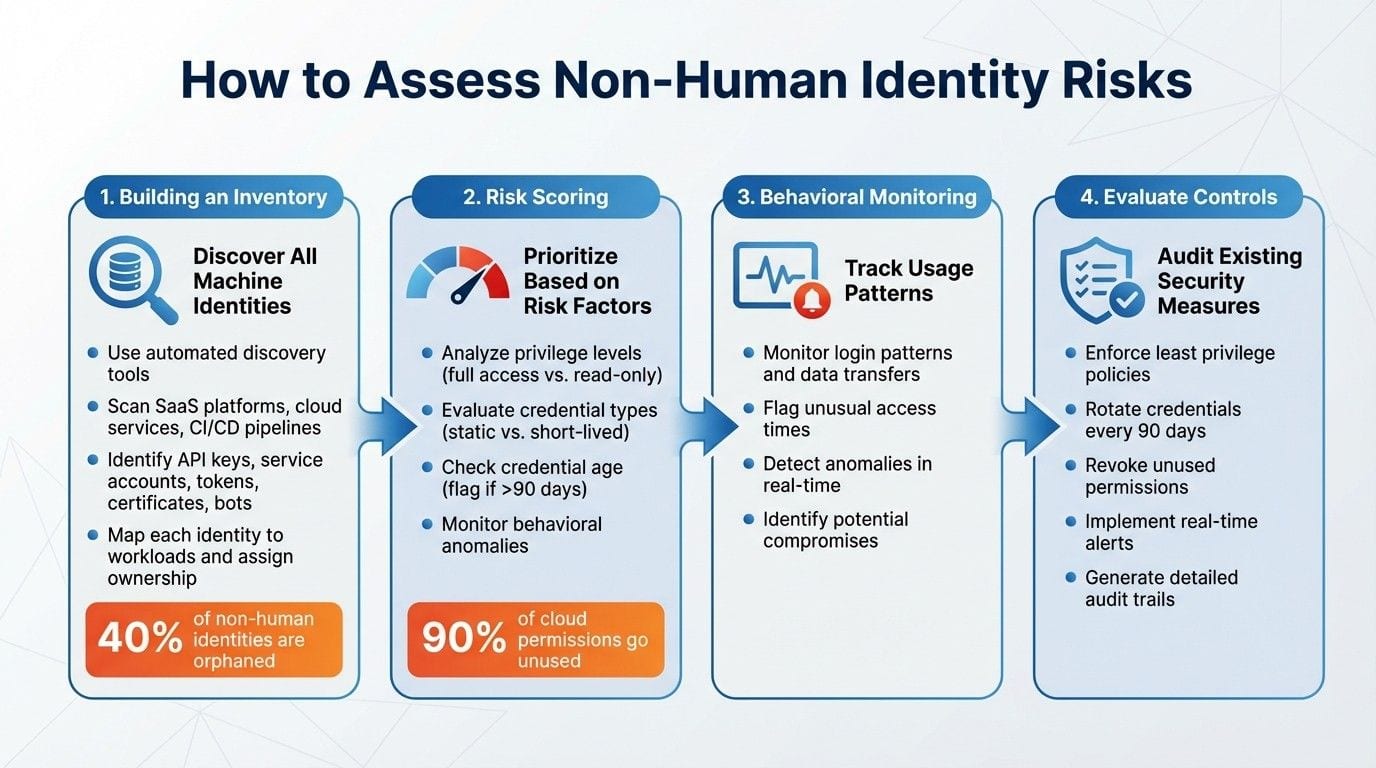
{4-Step Process to Mitigate Non-Human Identity Risks}
Building an Inventory
The first step in managing non-human identity risks is creating a detailed inventory of all non-human identities in your system. Automated discovery tools are key here - they can scan your entire environment, covering everything from SaaS platforms like Salesforce and Slack to cloud services like AWS IAM roles and CI/CD pipelines such as GitHub Actions. These tools can identify every API key, service account, token, certificate, and bot in your system. By integrating with identity providers and cloud APIs, multi-layered discovery helps uncover hidden identities that manual efforts might miss.
Once discovered, map each identity to its respective workloads and assign clear ownership. For example, link API tokens to specific applications, connect service accounts to the databases they access, and associate CI/CD bots with the repositories and deployment targets they manage. For AI agents, track OAuth tokens to their related SaaS workloads and monitor their tool-chaining activities. Research from Veza highlights that approximately 40% of non-human identities are orphaned - credentials that remain active but lack an assigned owner - making this mapping process essential for accountability. A thorough inventory not only helps you understand your environment but also lays the foundation for identifying and prioritizing risks.
Risk Scoring and Prioritization
To address the most pressing risks, assign scores to each identity based on potential threats. Start by analyzing privilege levels - a service account with full access to an S3 bucket is inherently riskier than a read-only bot. Then, evaluate the type of credentials being used. Static secrets and API keys pose higher risks compared to short-lived tokens because they don’t expire automatically. Credential age is another critical factor; keys that haven’t been rotated in over 90 days should raise serious concerns.
Behavioral monitoring is equally important. Keep an eye on login patterns and data transfer anomalies to flag high-risk identities. For example, a CI/CD bot accessing HR data outside of business hours or one with full S3 access should be prioritized for review. Real-time tracking of usage patterns can reveal potential compromises. By combining behavioral insights with static risk factors, you can pinpoint the most critical vulnerabilities and allocate resources to address them effectively.
Evaluating Existing Controls
The final step is to assess the controls you already have in place. Begin by auditing your policies to ensure they enforce the principle of least privilege. Studies show that over 90% of cloud permissions go unused, suggesting that many service accounts are over-provisioned.
Next, review your secrets management practices. Confirm that credentials are rotated automatically, preferably every 90 days, and ensure static keys aren’t stored in insecure locations like code repositories or internal wikis. Regular audits should focus on revoking unused permissions and replacing long-lived credentials with ephemeral certificates.
Finally, evaluate your monitoring capabilities. Do you have real-time alerts for unusual access patterns? Can you generate detailed audit trails to track each identity’s actions? Tracking metrics such as rotation compliance rates, the percentage of high-risk identities addressed each quarter, and the scope of your anomaly detection systems can help you measure your controls against industry benchmarks. Identifying gaps in your system before they result in breaches is critical for maintaining a secure environment.
Mitigation Strategies for Non-Human Identities
Governance and Ownership
Every non-human identity must have a specific human owner to ensure accountability. This could be a product engineer, DevOps lead, or app owner - someone responsible for tasks like reviewing permissions, rotating credentials, and managing incident responses. Without clear ownership, these identities are at risk of being overlooked, making them potential targets for attackers.
Create a centralized registry to track all non-human identities in your environment, whether they're service accounts, API keys, OAuth clients, bots, or AI agents. This registry should document each identity's owner, purpose, environment, sensitivity, and lifecycle dates. Tie this registry into your risk and compliance workflows to ensure privileged identities are reviewed at least quarterly. For AI agents, establish clear usage policies that define what data they can access, how they authenticate (e.g., OAuth/OIDC), and what actions require human approval versus autonomous execution. Tools like Prefactor can help enforce these policies by enabling fine-grained access control and built-in safeguards.
Once ownership is assigned, the next step is securing credentials effectively.
Secure Credential Management
Static credentials like API keys and passwords are risky and should be replaced with centralized secrets management tools like AWS Secrets Manager or other cloud-native services. Avoid hard-coding credentials, as this practice often leads to security breaches.
Automate credential rotation (every 30–90 days) and transition from static keys to short-lived tokens or OAuth/OIDC service principals. These modern alternatives reduce the risk of misuse by limiting the time credentials remain valid. Apply the principle of least privilege by scoping tokens and keys to specific APIs, tenants, or actions. Broad permissions, such as ":" or "full_access", should be avoided wherever possible.
For AI agents, look for platforms that support detailed scoping and offer comprehensive audit logs. For example, Prefactor integrates with OAuth/OIDC providers and supports CI/CD-driven provisioning, allowing credentials to be created, distributed, and revoked automatically in sync with infrastructure and application updates.
Securing credentials is crucial, but continuous monitoring is just as important to manage ongoing risks.
Monitoring and Response
Track all authentication events, API calls, and resource changes for non-human identities. Consolidate these logs in a SIEM or identity analytics platform to enable effective correlation and analysis. Establish behavioral baselines for high-value identities, such as typical activity hours, request volumes, and resource usage. Use anomaly detection to flag unusual behaviors, like unexpected geolocations, spikes in API calls, or attempts to access unfamiliar services.
Incorporate non-human identity data into your incident response plans. When anomalies are detected, your team should be able to quickly revoke or rotate credentials, disable or quarantine the identity, and notify the assigned human owner. For AI agents, monitor their interactions with SaaS applications and datasets, the types of actions they perform (e.g., read, write, delete, admin), and any policy violations. Detailed audit trails, like those provided by Prefactor, offer the context needed for effective investigations, helping clarify who or what performed specific actions, when, and why.
Adopt Zero Trust principles by requiring mutual TLS and continuous verification, even within private networks. Segment non-human identities into distinct projects, tenants, or network zones to limit lateral movement and minimize damage in case of a breach. Regularly conduct access reviews and check for "toxic combinations" (e.g., an identity that can both create users and assign admin roles) using IAM or CIEM tools. These steps ensure that your monitoring and response practices remain robust and adaptive.
Implementing Non-Human Identity Risk Mitigation
Building an NHI Risk Program
Creating a structured program to manage non-human identities (NHI) can be achieved within 90 days. Here's a suggested timeline:
- Weeks 1–4: Start by identifying and classifying all machine identities across your systems. This helps establish a clear inventory of what you’re working with.
- Weeks 5–8: Assign a human owner to each identity and set baseline policies. These should include rules for credential rotation intervals, least privilege access, and logging standards.
- Weeks 9–12: Focus on enforcing controls for high-risk identities. Automate credential rotation, centralize monitoring, and disable unused accounts. Remove unnecessary admin rights and consolidate credential storage to reduce risks.
To ensure long-term success, integrate NHI registration into your software development lifecycle (SDLC) and CI/CD pipelines. Every new machine identity should be assigned an owner and provisioned with least privilege access before it goes live. Treat changes to NHIs as tracked events in your IT Service Management (ITSM) tools, including risk reviews and approvals for applications with high impact.
When onboarding vendors or SaaS tools, confirm that their machine identities comply with your policies. Align NHI ownership with roles so that when someone leaves, credential rotations and access reviews are triggered automatically. These practices provide a solid framework for managing machine identities effectively.
Metrics and KPIs for Success
Tracking key metrics is essential to gauge the effectiveness of your NHI risk program. Some useful metrics include:
- Ownership coverage: Aim for 95–100% of identities to have a designated owner.
- Least-privilege compliance: Measure granted permissions against your defined policies.
- Decommissioning rates: Monitor the number of unused identities removed each month.
- Credential rotation: Track the average age of credentials and how often they’re updated.
- Detection and response times: For high-risk systems, target a Mean Time to Detect (MTTD) and Mean Time to Respond (MTTR) of 15–30 minutes.
Your targets should reflect your organization’s risk tolerance and industry requirements. For example, a U.S. financial services company under strict regulatory oversight might aim for near-perfect ownership coverage and a rapid 15-minute response time for critical issues. In contrast, a smaller SaaS startup could begin with 90–95% coverage and a 30-minute SLA, improving these benchmarks as the program matures.
To further refine your approach, classify applications and data by risk levels - such as regulated versus internal systems. Apply stricter KPIs to NHIs handling customer data or revenue-critical services. Regular reviews will help you adjust these thresholds as your tools and processes evolve.
Using Platforms for AI Agent Governance
Managing large numbers of machine identities can be challenging, but AI agent governance platforms like Prefactor can simplify the process while improving security. Prefactor works with OAuth/OIDC systems to enable secure agent logins, delegated access, and compliance with MCP standards. It replaces static API keys with tokens that are automatically rotated and scope-defined.
Here’s how a platform like Prefactor can help:
- Systematic Registration: Register new agents with clear ownership and access scopes, such as read-only or write permissions for customer data.
- CI/CD Integration: Define agent credentials and access scopes directly in your CI/CD pipelines. This ensures access changes are consistent, reviewable, and part of your deployment workflows.
- Activity Monitoring: Use agent-level logs to monitor behavior, flag anomalies (like accessing records outside of their usual scope), and meet audit requirements common in U.S. regulatory frameworks.
Conclusion
Non-human identities now outnumber human users in many organizations, yet they remain a weak link in security. This guide outlined key steps to protect them and secure your digital ecosystem.
Adopting an identity-first security approach is crucial. This means treating every service account, API key, and AI agent as a top-tier identity, applying the same level of scrutiny as you would for human users. Without this mindset, organizations risk exposing high-privilege access points that attackers can exploit, often going unnoticed for long periods. Incorporating non-human identity governance into CI/CD pipelines and zero trust frameworks can help minimize credential sprawl, speed up incident response, and create clearer audit trails.
AI agents introduce even more complexity. They scale quickly, act independently, and interact with multiple tools and data sources, making static permissions unreliable. Prefactor offers a solution with OAuth/OIDC-grade authentication, scoped access, and detailed audit trails that track every action. By replacing manual configurations with policy-as-code, this approach ensures versioning, testing, and seamless deployment through existing pipelines.
To get started: automate where you can, assign clear ownership, rotate credentials regularly, revoke unused access, and keep an eye on anomalies. Track metrics like ownership coverage (aim for over 95%), credential age, and response times to measure progress.
As one CTO from a venture-backed AI company explained, "The biggest problem in MCP today is consumer adoption and security. I need control and visibility to put them in production".
This emphasis on visibility underscores the importance of treating non-human identities as critical security perimeters.
FAQs
What are the best practices for tracking and managing unused machine identities?
To keep track of and manage unused or orphaned machine identities, organizations should use centralized identity management systems. These systems offer a complete view of all machine interactions, making it easier to spot and address potential issues. Tools that provide audit trails, enforce security policies, and automate the management of these identities throughout their lifecycle can significantly reduce risks while ensuring compliance with regulations.
Using platforms specifically designed for managing AI agents and machine identities can further enhance security and efficiency. These solutions help block unauthorized access, simplify workflows, and maintain a solid security framework across all systems.
How can I prevent secrets from spreading uncontrollably in a cloud environment?
To keep sensitive information secure in a cloud environment, start with centralized secret management. This allows you to store and control access to confidential data in one secure location. Make sure to enforce the principle of least privilege, ensuring that users and systems only have access to the information they absolutely need. Automating secret rotation is another key step - it helps minimize risks by regularly updating credentials.
Instead of hardcoding secrets directly into your codebase, rely on environment variables to keep them separate and protected. Pair this with secure secret vaults to manage and monitor access effectively. These strategies can go a long way in tightening security and maintaining better control over sensitive information.
Why is it essential to assign clear ownership to non-human identities?
Assigning clear ownership to non-human identities plays a key role in maintaining accountability, enhancing security, and ensuring precise management of their actions. When every identity has a specific owner, it becomes much simpler to oversee their behavior, regulate permissions, and carry out detailed audits when necessary.
This practice is especially critical in AI and SaaS environments, where non-human identities frequently interact with sensitive systems and data. Defining ownership ensures that every action taken by these identities can be tracked and managed, reducing potential risks effectively.