
Ensuring AI agent authentication meets compliance standards is no small task, especially in industries like finance and healthcare. The Model Context Protocol (MCP) addresses this by embedding identity, permissions, and traceability into every agent action. Rooted in OAuth 2.1, MCP enforces strict access controls, least privilege principles, and detailed audit trails, making it easier for organizations to meet regulatory requirements like SOC 2, HIPAA, and SOX.
Key takeaways:
- Why it matters: AI agents handle sensitive data at machine speed, raising risks of data breaches or regulatory violations.
- How MCP works: It standardizes agent interactions with tools and APIs, ensuring compliance through token validation, scoped access, and auditable logs.
- Added oversight: Tools like Prefactor enhance MCP by providing real-time monitoring, centralized policy enforcement, and emergency controls.
This combination of MCP and governance tools ensures secure, traceable, and compliant AI agent operations.
Securing AI Agents (A2A and MCP) with OAuth2 – Human and Agent Authentication for the Enterprise
Compliance Requirements for Agent-First Authentication
{MCP Agent Authentication Compliance Framework: OAuth 2.1 Flow with PKCE}
Agent-first authentication brings a unique set of compliance challenges compared to traditional user authentication. When agents operate independently - executing numerous API calls - organizations must ensure they can verify critical details like who authorized specific actions, what permissions the agent had, and why access was granted or denied. For U.S.-based enterprises subject to standards like SOC 2, ISO 27001, HIPAA, or other financial and regulatory frameworks, maintaining a clear chain of accountability is essential. This requires robust technical controls at every step.
Below, we’ll explore how OAuth 2.1, least privilege principles, and detailed audit trails form the backbone of MCP's compliance approach.
Authentication Standards: OAuth 2.1 and OpenID Connect
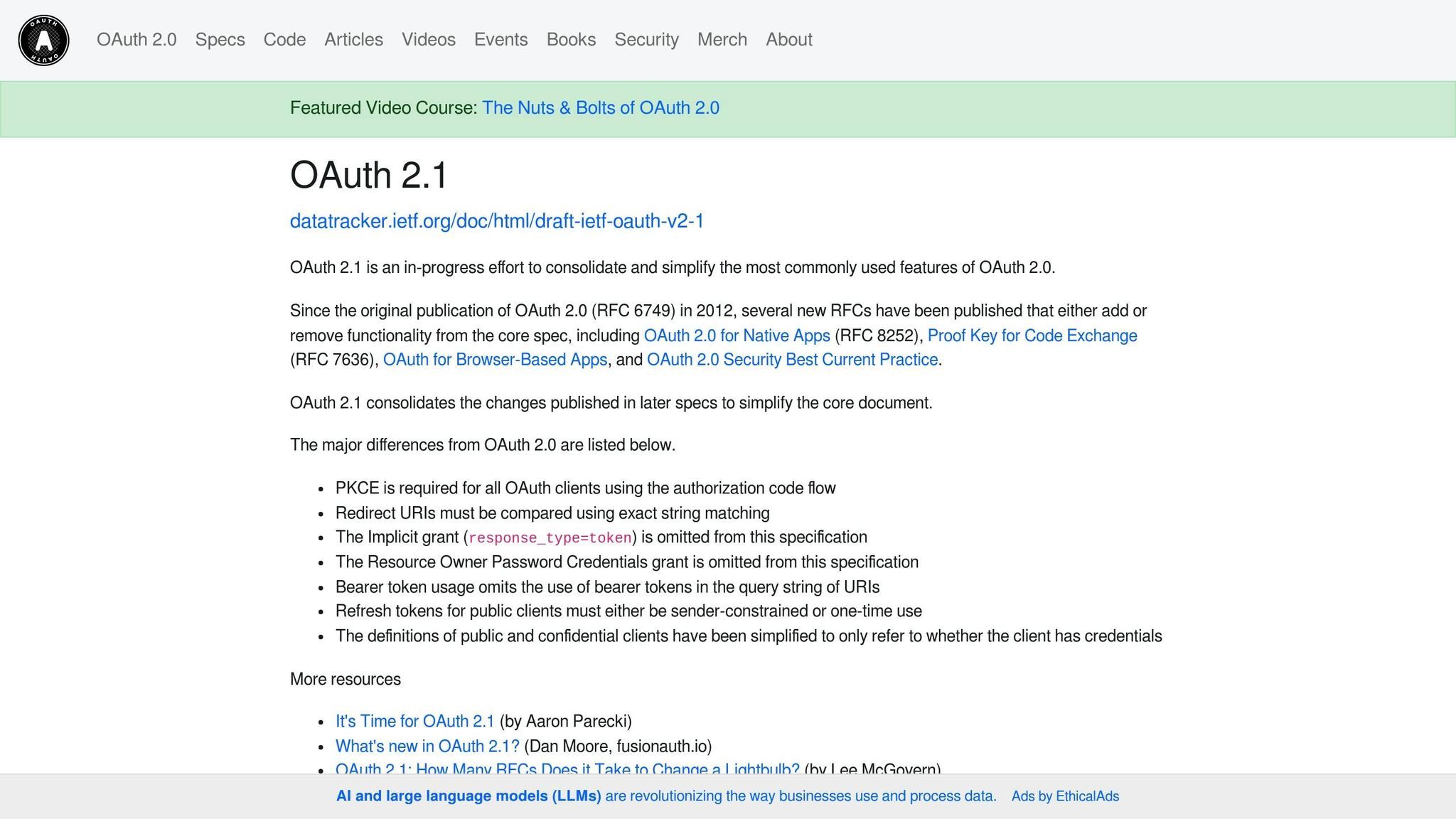
MCP’s authorization framework is rooted in OAuth 2.1 and related IETF specifications, making it compatible with existing enterprise identity systems. By adhering to these OAuth standards, organizations can seamlessly integrate MCP with established identity providers like Auth0, Okta, Firebase, or Clerk - eliminating the need to overhaul their authentication systems.
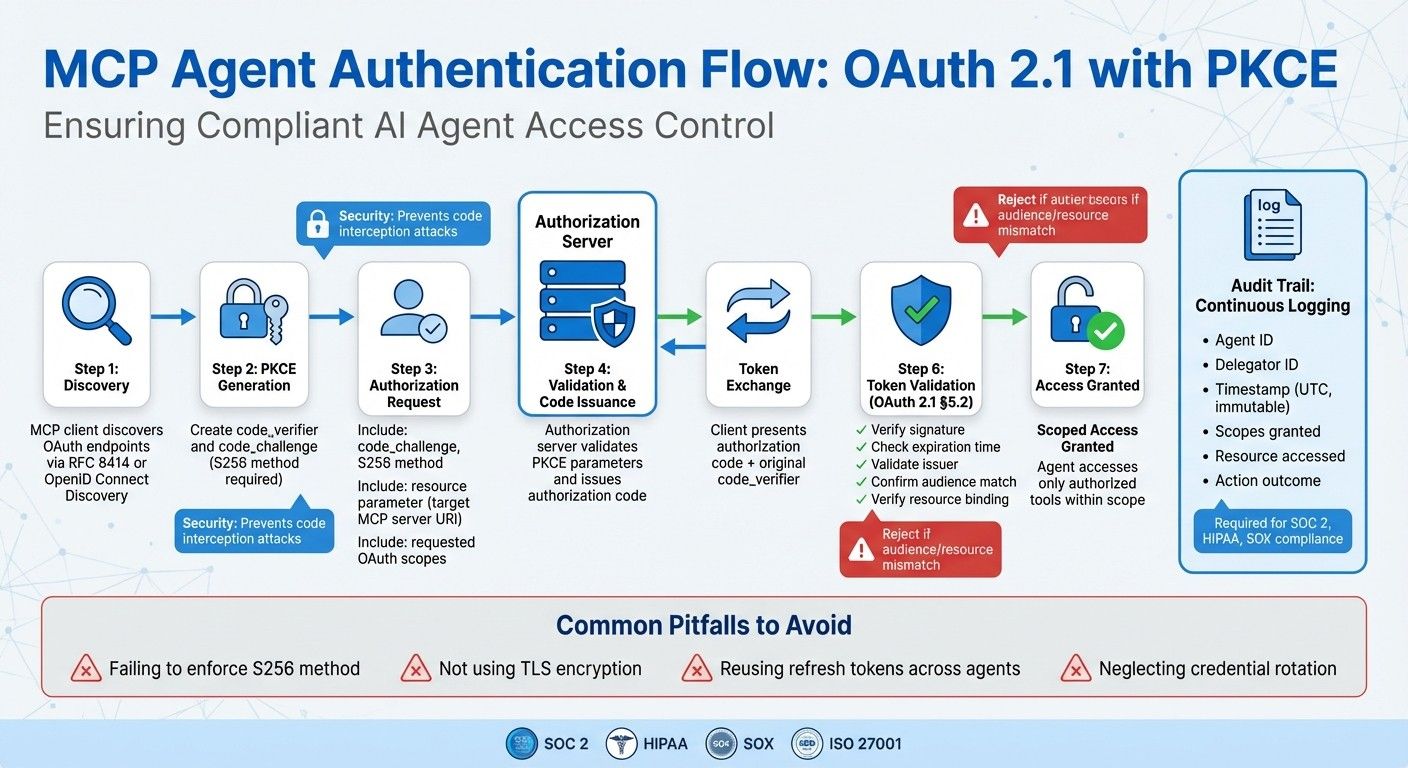
To enhance security, MCP enforces the use of PKCE with the S256 code challenge, which protects against authorization code interception attacks. During the OAuth 2.1 flow, the MCP client relies on server metadata for discovery, authenticates the delegator, and exchanges the authorization code for tokens only after presenting the correct PKCE verifier. Auditors will expect to see the use of PKCE, secure redirect URIs, short-lived access tokens, robust refresh-token management, and detailed logs that document every step - who initiated the flow, what scopes were granted, and when consent was changed or revoked.
These authentication standards provide the foundation for enforcing strict access controls and ensuring compliance.
Enforcing Least Privilege and Scoped Access
MCP addresses compliance challenges by tightly restricting each agent’s permissions to its specific tasks. In this system, least privilege means that agents are granted only the minimum scopes, tools, and data they need - nothing more. MCP enforces this principle through fine-grained OAuth scopes, role-based authorizations, and context-aware delegation. For instance, an AI finance assistant might only have the ability to create purchase orders within a set limit, while manager-level agents could have higher approval thresholds. Similarly, an HR agent might be allowed to view employee records but restricted from exporting or downloading them.
Every token request in MCP includes an explicit resource parameter to ensure that access tokens are bound to their intended MCP server. This audience binding demonstrates to auditors that tokens cannot be misused across the system and that each agent’s access is strictly limited to its authorized resources.
Audit Trails and Traceability in MCP
MCP’s audit trails deliver the real-time, tamper-proof oversight needed for compliance. A compliant deployment logs every action - from authentications and token events to tool usage - with immutable UTC timestamps, ensuring alignment with regulatory retention requirements.
This detailed traceability allows organizations to reconstruct the full picture of agent activities: who performed an action, when it occurred, on whose behalf, and under what authorization. During audits or security investigations, teams can cross-reference logs from MCP servers and related services to confirm that unauthorized access was blocked according to policy. They can also quickly revoke tokens or disable agent identities if necessary. This level of visibility is critical for meeting the demands of SOC 2, SOX, and other industry-specific audits in the U.S..
Setting Up MCP for Secure Agent Authentication
After understanding the compliance requirements, the next step is to configure MCP to enforce them effectively. Start by deploying an MCP server, a compliant MCP client that supports OAuth 2.1 with PKCE, and an OAuth authorization server that provides metadata in line with RFC 8414 or OpenID Connect Discovery. Make sure HTTPS is enabled, secrets are managed securely, and logging pipelines are in place to capture MCP authentication events for auditing purposes. For U.S. businesses, these configurations should integrate seamlessly with identity providers like Auth0, Okta, Firebase, or Clerk, as well as compliance frameworks such as SOX, HIPAA, and GLBA. These elements create the foundation for secure agent authentication.
Setting Up OAuth 2.1 with PKCE
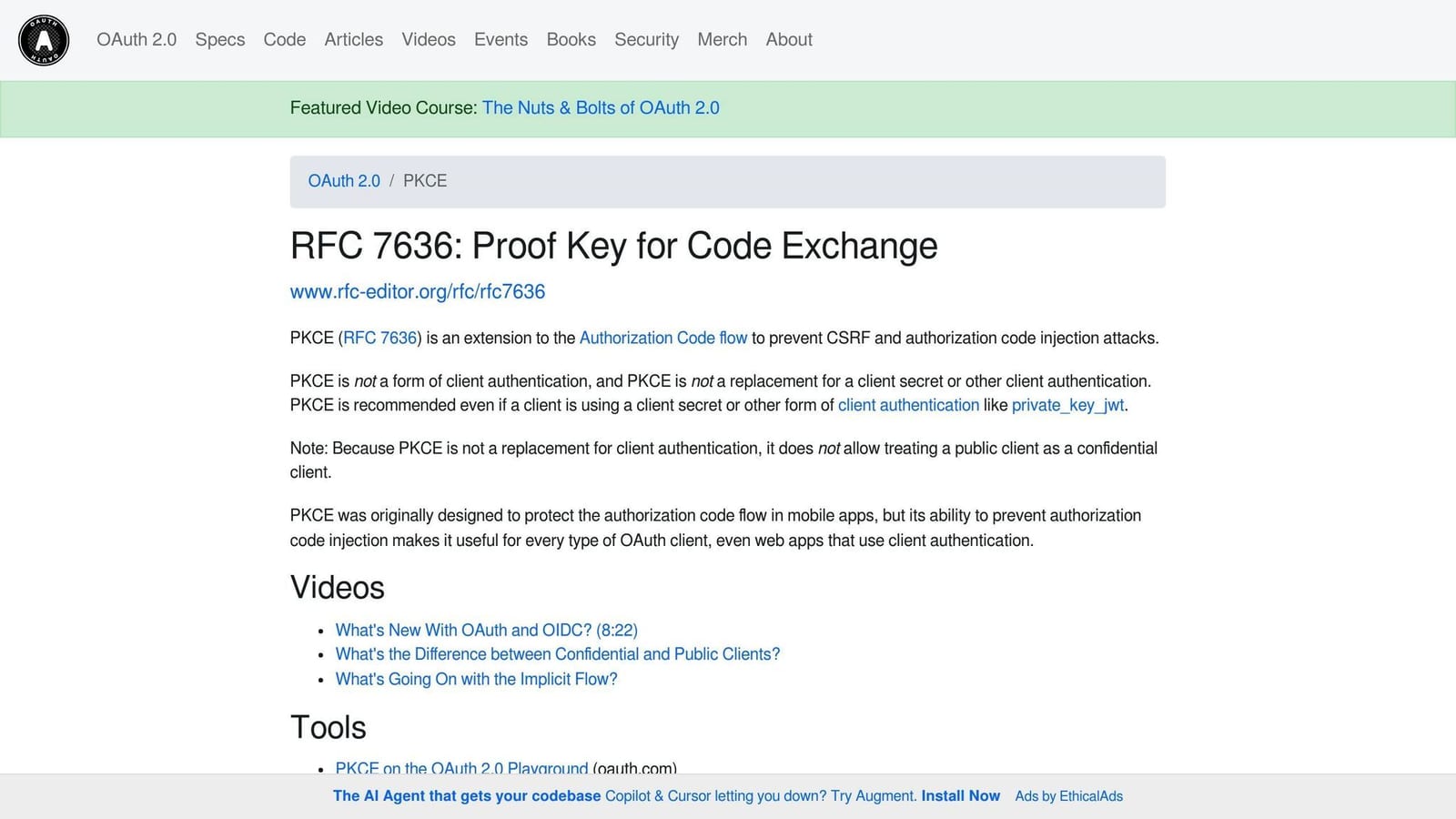
MCP clients rely on OAuth metadata to discover necessary endpoints. After discovery, the client begins an authorization code flow with PKCE by generating the required PKCE values and including them in the authorization request. The authorization server validates the PKCE parameters and issues an authorization code. The client then exchanges this code for an access token by presenting the original code_verifier. This ensures protection against code interception and replay attacks.
MCP resource servers must validate tokens according to OAuth 2.1 Section 5.2. This involves verifying the token's signature, expiration time, issuer, and audience, and rejecting any token without the correct audience or resource binding.
Some common missteps to avoid include failing to enforce the S256 method, not using TLS encryption, reusing refresh tokens across agents, and neglecting regular credential rotation. It's essential to test that PKCE is enforced, invalid tokens are correctly rejected, and expired tokens fail validation. These steps ensure agents only access tools within their designated scope.
Configuring Resource Indicators for Access Control
MCP clients use the resource parameter, as outlined in RFC 8707, in both authorization and token requests to clearly specify the target MCP server. This resource value should be the canonical URI of the MCP server, and the server must verify that tokens are issued specifically for that resource. Any token lacking the correct audience or resource claim should be rejected. For instance, a U.S.-based company might designate "https://mcp.finance.internal" for finance tools, ensuring tokens issued for one domain cannot be used in another.
For more granular authorization, teams can map each resource value to an internal policy domain. This mapping determines which tools and datasets are accessible with a given token, reinforcing compliance by limiting access to authorized data. Typically, this is implemented through the server's authorization middleware or a dedicated policy engine. These systems evaluate token claims (such as scope, roles, subject, and delegator) and log each decision for accountability.
Registering Agent Identities Dynamically
MCP authorization supports OAuth 2.0 Dynamic Client Registration (RFC 7591) and the use of Client ID Metadata Documents. This allows agents to register programmatically rather than through manual administrative processes. MCP clients should check for a client_id_metadata_document_supported flag or a registration_endpoint in the authorization server metadata. If supported, clients can either host their own HTTPS client metadata document or use the registration endpoint to obtain a client ID and credentials. Assigning each agent a unique registration and identifier enables per-agent scopes, rate limits, and decommissioning, improving traceability and simplifying access revocation when necessary.
Each agent should have a unique, persistent identity tied to a human owner, system account, or business service, rather than sharing a generic client or API key. In delegated scenarios, tokens should include both the agent's identity and the delegating user or principal. From a compliance standpoint, dynamic registration supports accountability throughout the agent's lifecycle. This process should be paired with detailed logging to track who initiated the registration, the requested scopes, and the approval process. These records create an auditable trail for regulatory or internal reviews, strengthening MCP's compliance framework and connecting back to earlier audit and access control measures.
Managing Governance and Compliance with MCP and Prefactor
Once MCP authentication is set up, keeping things compliant at scale becomes much easier with centralized policy management, real-time visibility, and audit trails. By pairing MCP with a control plane, you can track how agents access resources and enforce consistent policies across MCP servers. This setup generates audit logs that align with U.S. regulatory standards like SOX, HIPAA, and GLBA. Building on MCP's compliance framework, Prefactor steps in to provide the operational oversight needed for ongoing governance.
Defining Agent Roles and Permissions
Start by linking business roles to OAuth scopes and MCP resources. For example, a Customer Support Agent might be assigned scopes such as support:read and support:write-limited, tied to a specific MCP server using the resource parameter. Meanwhile, a Finance Operations Agent could have more restricted scopes like finance:read and payments:create-under-5000, with tokens explicitly linked to an internal finance system.
Each agent should have a unique and persistent identity - shared credentials are a no-go. For more precise control, an external policy engine can evaluate token claims and enforce contextual rules. For instance, a Finance Agent might be allowed to initiate purchase orders up to $5,000, but only during U.S. business hours. This centralized approach to authorization ensures policies are versioned, testable, and auditable. Once roles and permissions are set, real-time monitoring ensures these policies are consistently applied during operations.
Real-Time Governance with Prefactor
Prefactor brings the operational oversight needed to manage live environments effectively. Acting as an Agent Control Plane, it offers real-time dashboards that show which agents are active, what resources they’re accessing, and whether any unusual activity is detected. Prefactor works seamlessly with MCP's OAuth flows, monitoring authentication events and policy decisions as they happen and flagging any irregular actions.
The platform also allows for runtime controls without requiring MCP servers to be redeployed. If an agent is behaving suspiciously, teams can quickly revoke its token, narrow its access scopes, or pause its operations directly through Prefactor’s interface. With support for hierarchical permissions and delegated access, Prefactor ensures every agent is tied to an accountable human owner. This setup helps meet regulatory requirements like GLBA, which demand proof of authorized access to sensitive data.
Creating Detailed Audit Trails
Prefactor enhances MCP’s logging capabilities by generating detailed audit trails. These logs capture critical details like the agent ID, the action performed, the delegator involved, and the consent status. For example, an audit entry might look like this:
Agent ID: finance-bot-123 authenticated via OAuth 2.1 token (audience: mcp-finance-server), scope: read-only, delegator: user-jdoe, action: queried records at 12/16/2025 07:00 AM EST, decision: allowed per role policy.
These comprehensive logs serve as forensic evidence of agent activities and are essential for meeting U.S. regulatory standards. They track changes for SOX compliance, document access for HIPAA, and include time-stamped entries in U.S. date formats with relevant time zones. Additionally, Prefactor keeps a record of consent revocations and policy updates over time, creating a thorough compliance history that ties MCP's technical security measures to business-level accountability.
Maintaining Long-Term Compliance with MCP
Setting up MCP compliance is just the beginning. To keep things on track long-term, you’ll need continuous monitoring, regular reviews, and quick responses to incidents. While MCP’s OAuth 2.1 foundation offers the technical groundwork, staying compliant means carefully tracking agent activity, periodically recertifying access, and having emergency protocols ready - all without needing to rewrite code. Let’s break it down into key areas: monitoring activity, conducting reviews, and handling emergencies.
Monitoring Agent Authentication Activity
Streamlining authentication data is essential. Start by sending logs from MCP servers and authorization servers to a centralized SIEM system. Capture critical details like agent ID, delegator ID, client ID, token issuer, scopes, resource indicators, grant types, outcomes, and timestamps formatted in ISO 8601 for U.S. time zones. Focus on key metrics, such as authentication success and failure rates, scope usage, dynamic client registration events, and rejected tokens due to audience or resource mismatches.
Define what counts as "unusual" behavior by setting static thresholds and creating behavioral baselines. For instance, flagging more than five failed login attempts by the same agent within five minutes can be a red flag. Similarly, raise alerts if an agent requests access to scopes or resources it has never used before. Behavioral rules might also highlight sudden access to high-risk tools, like a payments API or secrets manager, especially if the agent hasn’t used them in the last 30 days. Prefactor helps enforce these rules across MCP servers, providing real-time alerts for abnormal activity.
Regular Compliance Reviews and Access Recertification
Real-time monitoring is crucial, but periodic reviews ensure your controls are still effective. At a minimum, plan for annual compliance reviews, with quarterly check-ins for high-risk systems, such as those in finance or healthcare. During these reviews, confirm that MCP servers and clients meet OAuth 2.1, PKCE, and resource indicator requirements. Check that dynamic client registration aligns with your policies, review mappings between agents, delegators, and tools, and verify that audit logs clearly reflect accountability and consent records.
Access recertification is another key step. This involves regularly reviewing and re-approving agent permissions, scopes, and delegations to ensure they align with business needs and follow least-privilege principles. Examine each agent's identity and roles, confirm their OAuth scopes and resource indicators match their responsibilities, and ensure delegator consents are explicit and time-limited. Revoke any unused or overly broad permissions. Prefactor simplifies this process by generating recertification campaigns that list agents, their tool access, recent activity, and consents. Business owners can then approve or revoke access through an organized workflow. Track metrics like on-time recertification rates and the number of permissions reduced to demonstrate improvement to auditors.
Managing Changes and Emergency Controls
When making configuration changes, stick to established change-management practices tailored to MCP. Use infrastructure-as-code (IaC) for MCP server and authorization server configurations to ensure changes are version-controlled and auditable. Require pull-request reviews for updates impacting scopes, resource indicators, redirect URIs, or PKCE enforcement. After updates, validate that MCP clients still include the required resource parameter and S256 PKCE challenges. Test MCP servers to confirm they correctly validate tokens against their intended audience and resource before deploying updates. A pre-production environment with synthetic agents can help run regression tests, ensuring compliance controls remain intact.
For emergencies, swift action is critical. You can revoke tokens for specific agents, clients, or delegators at the authorization server, or disable and quarantine agents or MCP clients at the MCP server through Prefactor. Dynamic policies can switch to "lockdown mode", restricting access to read-only or blocking high-risk tools. Runbooks should outline steps for disabling dynamic client registration, tightening scopes, and rotating credentials. Observability tools must allow real-time filtering and log searches to trace all actions by a compromised agent within a set time frame, aiding containment and forensic analysis. Regular tabletop exercises or simulations can test these protocols to ensure they function effectively under pressure.
These emergency measures, combined with MCP’s technical controls and Prefactor’s centralized governance, create a robust system for maintaining compliance over the long haul.
Conclusion: Achieving Compliance with MCP and Prefactor
Meeting agent authentication compliance requires a blend of robust technical standards and effective operational oversight. MCP lays the groundwork with features like OAuth 2.1 with PKCE, resource indicators for scoped access, dynamic client registration, and token audience validation. However, MCP is a protocol - it defines how agents authenticate, but it doesn’t address who can access what or provide the detailed visibility that compliance teams and auditors need.
This is where Prefactor steps in to fill the gap. Acting as an Agent Control Plane, Prefactor enhances MCP by delivering real-time governance, centralized policy enforcement, and detailed audit capabilities. It assigns unique identities to agents, monitors delegated access, and logs every tool interaction with relevant business context. Without this additional layer, organizations are often left manually piecing together logs, struggling with access recertification, and lacking the emergency controls necessary for handling unexpected issues.
FAQs
How does MCP help organizations stay compliant with regulations like SOC 2 and HIPAA?
MCP helps businesses stay compliant with regulations like SOC 2 and HIPAA by utilizing advanced governance tools designed for enterprise needs. Its security measures include real-time monitoring, comprehensive audit trails, and strict access controls, making it easier for organizations to meet demanding regulatory standards.
By ensuring clear accountability in agent authentication and data management, MCP allows companies to deploy AI agents securely while meeting industry expectations for privacy and compliance.
How does OAuth 2.1 support MCP's authentication process?
OAuth 2.1 is a cornerstone of MCP's authentication framework, providing a secure and standardized method for delegated access. It enables smooth integration with identity providers while allowing user-authorized authentication for AI agents, APIs, and various services.
Key features like Single Sign-On (SSO), Multi-Factor Authentication (MFA), and social login not only strengthen security but also streamline the authentication process. This approach ensures efficiency and aligns with enterprise compliance requirements.
How does Prefactor improve MCP's compliance for agent authentication?
Prefactor enhances MCP's compliance framework with features like real-time visibility, comprehensive audit trails, and policy-based access controls. These tools work together to ensure that agent authentication processes are secure, fully traceable, and adaptable to meet the demands of enterprise environments.
By tackling key accountability challenges, Prefactor enables organizations to implement AI agents with confidence, all while maintaining strong compliance standards and effective operational oversight.