
Dynamic authorization in MCP (Model Context Protocol) is a secure, real-time approach to managing AI access to enterprise tools and data. Unlike static methods like API keys, it uses OAuth 2.1 tokens with detailed scopes to ensure precise, session-specific permissions. This approach minimizes over-privileged access, aligns with compliance needs (e.g., HIPAA, PCI-DSS), and supports secure AI integrations with platforms like Salesforce or ServiceNow.
Key takeaways:
- Dynamic Authorization: Evaluates access based on user, resource, and context during each session.
- OAuth 2.1 Integration: Uses short-lived, scoped tokens tied to specific resources, preventing misuse.
- Fine-Grained Permissions: Grants AI agents only the access they need, reducing security risks.
- Compliance-Ready: Logs every action for accountability, supporting regulations like SOC 2 and HIPAA.
To implement this, design clear scope boundaries, enforce secure token flows, and use tools like Prefactor for centralized governance and auditing. Start small with a pilot project, refine policies, and scale securely.
Core Principles of Dynamic Authorization in MCP
What is Dynamic Authorization?
Dynamic authorization takes a flexible approach to permissions, evaluating access based on the requester, the resource being accessed, and the surrounding context. Unlike static authorization - which relies on unchanging rules like fixed role checks - dynamic authorization adjusts in real time. In the context of MCP, this involves leveraging OAuth 2.1 flows with resource indicators (RFC 8707) to tie tokens to specific MCP servers. This approach ensures that tokens can’t be reused across different sessions or services, adding an extra layer of security.
Think of static authorization as a master key that opens everything, while dynamic authorization provides temporary, purpose-specific keys. For AI agents operating at scale, this method enables context-aware, scoped access - preventing unauthorized actions while maintaining security and audit trails. This real-time evaluation is the backbone of MCP's interconnected authorization components.
Key Components of MCP Authorization
MCP's authorization framework relies on three core elements working in unison. First, Protected Resource Metadata (PRM) outlines the capabilities of the MCP server and specifies where its OAuth endpoints are located. Second, Dynamic Client Registration (DCR) - defined in RFC 7591 - enables AI agents to self-register by sending a POST request to the /contact endpoint. Once registered, the authorization server provides a client ID (and a secret, if required), allowing the agent to immediately participate in OAuth flows.
The third critical component is resource indicators (RFC 8707), which MCP mandates for all authorization and token requests. These requests must include a resource parameter, such as &resource=https%3A%2F%2Fmcp.example.com, to explicitly identify the target MCP server. This ensures that access tokens are bound to specific servers, preventing unauthorized reuse. MCP enforces exact URI matching - no trailing slashes allowed - to maintain security and compatibility.
Fine-Grained Permissions for AI Agents
Dynamic evaluation enables fine-tuned control over what each AI agent can access. For instance, an agent might be permitted to use a generate_summary tool for analyzing sales data but restricted from accessing other tools. MCP utilizes OAuth scopes to tightly define the actions an agent can take, ensuring access is limited to the resources and tools explicitly permitted.
While Role-Based Access Control (RBAC) assigns permissions based on predefined roles, Attribute-Based Access Control (ABAC) factors in variables like time, location, or data sensitivity. These policy engines integrate seamlessly with MCP authorization servers, dynamically evaluating policies during token issuance. The result? AI agents are granted exactly the permissions they need - no more, no less. Every action is logged for compliance with regulations such as HIPAA or GLBA, ensuring transparency and accountability.
MCP Gets OAuth: Understanding the New Authorization Specification
How to Design and Implement Dynamic Authorization in MCP
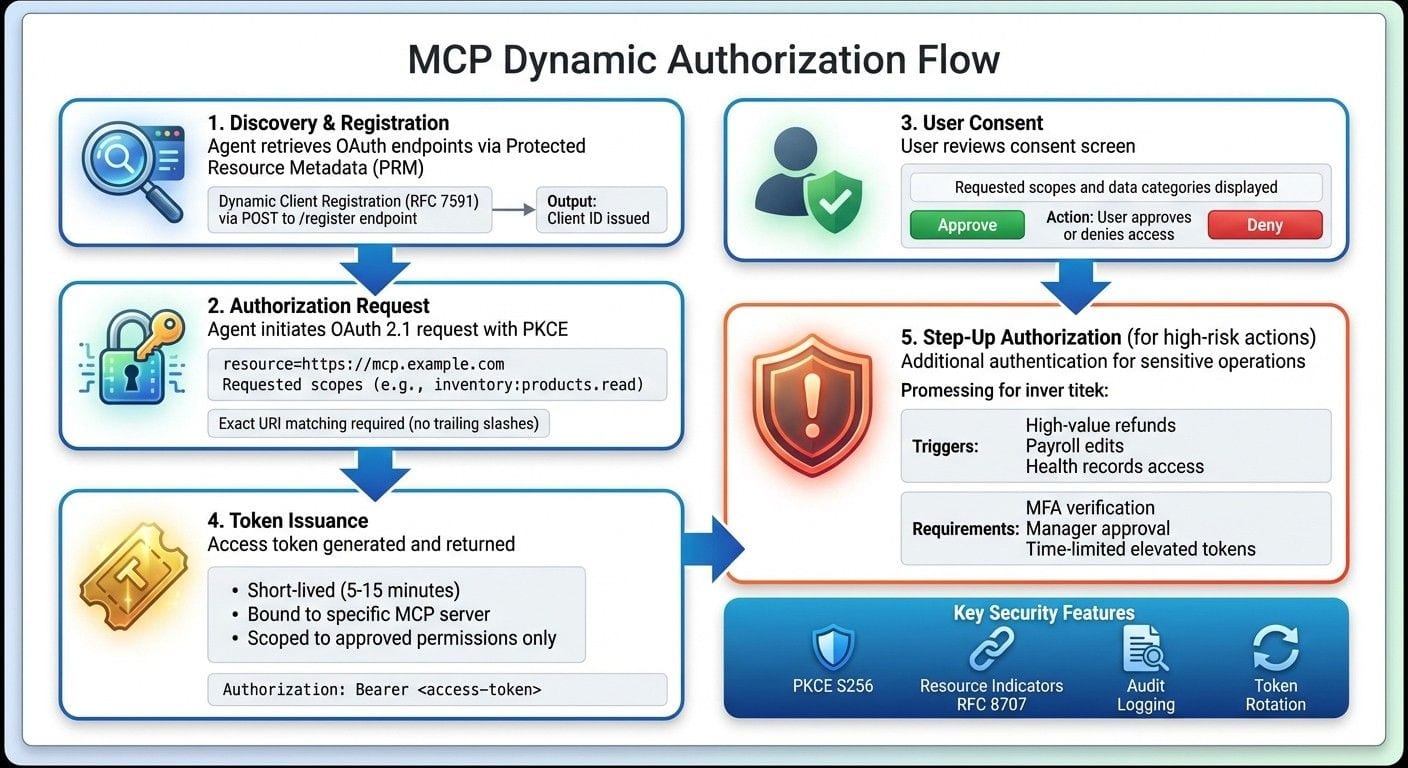
{MCP Dynamic Authorization Flow: 5-Step Implementation Process}
Designing Authorization Boundaries
Start by categorizing each MCP resource - like CRM data, HR records, or source code - based on its sensitivity and ownership. For every resource, list the specific operations it supports, such as read, write, delete, export, admin, or impersonate. Then, map these operations to individual MCP tools, ensuring each tool has only the permissions it needs. For clarity, create a scope naming convention like system:resource.operation (e.g., crm:accounts.read or hr:payroll.export). Reserve unique scopes for high-risk actions, such as bulk exports or system configuration changes.
To streamline integration, align these scopes with your existing enterprise RBAC (Role-Based Access Control) or ABAC (Attribute-Based Access Control) models. For instance, roles like "Sales Manager" or attributes like "department=finance" should be easily translated into MCP scopes during runtime. Clearly define tenant and environment boundaries to prevent cross-tenant or production-to-non-production data leaks. For example, use scopes like tenantA:crm:accounts.read or prod:payments.refund to enforce separation. This is especially critical for U.S.-based enterprises managing regulated or financial data.
Assign only the minimum necessary scopes to each MCP tool. For example, a get_customer_summary tool might only need crm:customer.read.basic, not full CRM access. Separate scopes for read, write, and admin operations, and require explicit elevation for actions that modify data or cross systems. Once these boundaries are set, you can enforce them through secure authorization flows.
Implementing Dynamic Authorization Flows
When an AI agent interacts with an unfamiliar MCP server, it begins with discovery, retrieving the server's OAuth endpoints and capabilities via Protected Resource Metadata. The agent then initiates an authorization request on the user’s behalf, specifying the MCP server as the resource parameter while requesting only the necessary scopes - like inventory:products.read - instead of broad access.
The user is redirected to the authorization server, where they review a consent screen listing the requested scopes and data categories. After approval, the user is redirected back to the agent, which completes the process using OAuth 2.1 with PKCE. The resulting access token is stored and sent with every request as Authorization: Bearer <access-token>. For long-running agents, regularly rotate tokens and adjust scopes as policies evolve, while adhering to U.S. enterprise security standards for session lengths and idle timeouts.
For highly sensitive actions - such as processing refunds above a certain dollar amount, editing payroll data, or accessing health-related records - implement step-up authorization. Start by assigning sensitivity classifications to MCP tools, then map higher-risk tools to additional requirements like multi-factor authentication, manager approval, or policy checks. When an agent attempts a high-risk action, pause execution and initiate a new OAuth flow requesting elevated access, such as payments.refund.high_value or hr:payroll.update. The user must complete stronger authentication and confirm the action on a detailed screen showing the action, dollar amount (formatted as $X,XXX.XX), and potential impact.
Elevated tokens should be time-limited and purpose-specific, with narrow scopes and short lifetimes. Record every detail - who performed the action, what was done, when it occurred, why it was necessary, and which agent was involved - in an audit system. This ensures compliance with regulations like SOX or PCI and supports thorough reviews.
To centralize control and improve visibility, consider integrating an Agent Control Plane.
Using Prefactor to Govern Authorization
Prefactor simplifies agent governance and auditing by acting as an Agent Control Plane. It maintains a registry of agent identities, their allowed scopes, and associated risk profiles. Prefactor enforces enterprise policies by orchestrating or vetoing authorization flows, ensuring agents operate within their designated boundaries - blocking actions like accessing tools outside their business unit or environment.
Prefactor also consolidates authorization events, such as client registrations, scope approvals, step-up flows, and token use, into a single audit trail. This gives security and compliance teams real-time insights into which agents accessed which resources, on whose behalf, and under what conditions. It enforces guardrails like maximum scope limits, region-based data access restrictions, or business rules such as "no production HR data access from non-corporate networks." Violations are flagged as alerts for immediate attention.
For regulated U.S. enterprises, Prefactor’s centralized control and auditability address the "accountability gap" often found between LLM behavior and traditional access control systems. By defining access policies through CI/CD pipelines, organizations can scale permissions efficiently. These policies are versioned, testable, and reviewable, just like any other infrastructure component, ensuring consistent and secure authorization management.
Security Hardening and Compliance for MCP Dynamic Authorization
Security Best Practices for MCP Authorization
To keep dynamic authorization flows secure, following strong security protocols is key. MCP authorization relies on OAuth 2.1 standards to safeguard against token theft and misuse. A critical component is the use of PKCE S256 in every authorization code flow, which ensures attackers cannot intercept and misuse authorization codes without the correct verifier. Authorization servers also strictly validate registered redirect URIs to block open redirect attacks that might lead users to harmful websites.
Access tokens should have short lifetimes - ideally between 5 and 15 minutes - and be accompanied by longer-lived refresh tokens that can be revoked if compromised. Always transmit access tokens in the Authorization header (e.g., Authorization: Bearer <access-token>) rather than in URI query strings. MCP clients also implement state parameters in the authorization code flow to defend against CSRF attacks. Additionally, they include the resource parameter (e.g., the canonical URI of the MCP server like https://mcp.example.com without a trailing slash) in both authorization and token requests, ensuring tokens are tied to the correct server.
For dynamic client registration, server-side policies play a key role. These policies restrict redirect URI patterns, limit supported grant and response types, and attach metadata like ownership and environment details to ensure robust inventory and governance. When using MCP proxy servers with static client IDs, explicit user consent is required before forwarding requests to third-party authorization servers. Tokens are tied to specific resources through exact URI matching, adding another layer of security.
Creating Audit Trails
Audit trails are essential for ensuring accountability and meeting regulatory requirements like SOC 2, ISO 27001, HIPAA, and PCI-DSS. They provide clear documentation of user consent and access controls. Every authorization event should be logged with detailed information such as:
- Client ID
- User or service identity
- Requested and granted scopes
- Resource indicators
- Step-up events
- Consent decisions
- Token issuance and revocation
- IP address and user agent
- Timestamps in ISO 8601 format (localized to MM/DD/YYYY for U.S. reporting)
- Correlation IDs for traceability
Logs should be stored in tamper-proof, append-only JSON files and retained for at least one year, or longer for HIPAA and PCI-DSS compliance. Here’s an example of a log entry:
<code>{
  "event": "scope_grant",
  "client_id": "abc123",
  "scopes": ["read:tools"],
  "user_id": "user456",
  "timestamp": "12/16/2025 02:00:00 AM UTC",
  "compliance": "SOC2"
}</code>
To enhance security, integrate these logs with SIEM tools. This allows real-time monitoring and alerts for anomalies, such as unusual scope requests or step-up failures. Such measures ensure auditors have the evidence needed to verify that access controls are functioning properly and support broader governance efforts.
Governance and Change Control
Managing MCP scopes, policies, and resources as code through version control systems like Git ensures a structured and reliable approach. All changes should be handled through pull requests, code reviews, and automated testing before being deployed to staging and production environments. Using environment-specific configurations and promotion pipelines minimizes the risk of manual errors in production, improving overall traceability and control.
Prefactor acts as a central hub for governance in MCP production environments. It maintains a detailed inventory of agents and their registered MCP clients, enforces consistent policies and scope baselines across environments, and provides real-time visibility into changes. Approval workflows for high-risk scope modifications further strengthen security. By addressing gaps in accountability - one of the leading causes of failure in AI projects - Prefactor enables organizations to scale AI agents securely while maintaining compliance and operational oversight.
Conclusion: Achieving Security and Scalability with Dynamic Authorization
Key Takeaways
This guide has explored how dynamic authorization strengthens security and supports scalability within MCP environments. By integrating OAuth 2.1 with PKCE, Dynamic Client Registration, and resource indicators, organizations can implement precise, tool-specific permissions. This reduces the risks posed by compromised tokens and over-privileged agents. Considering that 82% of organizations using generative AI lack consistent security policies across workflows, this approach offers a much-needed standardized framework, eliminating reliance on ad-hoc API keys and custom authentication methods.
Dynamic authorization also simplifies the onboarding process for AI agents, allowing them to connect to new MCP servers programmatically, without manual intervention. This is crucial for the fast-paced scaling required in modern deployments. A CTO from a venture-backed AI company emphasized the importance of control and visibility when deploying MCP in production environments. By leveraging policy-as-code, CI/CD-driven deployments, and detailed audit trails, teams can define access rules once and scale operations efficiently while maintaining accountability.
For industries with strict compliance requirements - like banking, healthcare, and mining - dynamic authorization ensures traceability that aligns with standards such as SOC 2, ISO 27001, HIPAA, and PCI-DSS. This positions MCP as a centralized security control plane, replacing fragmented, tool-specific security measures with a unified governance model.
These strategies set the stage for a practical and phased approach to adopting dynamic authorization.
Next Steps for Adoption
To start, consider a pilot deployment in a low-risk scenario - such as integrating a read-only CRM or an internal reporting tool. This allows you to validate OAuth 2.1 flows, test Dynamic Client Registration policies, and fine-tune scope definitions. Use the audit logs from this pilot to identify patterns, detect potential issues, and refine policies before rolling out dynamic authorization to more critical systems.
For a smoother transition from proof-of-concept to full production, tools like Prefactor can be invaluable. Prefactor provides real-time visibility into all MCP authorization events, maintains a centralized inventory of registered agents and clients, and enforces consistent policies across both staging and production environments. By addressing accountability gaps - one of the primary reasons 95% of agentic AI projects fail - Prefactor empowers organizations to scale AI agents securely. Connect your MCP servers to Prefactor's governance workflows, establish approval processes for high-risk changes, and confidently move AI agents into production while maintaining robust security and compliance.
FAQs
What is the difference between dynamic and static authorization in MCP?
Dynamic authorization within MCP adjusts permissions on the fly, taking into account factors such as user context, agent status, or situational conditions. This real-time approach ensures responsive and accurate access control, allowing organizations to handle shifting scenarios while maintaining robust security measures.
On the other hand, static authorization relies on fixed, pre-established permissions that stay constant throughout interactions. Though easier to set up, static methods fall short in dynamic, AI-driven environments, where adaptability is essential for managing complex or rapidly changing situations effectively.
What security advantages do OAuth 2.1 tokens offer for dynamic authorization?
OAuth 2.1 tokens offer a strong layer of security for managing dynamic authorization, thanks to their adoption of modern standards and practices. They've done away with older, less secure features like implicit flows and introduced more robust measures such as proof of possession and secure token exchange. These updates significantly lower the chances of token theft or unauthorized access.
By simplifying token management and aligning with the latest security protocols, OAuth 2.1 ensures the protection of sensitive information while enabling secure, scalable AI-powered applications.
How does Prefactor improve governance and auditing in MCP-based systems?
Prefactor enhances governance and auditing in MCP-based systems by providing real-time visibility into the actions of AI agents and maintaining comprehensive, agent-specific audit trails. This makes every action transparent and easy to trace.
Through role-based access controls and real-time monitoring, Prefactor allows organizations to set and enforce access policies directly within CI/CD workflows. This ensures a consistent, scalable approach to maintaining security and compliance, all while staying aligned with human intent across production environments.