MCP (Model Context Protocol) is a framework that ensures secure communication between AI agents and external systems. It replaces static API keys with short-lived tokens, improving security by enabling authentication, authorization, and audit trails. This is crucial for multi-tenant AI systems, where one infrastructure serves multiple customers but must keep their data and operations isolated.
Key Takeaways:
- Multi-Tenant AI Risks: Data leaks, misconfigured access controls, and insecure storage/logging are major concerns.
- Tenant Isolation: Achieved through unique IDs, Kubernetes namespaces, dedicated VPCs, and encryption.
- Prefactor's Role: A tool providing identity management, audit trails, and policy enforcement to secure MCP workflows.
Quick Overview:
- Risks: Cross-tenant data leaks, identity vulnerabilities, and insecure storage.
- Solutions: Short-lived tokens, tenant-specific roles, and encryption.
- Tools: Prefactor simplifies governance with policy-as-code and real-time monitoring.
MCP security is about embedding tenant-specific context into every action, enforcing strict boundaries, and continuously monitoring AI agent activities. Prefactor helps bridge security gaps, ensuring safer multi-tenant AI deployments.
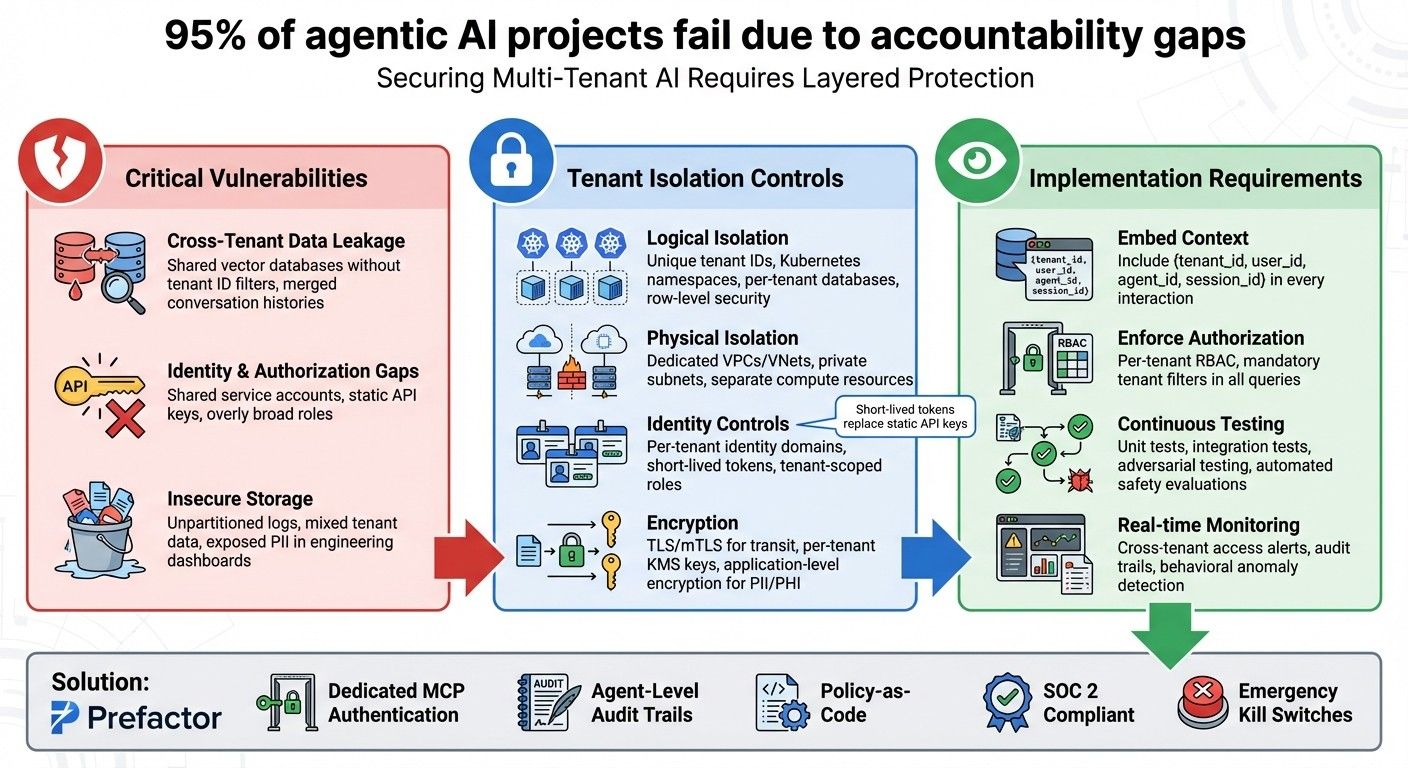
{Multi-Tenant MCP Security Framework: 3-Layer Protection Model}
AWS re:Invent 2024 - Generative AI meets multi-tenancy: Inside a working solution (SAS407)
Security Risks in Multi-Tenant MCP Workflows
Multi-tenant environments, while efficient, come with their own set of challenges. Sharing the same AI agent infrastructure among multiple customers introduces risks that don't exist in single-tenant setups. Misconfigurations, shared resources, and overlapping workflows can inadvertently expose sensitive data, creating vulnerabilities that demand attention.
Cross-Tenant Data Leakage
One of the most concerning risks in a multi-tenant setup is data leakage across tenants. This occurs when tenant-specific context isn't consistently enforced throughout the data pipeline. Imagine a shared vector database filtering by semantic similarity but failing to check tenant IDs. In this scenario, an AI agent assisting a U.S. retail client might accidentally pull healthcare records belonging to another tenant, potentially exposing protected health information (PHI).
Another example involves conversation history buffers. Bugs in session management or queueing logic can lead to traces from multiple tenants merging unintentionally. Even if the database uses logical partitions, an AI agent issuing broad, unscoped queries - such as "search all documents matching X" - could inadvertently combine data from multiple tenants into a single response. These breaches often bypass API-level authorization checks but still compromise data isolation during runtime.
Identity and Authorization Vulnerabilities
Identity and access management can also become a weak link in multi-tenant environments. Shared service accounts and static API keys blur the lines of accountability, making it difficult to trace which tenant's agent performed a specific action. Misconfigured access controls and overly broad roles can allow agents to impersonate other tenants or escalate privileges beyond their intended scope.
The problem worsens when agents act on behalf of users without proper tenant scoping. Even with valid API permissions, an agent could inadvertently process and aggregate data from multiple tenants, violating the platform's isolation model. Without sandboxing or runtime policies to restrict data usage, the risk of improper aggregation grows.
To mitigate these risks, industry standards recommend using short-lived tokens instead of static API keys. This approach ties MCP server connections to robust authentication and scoped authorization, ensuring agents operate within defined boundaries. However, when paired with insecure data storage practices, even strong authentication measures can fall short.
Insecure Storage and Logging Practices
Improper storage practices are another common pitfall in multi-tenant setups. When tenant data is stored without strict partitioning, hidden exposure channels can emerge. For instance, a single vector index containing embeddings for all tenants' documents might lack enforced tenant ID filters during queries. This allows improperly scoped queries to retrieve vectors and documents belonging to other tenants. Similarly, shared databases and unpartitioned logs that mix tenant data can result in accidental cross-tenant reads if tenant-specific conditions are omitted.
Logs, in particular, pose a unique challenge. They are often more accessible within an organization than production data stores. If engineering dashboards or observability tools allow unrestricted access to raw logs, sensitive content such as U.S. customer PII, financial data, or intellectual property could be exposed. Logging practices that capture entire prompts or database rows without redaction can even store secrets like API keys or tokens in shared log indexes, leaving them vulnerable long after their operational use has ended.
Tenant Isolation Principles for MCP Security
When it comes to tenant isolation, a layered approach is key. The objective is clear: ensure that each tenant’s AI agents, data, and infrastructure remain fully separated from others. Achieving this requires building multiple levels of separation, including logical boundaries in code and data, physical network and compute segregation, and cryptographic safeguards to protect data wherever it resides. Let’s dive into how both logical and physical isolation methods play a role in enforcing these boundaries.
Logical and Physical Isolation
Logical isolation serves as the first line of defense. Each tenant is assigned a unique identifier that accompanies every MCP request, tool invocation, and database query. This identifier isn’t just enforced at the UI level - it’s embedded at the service and data layers. To strengthen this, organizations often implement per-tenant Kubernetes namespaces with network policies that block cross-namespace traffic. Data is similarly partitioned using per-tenant databases, schemas, or row-level security, ensuring that the MCP layer cannot access mixed-tenant datasets.
On the other hand, physical and network isolation provides an even stronger barrier. Tenants managing sensitive data, such as PHI or financial records, often operate within dedicated VPCs or VNets. These environments include private subnets, security groups, and network ACLs that restrict traffic to only the relevant MCP servers, vector stores, and backend services. For high-risk workloads, dedicated compute resources - like separate Kubernetes node pools, VM scale sets, or even entirely separate clusters - are used to eliminate noisy-neighbor risks and simplify compliance efforts. This approach allows enterprises, including those in the U.S., to maintain a shared platform while proving that production tenants are securely isolated at both the network and compute levels.
Once these isolation measures are in place, strict identity controls further reinforce tenant security.
Identity-Based Security Controls
Strong identity management is critical for maintaining tenant boundaries. This involves creating per-tenant identity domains or scopes, where all roles and policies are explicitly tied to a tenant_id. Avoid using global "super-roles" except for tightly restricted platform admin accounts. For AI agents, first-class, autonomous identities are essential - recycling user credentials is not an option since traditional methods like MFA and CAPTCHAs don’t work for agents. Instead, issue short-lived tokens tied to tenant identities to ensure scoped, isolated access. Data access should be further restricted with tenant-scoped roles and fine-grained filters, such as limiting queries to a specific tenant_id, region, or business unit.
Encryption and Monitoring
Encryption and monitoring practices are vital for maintaining end-to-end tenant security. Start by enforcing TLS with strong ciphers for all communications, even within internal U.S. data center traffic, to block lateral movement. Many organizations also implement mutual TLS (mTLS) to verify both client and server identities, using certificates tied to specific tenants or workloads to prevent cross-tenant token misuse. For encryption at rest, disk- and volume-level encryption with cloud KMS keys is standard, often with per-tenant or tenant-group keys for added isolation. For especially sensitive data - like PII, PHI, or financial records - application-level encryption is used. Here, fields are encrypted with tenant-specific keys before being stored in databases or object storage. Enforcing tenant-specific key usage through strict key management ensures that no key is improperly shared.
Real-time monitoring acts as the final safeguard, identifying potential violations before they escalate. Organizations deploy runtime monitoring and set alerts for signs of cross-tenant access, such as an agent accessing data for multiple tenants within a short timeframe without an explicit "broker" pattern. AWS guidance for multi-tenant AI architectures emphasizes tenant isolation, identity and access management, and data protection as the three critical control areas for secure multi-tenant workloads.
Building Secure MCP Workflows for Multi-Tenant AI
When it comes to multi-tenant AI systems, ensuring secure workflows goes beyond just isolating tenants. It’s about embedding tenant-specific context into every interaction, enforcing strict authorization at every level, and consistently verifying that isolation mechanisms are working as intended. Let’s break down the steps to achieve this.
Embedding Tenant Context into MCP Interactions
The key to secure multi-tenant workflows lies in embedding tenant context into every interaction. A robust way to do this is by including metadata like {tenant_id, user_id, agent_id, session_id} in the connection context for every interaction. This metadata should then be applied to all tool calls, resource paths, and query filters. By doing so, even if a language model generates an incorrect or harmful query, the backend ensures that the request stays confined to the appropriate tenant’s data, structurally preventing cross-tenant access.
For added security, resource identifiers should be tenant-specific from the outset. For example, use tenant-based namespaces for identifiers to enforce isolation. Backend services - not the language model - should handle tenant context resolution, including credentials and resource locations. This approach keeps sensitive details like secrets and raw tenant IDs out of prompts.
For relational databases, every query must include a mandatory filter such as tenant_id = :tenant_id, enforced at the server level. This ensures that no query bypasses tenant isolation. Similarly, vector databases should maintain separate collections or namespaces for each tenant, with queries restricted to the appropriate namespace. Even search and analytics systems need tenant-scoped filters, such as tenant-specific index names or prefixes, to ensure that no cross-tenant data retrieval occurs, regardless of the query.
Authorization Within Tenant Boundaries
Authorization must always operate within the scope of the tenant. Implement per-tenant role-based access control (RBAC), defining roles like Admin, Analyst, Viewer, or Bot for each tenant individually. This ensures that permissions are evaluated strictly within the tenant’s boundary. For high-risk actions, consider adding human approval steps and maintaining detailed audit logs. Credentials for downstream systems should also be tenant-specific, ensuring no cross-tenant credential exposure.
To streamline this process, tools like Prefactor provide built-in support for context-aware, delegated agent access. Prefactor is designed for multi-tenant and multi-agent environments, allowing organizations to define access policies as code and manage them through CI/CD pipelines. This ensures that access policies are versioned, testable, and reviewable alongside the rest of the system infrastructure.
Testing and Validating Tenant Isolation
Testing is essential to ensure tenant isolation holds under all conditions. Start with unit tests to confirm that every MCP tool automatically enforces tenant filters and cannot operate without the correct tenant context. Integration tests should simulate real-world scenarios by provisioning multiple tenants (e.g., Tenant A and Tenant B), seeding them with distinct test data, and verifying that agents under one tenant cannot access or infer data from another, even under adversarial conditions.
Adversarial testing plays a crucial role here. Simulate cross-tenant attack scenarios and load-test the system to check for vulnerabilities like caching errors or connection pooling leaks that could mix tenant contexts. Using uniquely labeled test data for each tenant simplifies the process of detecting any data leakage.
Continuous testing is equally important. Automated safety evaluations and regression tests should run whenever there are changes to models, tools, or policies. This helps identify new paths for potential cross-tenant leakage. Prefactor’s agent-level audit trails provide full visibility into every action, making it easier to validate policy enforcement and tenant isolation in production. These testing and auditing practices ensure that tenant isolation remains intact, even as systems evolve.
Governance and Audit for MCP-Based AI Agents
Why Governance and Visibility Matter
When it comes to multi-tenant AI agents, strong governance and audit controls are essential to creating a secure environment. These controls build on the foundation of tenant isolation, ensuring that every deployment is protected from potential risks. Without proper governance, introducing AI agents into production can leave your infrastructure vulnerable. In fact, 95% of agentic AI projects fail due to accountability gaps during the transition from proof-of-concept to production. This challenge becomes even more pronounced in multi-tenant setups, where every interaction involves sensitive data. Without real-time visibility, the risks multiply.
For industries like banking, healthcare, and mining, governance isn’t just a best practice - it’s a legal requirement. Organizations operating in these regulated sectors must align AI agent telemetry with compliance frameworks such as the EU AI Act and NIST AI RMF. Achieving this alignment requires integrating continuous monitoring tools like Microsoft Purview and Defender XDR, ensuring that every action taken by an AI agent adheres to regulatory standards. As one CTO from a venture-backed AI company explained:
The biggest problem in MCP today is consumer adoption and security, I need control and visibility to put them in production.
This underscores the importance of having real-time insight into operations, along with rigorous audit trails and enforceable policies.
Audit Trails and Policy Enforcement
To maintain accountability in MCP workflows, immutable audit trails are a must. These trails provide a detailed record of every action, translating agent activities into a business context. By adopting policy-as-code practices through CI/CD pipelines, organizations can enforce versioned and testable policies. This approach ensures that AI agents operate with distinct, tightly controlled identities, using short-lived tokens to maintain least privilege access and continuous oversight. Adding human-in-the-loop controls, such as requiring MFA approvals for restarts, adds another layer of security.
A great example of these principles in action is Prefactor, which seamlessly integrates audit trails and dynamic control mechanisms.
Prefactor as an Agent Control Plane
Prefactor provides the tools necessary to take MCP-based AI agents from experimentation to full-scale production. It offers dedicated MCP authentication for AI agents, enabling secure, autonomous identities that work with existing identity solutions. Through dynamic client registration, Prefactor supports human-delegated authentication for agents, APIs, and services, ensuring compatibility with OAuth/OIDC-based systems.
One of Prefactor’s standout features is its agent-level audit trails, which track every action in detail. These trails provide the context needed for debugging and compliance, giving organizations the confidence to scale AI deployments. Additionally, Prefactor includes emergency kill switches for quick responses to operational issues. For businesses managing complex, multi-tenant SaaS applications, Prefactor simplifies the process by handling roles, attributes, and delegated access within a unified framework designed specifically for agent-based access patterns. Its SOC 2 compliance further addresses enterprise concerns, making it a reliable choice for large-scale AI agent deployments.
Conclusion
Ensuring the security of MCP workflows for multi-tenant AI agents demands constant vigilance. The risks are undeniable: cross-tenant data leaks, weak authorization protocols, and insecure logging practices can compromise even the most robust systems. To counteract these threats, organizations must enforce strict tenant isolation across all layers - from data storage to authorization processes - and embed tenant context into every MCP interaction. This layered approach not only enhances security but also builds a foundation for safer AI systems.
In addition to these design measures, organizations should prioritize regular safety assessments, adversarial testing, and continuous monitoring. These practices help identify anomalies, confirm tenant isolation, and ensure encryption and logging practices comply with evolving business needs and U.S. regulatory standards. Behavioral monitoring plays a crucial role in spotting irregularities, such as unexpected cross-tenant access or unusual tool usage. Periodic policy reviews - whether quarterly or aligned with release cycles - keep isolation rules in sync with both business objectives and regulatory requirements.
Strong MCP security does more than mitigate risks; it fosters the transparency and accountability that industries like banking, healthcare, and mining need to adhere to compliance frameworks such as the NIST AI RMF and the EU AI Act. Prefactor’s SOC 2 compliance and agent-level audit trails lay the groundwork for meeting these standards while maintaining operational control.
With features like dedicated MCP authentication, dynamic client registration, and policy-as-code, Prefactor simplifies the journey from proof-of-concept to full-scale production. These tools address the accountability gaps that derail 95% of agentic AI projects. By integrating seamlessly with existing OAuth/OIDC-based identity solutions, Prefactor ensures agents can securely and programmatically access APIs and applications. This comprehensive approach equips teams to tackle today’s security challenges with confidence.
FAQs
How does MCP improve security for multi-tenant AI systems?
MCP enhances security in multi-tenant AI systems by using strong authentication and authorization mechanisms. It ensures a clear distinction between human users and AI agents through dynamic registration, simplifying secure access management.
On top of that, MCP works effortlessly with existing identity management systems, allowing organizations to maintain a unified security framework. It also offers granular access controls and thorough audit trails, safeguarding sensitive data while providing complete visibility into system activities. This approach helps organizations maintain control and meet compliance requirements, even at scale.
What are the key risks of data leaks between tenants in AI systems?
The biggest risks of data leaks in multi-tenant AI environments stem from unauthorized access to sensitive information, poor isolation practices that allow data to spill between tenants, and malicious actions by other users sharing the same system. Problems like weak access controls or misconfigured permissions can open the door to serious security vulnerabilities.
Addressing these challenges requires implementing strong security frameworks and reliable governance tools to keep data secure and properly isolated across all tenants in the system.
How does Prefactor ensure secure tenant isolation and manage identities?
Prefactor prioritizes secure tenant isolation by leveraging its MCP framework to establish scoped, auditable access policies. This ensures that each tenant's data remains entirely separate and safeguarded.
When it comes to identity management, Prefactor employs dynamic client registration to generate secure, independent agent identities. It also works effortlessly with popular identity platforms like Auth0 and Okta, allowing for human-delegated authentication and simplified access control. This method not only strengthens security but also makes managing identities more efficient in multi-tenant AI environments.