TL;DR
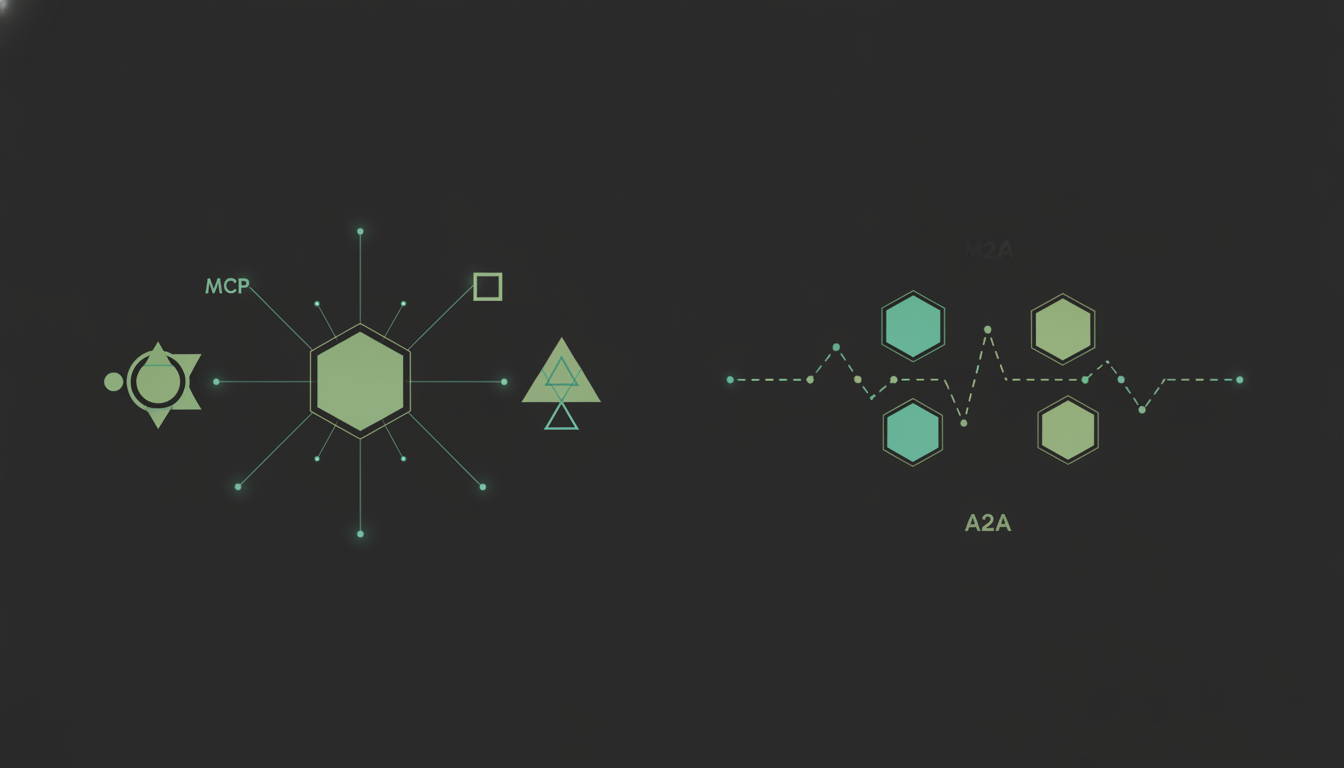
MCP and A2A are complementary protocols, not rivals. MCP (Model Context Protocol) connects a single agent to tools and data, the agent-to-tool layer. A2A (Agent-to-Agent protocol) connects agents to each other so they can delegate tasks and share results, the agent-to-agent layer. A full agent system often uses both.
Why they get compared
Both are open protocols that appeared around the same time for building agent systems, so they get framed as competitors for the same slot. They are not. They solve different connections: MCP is how an agent reaches its tools, and A2A is how agents reach each other.
What is MCP?
The Model Context Protocol is a standard for connecting an agent to external tools and data through one consistent interface. An MCP server exposes tools in a structured, self-describing way; the agent, an MCP client, discovers and calls them at runtime. MCP answers the question: how does one agent use a tool? Query a database, call an API, read a file, all without custom wiring for each.
What is A2A?
The Agent-to-Agent protocol is a standard for agents to talk to each other, including agents built on different frameworks or run by different vendors. An agent publishes what it can do, a capability description, and another agent can hand it a task, track its status, and collect the result. A2A answers a different question: how does one agent get another agent to do something? It covers the task lifecycle, messages, artifacts, and streaming updates between agents.
MCP vs A2A: the core difference
MCP wires an agent to its tools. A2A wires agents to one another. Same goal of interoperability, different edge of the system.
| MCP | A2A | |
|---|---|---|
| Connects | An agent to tools and data | An agent to other agents |
| Layer | Agent-to-tool | Agent-to-agent |
| Answers | How does an agent use a tool? | How do agents delegate to each other? |
| Unit of work | A tool call | A task handed between agents |
| Exposes | Tools, resources, prompts | Agent capabilities and task lifecycle |
| Best for | Giving one agent access to systems | Coordinating multiple agents |
How they work together
In a multi-agent system the two protocols stack cleanly:
Agent A --A2A--> delegates a task --> Agent B --MCP--> calls tools --> does the work --A2A--> returns the result
A2A moves work between agents; MCP is how each agent actually gets that work done with real tools. They are different layers of the same stack, not two answers to one question.
Picture a research assistant that hands off to a coding agent. Over A2A, the research agent packages its findings as a task and passes it along, then waits for the finished code. Inside that coding agent, MCP is what lets it read the repo, run the tests, and write the files. Neither protocol could do the other's job: A2A never touches a tool, and MCP never talks to a second agent.
Which do you need?
If you are giving one agent access to tools and data, you need MCP. If you are coordinating several agents that must delegate and share results, possibly across frameworks or vendors, you need A2A. Build a single tool-using agent and MCP is enough; grow into a system of agents and A2A becomes the layer between them, with MCP still under each one. Both are examples of an agent protocol.
Across both layers, the same question decides whether the system works: was each tool call and each hand-off actually correct? That is evaluation, and it is what Prefactor measures on every run, whether the agent is calling a tool over MCP or handing a task to another agent over A2A.